IBM Is Building a $2.51 Billion Quantum Facility in Poughkeepsie. The County Is Paying to Help.
On September 29, 2026, the board of the Dutchess County Industrial Development Agency voted 5 to 1 to hand IBM one of the largest tax-benefit packages in the region's history. The prize: a sales tax exemption and a payment in lieu of taxes, or PILOT, tied to a $2,509,700,000 quantum-computing construction project at IBM's campus at 2455 South Road in the Town of Poughkeepsie. According to the agency's draft minutes, reported by Quantum Weekly via SITG Consulting, a motion to move the sales tax recapture dates three years forward was not seconded. IBM got what it came for. Taxpayers in Dutchess County should be asking what they got back.
(A note on sourcing: the minutes cited here are draft, pending approval at the agency's next meeting. Readers should check the Dutchess County IDA's own site for the final version before treating any figure as settled.)
WHAT IBM IS ACTUALLY BUILDING
The project, as described in the agency's project summary, covers roughly 300,000 square feet of new and renovated space. Inside that envelope: a cryogenic plant, dilution refrigerators, and cleanroom tooling, all oriented toward what the agency documents call "development, integration, test, and delivery of fault-tolerant quantum-computing systems." Construction is expected to finish in the first half of 2029, with occupancy at year-end 2029. The capital program runs from 2026 through 2035.
Fault-tolerant quantum computing deserves a plain-English translation, because the phrase does a lot of work in this story. Quantum computers exploit the physics of subatomic particles to process certain categories of problems, including drug discovery, materials science, and cryptography, at speeds that conventional silicon cannot approach. The "fault-tolerant" part is the hard part. Today's quantum systems make errors at rates that limit their practical usefulness. A fault-tolerant machine corrects those errors in real time, which is the threshold where quantum stops being a research curiosity and starts threatening the encryption standards that protect banking, defense, and communications infrastructure. IBM has staked its long-term technology roadmap on reaching that threshold. Pouring $2.5 billion into a dedicated campus is the physical expression of that bet.
THE TAX MATH, AND WHO RUNS IT
The IDA's own project summary puts the estimated sales tax benefit at approximately $99.4 million. That figure represents taxes IBM will not pay on construction materials, equipment, and other qualifying purchases over the life of the project. The PILOT further reduces IBM's property tax burden below the rate it would otherwise owe, spreading payments over a negotiated schedule rather than at full assessed value.
Defenders of these arrangements make a consistent argument: without the incentive, the project goes elsewhere, and the county collects nothing. That argument is worth taking seriously and examining carefully. IBM has operated its Poughkeepsie campus for decades. The Hudson Valley is already embedded in the company's supply chain, workforce pipeline, and regulatory relationships. The leverage taxpayers have in that negotiation is not zero, but it is also not unlimited, and the IDA's 5-to-1 vote, combined with the failure to even second the motion for earlier recapture dates, suggests the agency did not push hard on the terms.
The IDA summary projects 2,000 jobs retained and 140 created. Retained jobs are not the same as new jobs. They are an argument that the existing workforce would be at risk without the deal, which is a claim IBM controls the evidence for. The 140 new positions against a $99.4 million sales tax exemption works out to roughly $710,000 per new job in foregone tax revenue, before accounting for the PILOT. That arithmetic does not make the deal wrong. It does make it worth scrutinizing.
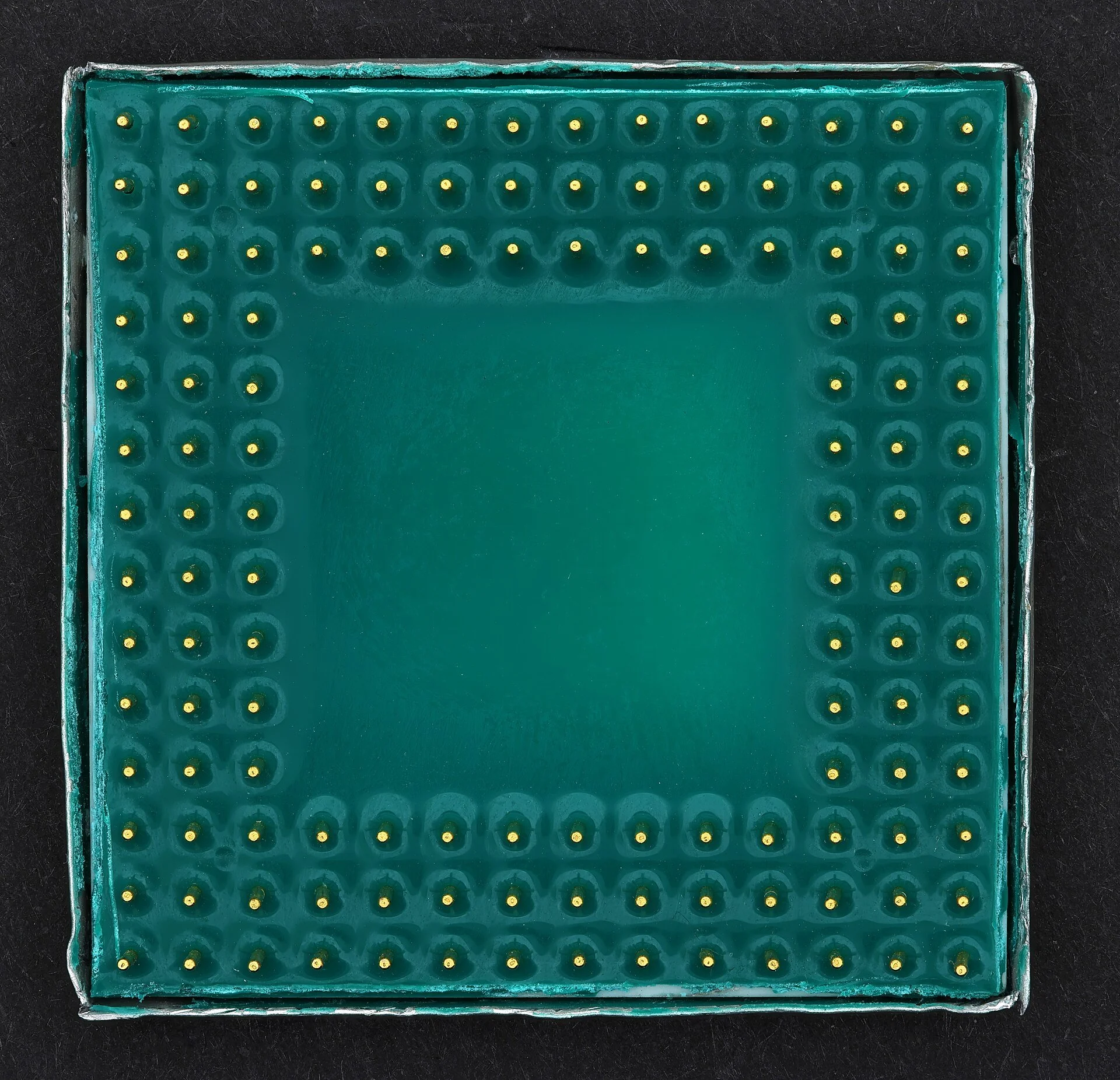
Mister rf, via Wikimedia Commons (CC BY-SA 4.0)
THE EAST FISHKILL CONTRAST
Dutchess County is not a monolith on tech infrastructure. Earlier this year, the Town of East Fishkill moved to freeze new data center development, citing concerns about energy consumption and water use. The decision put a visible wedge between municipal-level caution about the costs of hosting tech buildouts and county-level eagerness to court them with incentives.
That contrast matters here. A quantum facility is not a data center: its power and water footprint are different, and its research orientation gives it a different political profile than a hyperscale warehouse full of servers cooling cryptocurrency transactions or streaming video. But the underlying question is the same one East Fishkill was asking. When a large technology company builds on your land, who bears the infrastructure costs, who captures the upside, and how transparent is the public agency writing the terms?
Dutchess County answered that question on September 29 with a 5-to-1 vote and a package worth, at minimum, $99.4 million in sales tax benefits alone. IBM answered it by not having its recapture-date motion seconded.
WHY IBM IS MOVING NOW
The timing is not accidental. The race to fault-tolerant quantum is intensifying across IBM, Google, Microsoft, and a growing field of startups backed by sovereign wealth funds and defense contractors. Whoever reaches scalable fault tolerance first holds an asymmetric advantage: the ability to break, and to build, the next generation of encryption. Governments know this. The U.S. Department of Defense and the intelligence community have both accelerated quantum-related procurement and investment. A dedicated, purpose-built facility in an existing IBM stronghold, backstopped by public tax incentives, is how you anchor that kind of generational capital program to a specific geography.
IBM's Poughkeepsie campus already manufactures mainframes. The addition of a quantum facility deepens the site's strategic importance to the company and, by extension, to the federal customers who depend on IBM infrastructure. Whether Dutchess County taxpayers share proportionally in that strategic value is a different question, and it is the question the IDA's draft minutes do not answer.
WHAT TO WATCH
The IDA minutes are draft. When the agency meets to approve them, the final terms of the PILOT and the specific recapture provisions will be on the record. Those details matter: the length of the PILOT, the abatement schedule, and whether any clawback provisions apply if IBM reduces headcount or scales back the project are the numbers that determine whether this deal was negotiated or simply accepted.
Follow the final minutes when they are published. Then follow the construction timeline. If the facility opens on schedule in late 2029, the case for the incentive package gets stronger in hindsight. If the capital program quietly contracts after the tax benefits are locked in, Dutchess County will have learned the same lesson that municipalities from upstate New York to rural Georgia have learned about anchoring public money to private tech ambitions: the risk transfers in one direction, and it is not toward the company.
SOURCES
WAMC: IBM to Build Quantum-Computing Facility at Poughkeepsie Campus (September 29, 2026)
Featured image: Jefferson Lab / Aileen Devlin, via Wikimedia Commons (public domain)