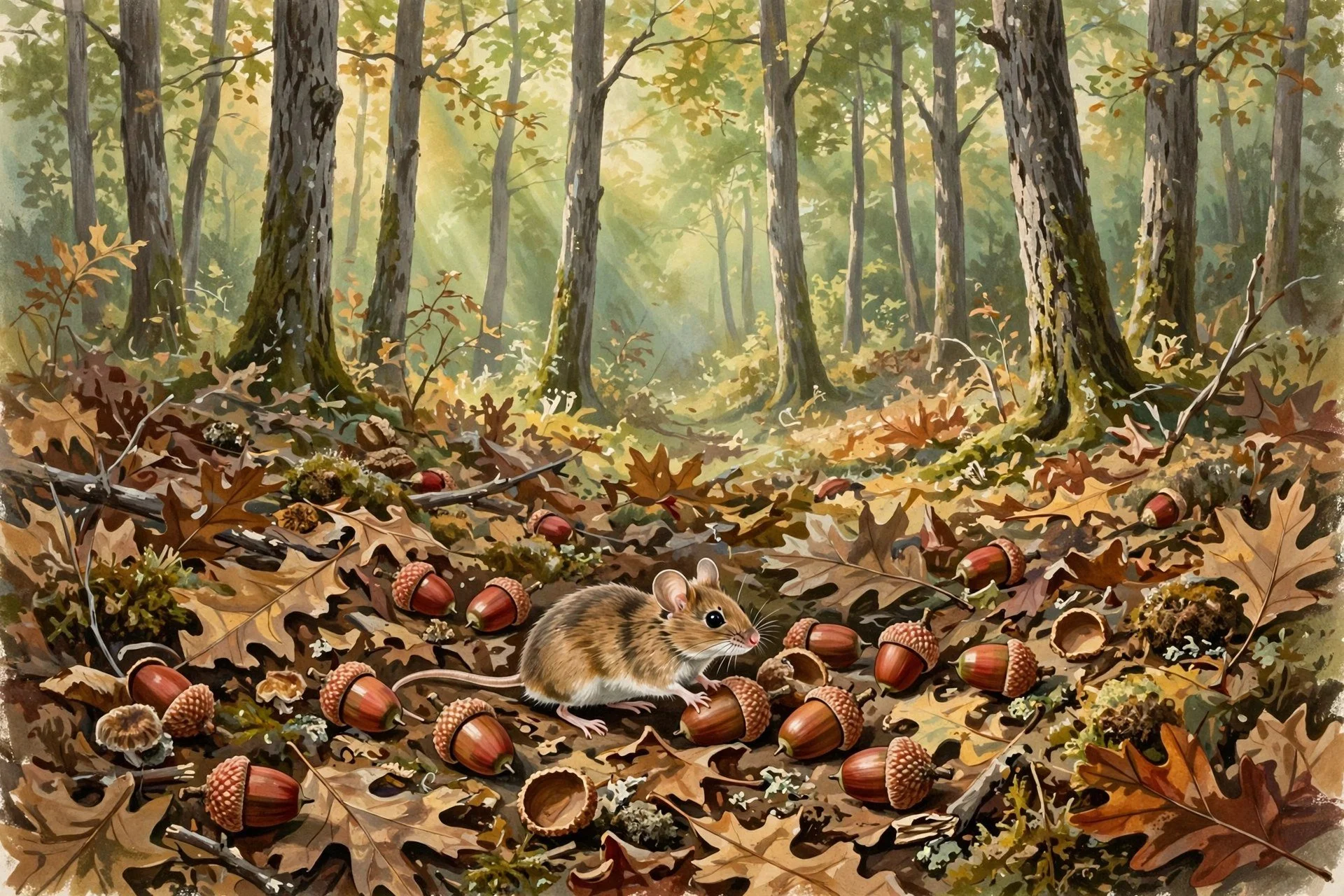
Acorns down, mice follow: the two-year warning.
By Mara Quinn | November 13, 2026
Thirty-five years. Roughly 2,000 acres of Dutchess County forest. Acorn counts, mouse traps, tick drags, deer surveys, weather logs. And at the end of all that, a finding that cuts against one of the oldest assumptions in Lyme disease prevention.
A new study published this summer in the Proceedings of the National Academy of Sciences finds no statistical link between deer abundance and nymphal tick density across the full three-and-a-half-decade dataset. Deer numbers at the study site varied more than sixfold over that period. Tick counts did not follow.
The research comes from the Cary Institute of Ecosystem Studies in Millbrook, New York, where disease ecologist Richard Ostfeld has led long-term ecological monitoring in a Dutchess County forest since 1991. It is one of the longest continuous tick studies in the country. It points health departments toward a different predictor: red oak acorns, two years before the ticks arrive.
The Deer Theory Had a Logical Problem
Lyme disease gained recognition as a distinct illness in the United States in the 1980s. As cases climbed, researchers looked for causes. White-tailed deer were the most visible candidate. They were numerous in the Northeast, their populations had recovered after decades of hunting pressure, and adult ticks fed on them. Deer, the thinking went, were fueling tick populations by providing the reproductive hosts that adult ticks needed.
The logic was not wrong on its face. Deer do support adult ticks. Ticks feed on deer, mate on deer, and drop off to lay their eggs in the leaf litter below. Reduce the deer, the argument followed, and you reduce the reproductive success of the tick.
The logic had a gap. Deer cannot transmit Borrelia burgdorferi, the bacterium that causes Lyme disease, to ticks. A tick that feeds on a deer does not pick up the pathogen. Deer are, in the technical language of disease ecology, incompetent reservoirs for the Lyme bacterium. They carry ticks without passing the infection on.
That distinction matters enormously. Even if deer culling succeeded in reducing total tick numbers, the relationship between deer and Lyme transmission was always more complicated than the narrative suggested. The deer-tick story made intuitive sense for decades. The data, it turns out, did not back it up.
35 Years Rewrites the Short-Term Picture
The Cary Institute's monitoring site sits in the Hudson Valley, in a mixed hardwood forest in Dutchess County, the kind of terrain where Lyme disease is well established. Researchers have worked there every year since 1991. The program tracked not just ticks and deer but the full ecological web: acorn production, white-footed mice, chipmunks, weather patterns, and multiple predator species.
Over short stretches of that record, a pattern appeared that seemed to confirm the deer hypothesis. Ostfeld acknowledged it directly. "We had detected a weak positive relationship between deer and subsequent nymph abundance over short subsets of the data," he said, "but the whole data set in its entirety shows no such thing."
That tension between short-term signals and long-term data is a recurring problem in ecology. A four-year snapshot can produce a convincing correlation that breaks apart when you add another decade of observations. Few ecological datasets run long enough to test whether a pattern holds. The Cary Institute's 35 years gave the researchers enough time to find out.
It did not hold. Deer abundance across the full study period showed no meaningful statistical relationship to nymphal tick density. The deer-tick narrative, as a predictive tool, failed the long-term test.
The Chain That Predicted Ticks
What did work was a different sequence, running through the bottom of the food web rather than the top.
Red oak trees produce large acorn crops in irregular cycles. When a mast year hits, the forest floor fills with acorns. White-footed mice eat acorns heavily. Their populations expand the following season, fed by the surplus.
A year of dense mouse populations sets up the next link. White-footed mice are highly competent reservoirs for B. burgdorferi, meaning they readily transmit the pathogen to feeding ticks. Larvae that feed on infected mice pick up the bacterium. Those larvae molt into nymphs the following year.
The result is a two-year chain. A large acorn crop in autumn predicts a large mouse population the next year. A large mouse population predicts roughly 40 percent more nymphal ticks the year after that. From acorns to nymphs, the lag runs approximately two years.
The sequence does not operate in complete isolation. Weather can push acorn production, mouse survival, and tick activity in the same direction at once. That creates the possibility of confounding: the correlation between mice and ticks could partly reflect a single environmental driver moving all of them together. Ostfeld's team has been careful to note this, and it is one of the reasons the finding calls for verification rather than immediate policy action.
Nymphs Are the Problem
The study focuses specifically on nymphal ticks, and that focus reflects where most Lyme transmission to humans actually happens.
Adult ticks are large enough for most people to find during a tick check after outdoor activity. Nymphs are another matter. They are roughly the size of a poppy seed. They attach in skin folds and go unnoticed for the extended feeding time needed to transmit the pathogen. Most Lyme infections in humans trace back to nymphal bites, most of which happen in late spring and early summer when nymphs are most active.
Federal estimates put annual Lyme disease diagnoses in the United States at roughly 500,000 cases per year. That figure makes it among the most common vector-borne diseases in the country. Understanding what drives nymph abundance is not a peripheral concern.
One finding from the Dutchess County data surprised even the researchers. Mouse numbers did not reliably predict the share of nymphs carrying B. burgdorferi. Infection prevalence at the study sites stayed stable over time: roughly 15 to 30 percent of nymphs carried the Lyme bacterium, while 30 to 50 percent carried at least one tick-borne pathogen.
That stability is important for interpreting the acorn-mouse-tick chain correctly. Acorn counts forecast how many infected ticks will be active in a given year, not by changing the infection rate among individual ticks, but by changing the total number of ticks present. More nymphs at a consistent infection rate means more infected nymphs in the forest.
What This Means for Deer Culls
Ostfeld's conclusion on culling is stated plainly. "Culling deer is unlikely to have any impact on ticks," he said.
That is a significant departure from current practice. Many communities across the Northeast have pursued deer reduction as a Lyme prevention strategy. The efforts are expensive, often controversial, and built on the assumption that the deer-tick link is strong enough to make removal worthwhile.
This study does not prove that deer culls have zero effect under any circumstances. What it shows is that across 35 years of monitoring, with deer numbers varying more than sixfold, those variations did not translate into detectable changes in nymphal tick density. If the relationship were strong enough to be useful for management, it should have appeared in one of the longest continuous tick datasets available.
The study points elsewhere. Acorn production and mouse density are the variables that actually moved with tick numbers at this site. Those are different things to track, but they are trackable.
What One Forest Cannot Prove
The researchers have been consistent about the limits of their data, and those limits are worth stating clearly.
This is a single-site study. The Dutchess County forest is not every forest. The Northeast has white-footed mice, red oaks, and a particular ecological community that shapes how Lyme circulates. The Midwest has different host communities. The Pacific West differs further. The acorn-mouse-tick chain may not operate the same way across every region, and findings from one site should not be extended to places with different ecology without further research.
The study is also observational. It identifies associations among variables measured over time. It does not prove that actively managing oak trees or rodent populations would change human Lyme case rates. The chain from acorn crop to infected nymph to human case involves human behavior, healthcare access, surveillance accuracy, and many other factors that field ecology at one site cannot capture.
Weather compounds the difficulty. A wet spring, a warm autumn, or an unusual winter can affect acorn production, mouse populations, and tick survival all at once. When a single environmental variable moves everything in the same direction, it creates correlations that are hard to separate from the biological relationships the researchers are trying to measure.
A Forecasting Tool Worth Building
The study offers specific and practical information. Acorn surveys already happen in many forested regions, often for wildlife management purposes. The data exists. Ostfeld's team has shown that it carries useful information about tick risk two years out.
A county health department that tracks acorn crop density in autumn could use that data to anticipate nymph abundance the summer after next. A large mast year signals that extra resources should be ready. Public advisories could go out earlier. Clinicians could be briefed before the peak season rather than during it.
That is not a solution to Lyme disease. It is a planning tool. After 35 years of watching one forest in the Hudson Valley, Ostfeld and his colleagues have found a signal that actually predicts what comes next. For public health departments that have long struggled with Lyme forecasting, that is a meaningful change.