Running where nobody put them.
By Ellis Ward | November 17, 2026
The Agents You Forgot You Deployed
Security teams already struggle to inventory their cloud environments. AI agents have made the problem worse. A report from Palo Alto Networks, covered by SiliconANGLE on November 16, found that organizations broadly struggle to track and secure the AI agents running in their cloud infrastructure. The gap between what security teams think they have deployed and what is actually running is not a rounding error; it is the gap.
The number that keeps appearing in this story is 99. According to Techzine Global, 99 percent of organizations report finding AI agents in places where they were not expected. That is not a few surprises at the edge. It means that virtually every organization conducting any kind of audit is finding agents it did not plan for, did not authorize, or simply lost track of somewhere between deployment and production.
That figure deserves a moment. If 99 percent of organizations find unexpected agents, the problem is not poor hygiene at a handful of companies. The problem is structural. AI agents get deployed fast, often by individual teams or developers working independently of central IT. They integrate with services, accumulate permissions, and handle data. Then a team moves on, the original use case shifts, and the agent keeps running. Nobody files a ticket to decommission it.
Already Inside
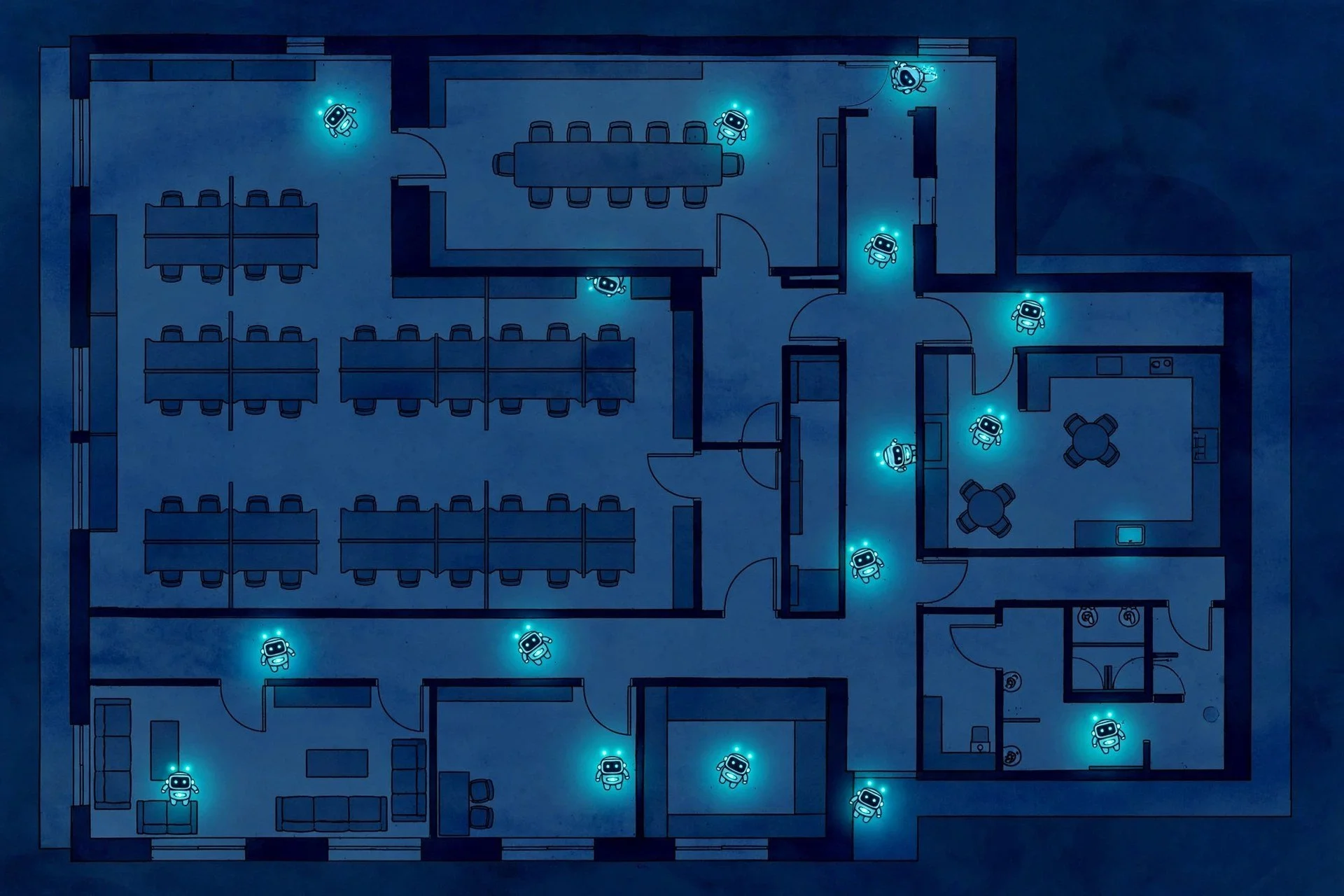
The situation is not hypothetical. According to Security Info Watch, ungoverned AI agents are already inside clients' buildings. That framing matters. It is not a warning about future risk or a theoretical scenario from a research lab. Agents that no one is actively supervising are present right now in production environments across industries.
The word "ungoverned" carries real weight. An ungoverned agent is not necessarily malicious. It may have been built with good intentions, deployed for a legitimate purpose, and simply drifted out of anyone's active oversight. But an agent without governance still makes decisions, still accesses resources, and still acts on behalf of whoever gave it credentials. If those credentials have not been reviewed, rotated, or scoped correctly, the agent operates with more trust than any security team would consciously grant it.
This is the architecture of the problem. Organizations moved fast to deploy AI agents. The tooling and processes for tracking them did not keep pace. Now the inventory is incomplete, the permissions are stale in many cases, and the agents are running anyway.
The Market Reads the Gap
Where there is a visible security gap, vendors move in. The speed of that response is itself a signal about how seriously the market reads the problem.
Pretxt launched on November 17, announcing a runtime oversight layer designed to supervise AI agents in real time. SiliconANGLE reported the launch came with five million dollars in funding. The product focuses specifically on the runtime layer, which is the moment when an agent is actually executing, making decisions, calling APIs, and handling data. That is different from the deployment-time checks that security teams have traditionally applied to software. An agent that passes all pre-deployment review can still behave unexpectedly once it is running and encountering conditions its designers did not fully anticipate.
Runtime supervision addresses that gap directly. If you can observe what an agent is doing as it does it, you have the option to intervene before the consequences compound. That is a different posture than auditing logs after the fact.
Pretxt is one company entering this space, and five million dollars is an early-stage bet. But the timing is deliberate. The Palo Alto Networks report, the Techzine Global statistic, the Security Info Watch observation about ungoverned agents already in the field - all three arrived on November 16. Pretxt launched the next day. Whether that timing was engineered or coincidental, the narrative alignment is clean.
What Organizations Are Actually Facing
The practical problem for a security team right now is not theoretical. It is a question of where to start.
The 99 percent figure suggests that most organizations will find agents they cannot immediately account for if they go looking. Some will be low-risk, abandoned experiments running with minimal permissions. Others will be active agents handling sensitive workflows with credentials that have never been reviewed. The challenge is distinguishing between the two quickly enough to act on the dangerous ones.
Traditional asset inventories were not built for agents. They were built for servers, services, and applications with relatively stable configurations. An AI agent can be spun up by a developer in an afternoon, integrated with a production API, and left running indefinitely. It does not necessarily appear in a configuration database or a cloud asset registry unless someone deliberately registers it. Many do not.
The vendors entering this space are betting that organizations will pay for the ability to see what they cannot currently see. That is a reasonable bet. Visibility is the precondition for every other security control. You cannot govern what you cannot find. And right now, by the numbers, most organizations cannot find all of it.
Sources
- SiliconANGLE — Palo Alto Networks report finds organizations struggle to track and secure AI agents in the cloud, November 16, 2026
- Techzine — 99 percent find AI agents where they aren't expected, November 2026
- Security Info Watch — Ungoverned AI Agents Are Already Inside Your Clients' Buildings, November 16, 2026
- SiliconANGLE — With $5M in funding, Pretxt launches runtime oversight layer to supervise AI agents in real time, November 17, 2026