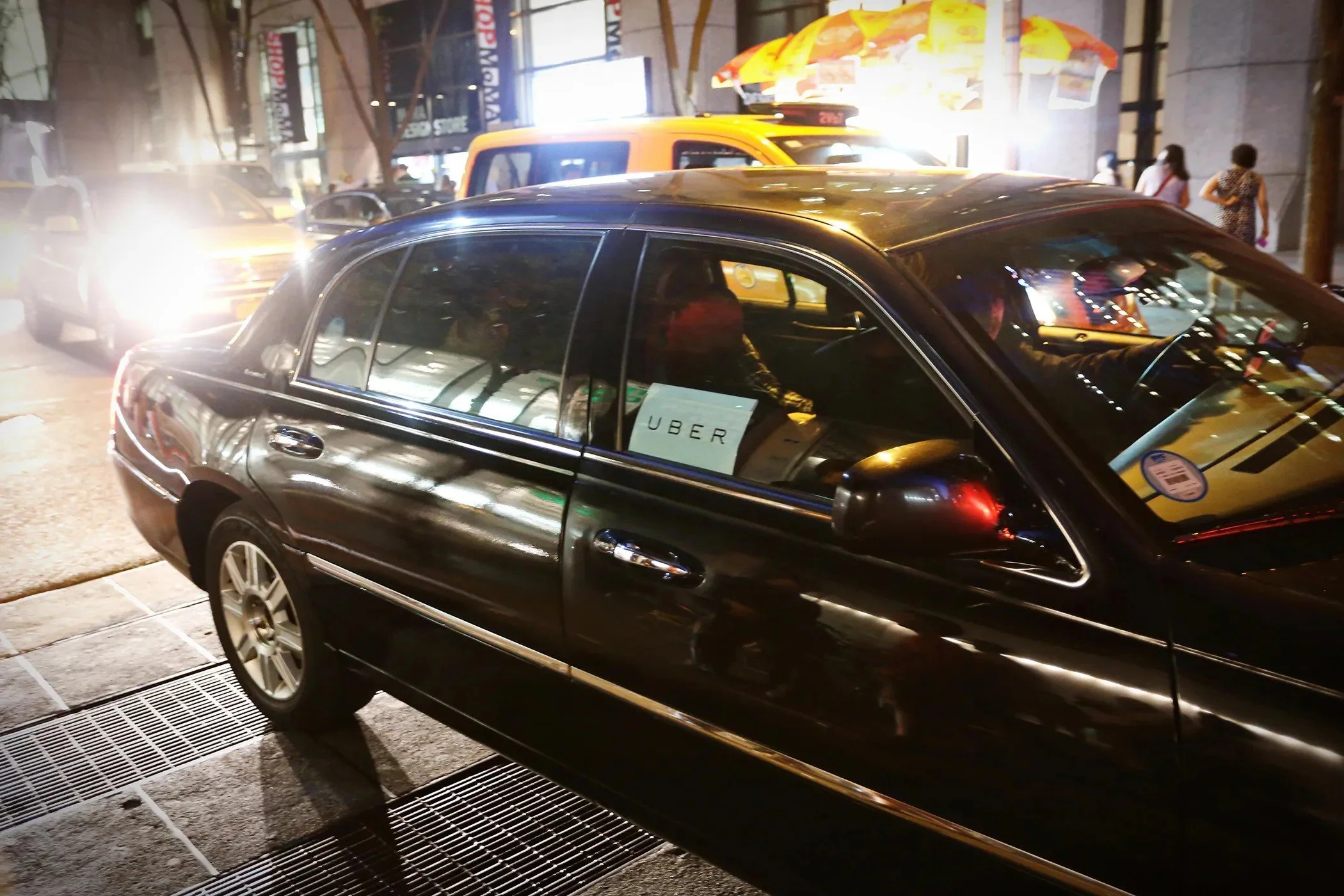
An Uber car at a city curb at night. Stock photo for RFTUV.
By Mara Quinn | November 6, 2026
Four rides. That is what AI agents booked on Uber during Halloween week, its busiest week in October. Not four thousand. Four. Uber's chief financial officer, Balaji Krishnamurthy, gave the breakdown on the company's third-quarter earnings call on November 4. Around 320 million trips and orders moved across Uber and Uber Eats that week. Of those, about 500 came from AI agents on the food delivery side. On the rides side, the total was four trips. TechCrunch reported it. Unite.AI reported it. Uber said it plainly.
The industry had been making a different argument. Shopping agents are the next retail channel. AI is about to reshape consumer commerce. The advertising models that fund Amazon and Walmart are threatened. This week, four platform companies put actual numbers on the record. The numbers and the story do not match.
The Figure and What Surrounds It
Uber is not a small test market. The company recorded 4.1 billion trips in the third quarter, up 16 percent year over year, and 215 million monthly active platform consumers, as Unite.AI reported from Uber's earnings disclosures. Its gross bookings reached $59.8 billion in the quarter, up 20 percent. When a company that size checks for agent-initiated bookings and reports four, the number carries weight.
CEO Dara Khosrowshahi called the agent traffic "very, very early and very limited traction," as TechCrunch quoted him. He added an observation about the existing app: booking a ride takes about 50 seconds on average. Reordering a favorite Eats meal takes about 90 seconds. An agent needs to beat those numbers to offer meaningful improvement. So far, most do not.
Uber is not alone in this accounting. DoorDash CEO Tony Xu, on his company's earnings call the prior week, said DoorDash had received only several hundred orders from third-party AI agents total, not in a week but across the agents' entire operating history, as TechCrunch reported. Customers still order almost everything through the app directly. Xu put it plainly, as Benzinga quoted him: "You never want to fight gravity. But at the same time, you don't want to be delusional."
Two of the largest on-demand consumer platforms in the country reported negligible agent volume in the same two-week period. Both framed it as a channel worth watching but nowhere near material. That is the documented baseline for what the agent economy actually is right now.
The Pitch Running Ahead of the Evidence
Set those numbers against the claims circulating this same week.
Barron's published a piece on November 4 headlined "The Rise of AI Shoppers and the Asterisk Attached." The title contains the analysis. Shopping agents are being promoted as the next retail channel. Barron's attached the asterisk: the evidence for that scale is thin, and much of what the industry calls agent commerce today is still human-directed, with an AI filling a form at the end of a research process.
Reuters reported the same day that AI agents pose a structural threat to the advertising businesses of Amazon and Walmart. The logic is structurally correct. Amazon and Walmart together hold a combined 88 percent share of the estimated $74.4 billion US retail media market, according to projections from data firm Emarketer, as Reuters cited. An AI agent completing a purchase has no reason to notice a sponsored listing. It compares price, availability, and user preferences. It acts. It skips the display entirely.
Morgan Stanley researchers said in July, as Reuters noted, that agents could account for 10 to 20 percent of US e-commerce spending by 2030. That is a claim, attributed to Morgan Stanley, for a date four years out. Amazon CEO Andy Jassy said last week, also via Reuters, that third-party agents have had no meaningful effect on the company's advertising business so far. Amazon's ad revenue grew 11 percent year over year in the third quarter, its slowest growth rate in nearly four years according to LSEG data cited by Reuters, though Jassy has not attributed the slowdown to agent traffic.
Amazon's response to agent access was not to build a frictionless lane. It banned Meta's shopping agent Muse from its website in September, saying Muse had accessed its online store without authorization and captured and stored customer credentials, as Reuters reported. The company told Reuters that third-party agents should operate openly and respect service providers' decisions about whether to participate. That is a platform saying it controls the door.
PYMNTS reported a finding from Expedia that lands in a different register, more candid than threatening. Expedia CEO Ariane Gorin said on the company's third-quarter earnings call that "agentic AI's real strength is in discovery." Travelers use agents to plan. They research destinations, compare hotels, and build itineraries. Then they go to Expedia and book. Gorin told CNBC on November 5 that agents have not changed booking habits. The referrals from agents were too small to show whether they create new demand or simply redirect traffic from other channels, she said, as PYMNTS reported. Expedia's gross bookings grew 11 percent that quarter and revenue grew 12 percent. The growth came from humans booking on the platform.
Why the Gap Is Structural, Not Incidental
The distance between the pitch and four rides is not a timing problem waiting for a software update. It reflects specific mechanics that do not resolve quickly.
The first is credentials and payment authority. For an agent to complete a purchase, the user has to give it access, meaning login credentials or delegated payment authority via a stored card or a connected account. People resist this. The resistance is rational. An agent with payment authority can book the wrong thing, charge at the wrong moment, or book twice. Trust accumulates slowly. Most users have not had long enough with these systems to extend meaningful authority. The business AI consultancy Cognativ, covering the Uber numbers, identified trust in pickup details, payment permissions, and existing habits as the visible frictions keeping users in the app rather than delegating to an agent.
The second barrier is platform architecture. Booking flows are built for human eyes. They include interstitials, confirmation screens, upsells, and ad impressions. Those elements are not incidental. They are revenue. Amazon earns roughly 10 percent of its total net sales from advertising, as Reuters cited from LSEG data. A platform that smooths agent traffic volunteers to cut its own ad and upsell revenue. Uber stated the preference directly: Khosrowshahi said, as BigGo Finance reported from the earnings call, "We think our direct services are going to be the most delightful and easy, but we will work with these third parties." The strategy keeps the app primary. Platforms have structural reasons not to accelerate agent adoption.
The third barrier is error handling and legal accountability. Consumer protection law assumes a human customer. When an agent books a ride to the wrong address, the question of responsibility sits in a gap that most platforms have not resolved. The agent acted on a prompt. The user gave the prompt. The platform executed the booking. Refund flows, support channels, and legal liability all presuppose a human who can verify, dispute, and confirm. That infrastructure does not yet exist for agent-initiated transactions at scale. Expedia's annual filing, as GeekWire reported, explicitly flagged "agentic booking capabilities that may lack strong consent controls" as a potential significant fraud risk. The company built a warning about its own advertised future into a regulatory document.
Together, these barriers mean agent commerce requires not just better AI but restructured trust models, restructured platform incentives, and restructured legal accountability. None of those happen fast.
The Strongest Version of the Other Side
Agent advocates make a coherent counterargument and it deserves a fair presentation.
Early numbers, they say, miss the direction of the curve. Khosrowshahi's posture at Uber reflects the advocate's logic. He said, as TechCrunch reported, that agents represent "another opportunity to reach our platform" and that he expects them to be "a net positive in terms of demand on the ecosystem." He added that every major AI system company is talking to Uber. The channel is not dead. It is early.
Morningstar analyst Brett Husslein described the moment, as Reuters reported, as "an evolution rather than an existential threat" for retail media. That framing cuts both ways. It says the threat is real and coming. It also says it is not arriving on the timeline the most aggressive claims suggest.
The credential and payment authority problem is an engineering problem, not a permanent wall. Open standards for agentic authorization are in development. Expedia CEO Gorin said the company is "experimenting aggressively," as PYMNTS reported, noting that while AI-driven volume remains small today, each integration provides data and learnings about how consumer behaviors are evolving. The infrastructure is being built. Qantas is the first partner using Expedia's new agentic template, combining Expedia's supply and technology with a customizable traveler experience layer.
The advocates are right that four rides does not tell you where the channel is in four years. It tells you where it is today.
What advocates tend to minimize is the platform incentive problem. It is not only an engineering gap. A platform earning meaningful revenue from ad impressions and upsell flows has a financial reason to keep agents in a secondary lane. The competitive pressure to change has not arrived yet. Brands are expected to spend 22.6 percent more on retail media in 2026 than last year's $60.7 billion, according to Emarketer forecasts as cited by Reuters. The platforms are not hurting. The urgency to restructure for agents has not materialized in the revenue lines.
Expedia's Gorin said agent referrals do not appear to cut into the company's direct traffic, as PYMNTS reported. She said the volume is too small to draw conclusions. That is an honest thing for a CEO to say. It is also a description of a research layer, not a transaction layer. The agent finds the trip. The human books it.
What Real Looks Like From Here
A technology can be genuinely coming and still be, today, four rides. These two things are compatible. They have always been compatible. The documented record does not prove agents will fail. It proves agents have not arrived yet in consumer commerce, and the gap between the narrative and the data is wider than the coverage suggests.
The architectural logic for agent commerce is real enough. Agents that hold context, execute multi-step tasks, and act on user preferences will eventually handle certain kinds of purchasing better than a human navigating a cluttered app. That case is coherent. It is a future case. The booking flows today are still built for human eyes. The platforms are still collecting ad revenue. Amazon banned the most prominent third-party shopping agent from its website. The legal accountability frameworks still assume a human customer.
Barron's attached the asterisk. Reuters documented the structural threat that requires agent volume before it can bite. PYMNTS reported that Expedia's travelers plan with agents and then do the actual buying themselves. And Uber's CFO told analysts, in the middle of the company's busiest week of October, that the total number of rides initiated by an AI agent was four.
That number is real. It is attributed. It came from the company's own earnings call. Everything else, right now, is a claim about where this goes next.
Sources
- Unite.AI, Uber Says AI Agents Booked Just Four Rides During Halloween Week, November 4, 2026
- TechCrunch (Sarah Perez), Almost no one uses AI agents to book their Uber, company says, November 4, 2026
- Barron's, The Rise of AI Shoppers and the Asterisk Attached, November 4, 2026
- PYMNTS, Expedia Says Travelers Plan With AI Agents but Book Direct, November 4, 2026
- Benzinga, Uber Reveals AI Agents Barely Make a Dent, November 4, 2026
- BigGo Finance, Uber Says AI Agents Booked Just 4 Rides in Its Busiest Week of October, November 2026
- Cognativ, Uber AI Agents: Four Rides in Its Busiest Week, November 2026
- GeekWire (Taylor Soper), We're experimenting aggressively: How Expedia sees AI reshaping travel and its own business, February 16, 2026