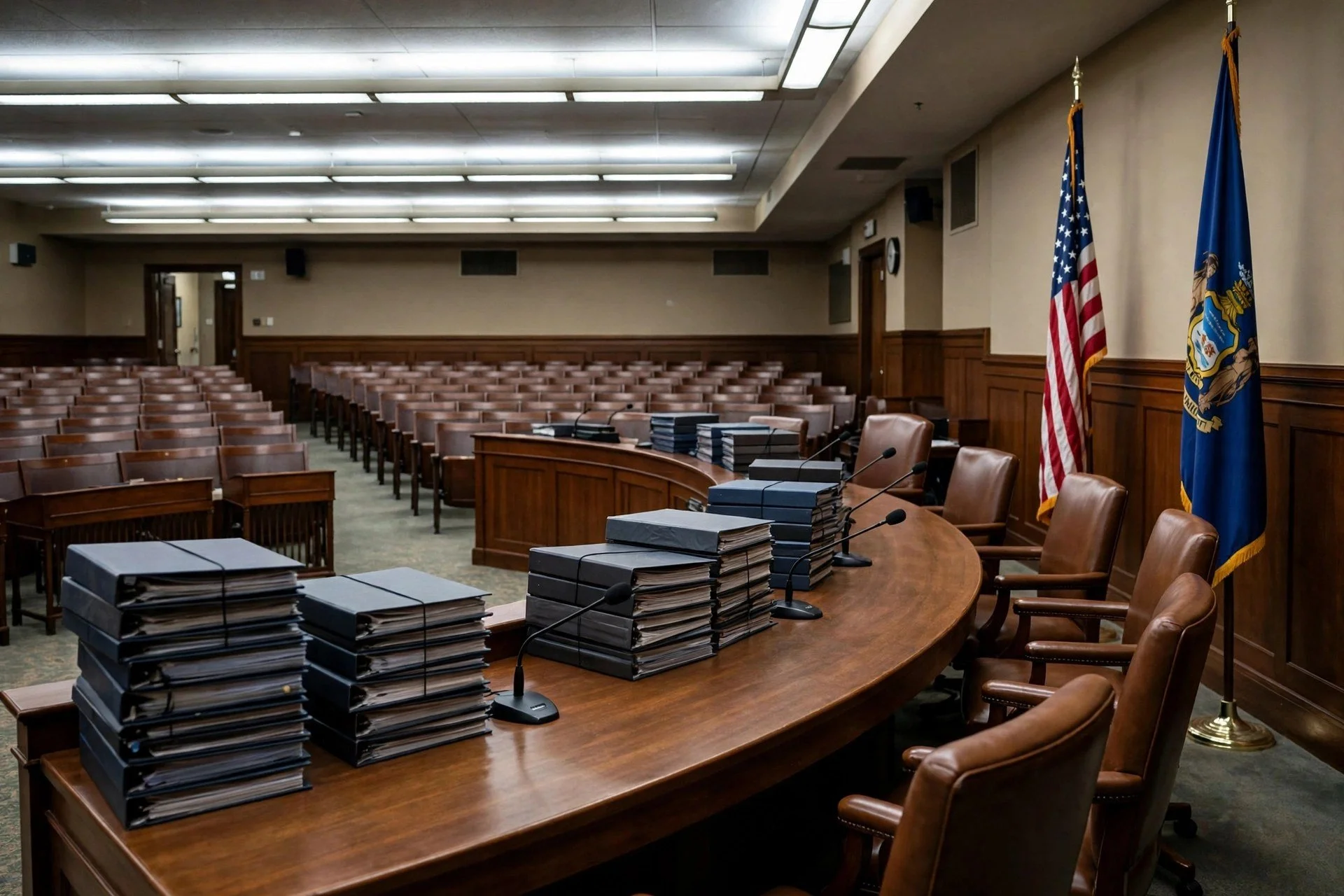
A county legislature chamber.
By June Mercer | November 10, 2026
Dutchess County Executive Sue Serino stood before the Legislature Chambers in Poughkeepsie on October 30 and presented a $722 million budget she described as no-frills. The label invites scrutiny. The budget closes a starting gap of nearly $90 million. It draws tens of millions from reserves, proposes raising the county sales tax rate, and still cuts the property tax rate per dollar of assessed value. Those facts pull in different directions. Understanding how they coexist requires looking at each piece separately.
A $90 Million Gap and How It Closes
The gap did not appear quietly. Serino warned of it herself in March 2026 during her State of the County address. She told residents then that a large structural imbalance was building for 2027, described an unassigned fund balance of roughly $90 million, and raised concern about the county's ability to absorb continued cost growth without structural changes.
Eight months later, the proposed budget assembles a response from several sources. State aid totals $156 million, federal funds add $48 million, and hotel tax revenue contributes $6.4 million, according to the Highlands Current. Even with those flows, the administration needed additional revenue.
The proposed sales tax increase provides one piece of that answer. If the state Legislature and the county Legislature both approve the change, the county rate would rise from 3.75 percent to 4 percent starting in June 2027. That quarter-point increase is projected to generate roughly $9.3 million annually.
Reserves cover a substantial portion of the remaining shortfall. The budget draws $28.5 million from the county's general fund, slightly less than the $28.6 million drawn for 2026. The Community Benefit Fund contributes another $3.7 million, down from $5.3 million last year. The two reserve draws together total $32.2 million, a large reliance on accumulated balances even if the individual figures track close to last year's draws.
The Tax Math: Rates Fall, Levy Rises
The property tax picture splits into two figures that point in opposite directions, and the difference matters for how residents read their bills.
The tax rate falls 4.5 percent, from $2.11 to $2.02 per $1,000 of assessed value. A homeowner whose assessed value has held steady will see a modestly lower county tax bill.
The levy, however, climbs 3.5 percent to approximately $109 million. Rising property assessments across the county allow the rate to drop while the total amount collected grows. County government captures more overall revenue from property while each unit of assessed value costs slightly less to tax. That distinction often gets lost in coverage of local budgets, but it determines what a specific household actually pays.
The proposed sales tax change adds a separate layer. For a $100 purchase, the increase from 3.75 percent to 4 percent amounts to 25 cents. For a household spending $30,000 annually on taxable goods, the additional cost approaches $75 per year. At scale across the county economy, the administration projects $9.3 million in new revenue.
The sales tax proposal carries a condition. It needs approval from both the state and county legislatures before it takes effect. Neither vote is guaranteed, and that uncertainty distinguishes this revenue projection from figures based on existing sources.
What State and Federal Law Already Decides
More than 70 percent of the county budget covers costs that Dutchess County does not control. State and federal mandates, primarily Medicaid and other human services programs, determine what the county must spend. Local officials have almost no discretion over those lines.
This constraint shapes the entire budget conversation. When state Medicaid formulas change, Dutchess County absorbs the difference. When federal program requirements expand, the county adjusts its spending accordingly. The share of the budget where local policy choices actually operate sits below 30 percent of the total.
That context matters for interpreting any year-over-year growth percentage. Much of the increase in total spending from one year to the next reflects mandated cost growth, not new county programs or expanded services. When state or federal costs rise, Dutchess County has little choice but to follow.
No Cuts, No Layoffs, Four Added Positions
The budget adds four positions the administration deemed essential. Other positions are eliminated through attrition or direct removal. The net result across county government is a reduction of four positions. No services are cut. No employees are laid off.
The staffing approach reflects the administration's stated goal of maintaining service levels while holding down headcount modestly over time. The four new positions address specific areas where current staffing fell short of what the county determined was needed to deliver required services. The document does not specify which departments receive the additions, but the county's framing places them within its core service priorities.
Protected Services: Safety, Youth, Health, Housing
The budget holds funding steady for a broad set of programs the county identifies as priorities. Public safety services, including emergency medical services, receive continued support. Youth programs keep their funding intact. Services for veterans and older adults maintain their current levels.
Health services and mental health programs are protected from cuts. Housing assistance continues. Community programs that received funding in prior years carry forward under this proposal.
For residents who rely on these services, the practical message is stability. No program in these categories faces elimination or significant reduction under the executive's proposal. The Legislature can still alter those choices during its review and hearings, but the starting document protects them entirely. Emergency medical services, in particular, have drawn attention in recent years as rural and suburban counties across the state have struggled with EMS capacity. Dutchess County's budget keeps that line funded without reduction.
A $20 Million State Investment in Early Childhood
One new initiative stands apart for its scale. The state awarded Dutchess County a $20 million grant through the First 3 program, a pilot focused on childcare for children in the first three years of life. The county must provide a $2 million match to draw the full state award.
The First 3 program targets a gap that county and regional leaders have cited repeatedly. Childcare availability and cost have constrained workforce participation across the Hudson Valley for years. A $20 million pilot cannot resolve those structural forces on its own, but it represents a substantial state commitment to test new approaches specifically in Dutchess County.
The grant and the required county match appear in the 2027 budget. If the Legislature adopts the budget as proposed, Dutchess County will operate one of the state's early childcare pilots beginning next year. That positions the county for potential follow-on state investment depending on how the pilot performs.
The Fund Balance Dispute
The fund balance question runs through Serino's March warning and shapes the reserve draws in this budget. In her State of the County address, Serino criticized the Legislature's decision to use fund balance to cover 2026 operating expenses rather than allowing a sales tax exemption to lapse.
The exemption covers clothing and shoe purchases below $110. Allowing it to expire would have generated roughly $5.4 million in annual recurring revenue. The Legislature preserved the exemption and drew equivalent funds from reserves instead. Serino argued that choice avoided a modest consumer cost by consuming a reserve that now has less room to absorb future shocks.
A new labor contract compounded the pressure. The county reached an agreement with the Civil Service Employees Association that drew $12 million from the fund balance. Serino noted the CSEA contract delivered the largest percentage raises for the county's lowest-paid workers. That was a stated priority, it reflects a genuine commitment to employees at the bottom of the county pay scale, and it consumed a portion of the buffer the administration now must manage carefully through 2027 and beyond.
Together, those two decisions help explain why the 2027 budget still relies on $32.2 million in combined reserve draws despite the administration's preference for reducing that dependence.
Growth by the Numbers: Different Baselines, Different Percentages
Readers comparing coverage of this budget will encounter different year-over-year growth figures depending on the source. The Poughkeepsie Journal reported growth of approximately 10.7 percent. The Highlands Current reported either 10.4 percent or 5.6 percent depending on the comparison baseline chosen.
These figures do not contradict each other. They reflect different methodological choices about which prior-year figure to use as the starting point. Whether the comparison runs from the adopted 2026 budget, a modified figure, or another baseline produces different percentages from the same $722 million total. Neither outlet reported an incorrect number. Readers who want the precise year-over-year comparison should consult the county's own tables at dutchessny.gov.
The Legislative Calendar Ahead
The 2027 Executive Budget now moves to the county Legislature for review and modification. Committee hearings run November 9 through 12. The public hearing takes place December 3. The Legislature must adopt a final budget by December 10. Veto overrides, which require a two-thirds vote, must be completed by December 20.
Roughly five weeks separate today from the adoption deadline. That compressed timeline covers a $722 million plan that includes a contested sales tax proposal, significant reserve draws, and a new state childcare pilot requiring a county match. Each of those elements may draw scrutiny in committee.
The sales tax increase carries the most political weight. It requires a separate approval process beyond the standard budget vote, which means its fate may be decided on a different schedule from the rest of the document. Legislators who oppose the increase could reject that piece without blocking the broader budget from adoption.
Residents who want to shape the outcome before December can appear at the public hearing on December 3 or contact county legislators directly during the November committee sessions. The hearings represent the primary window for public input before the Legislature commits to a final number.