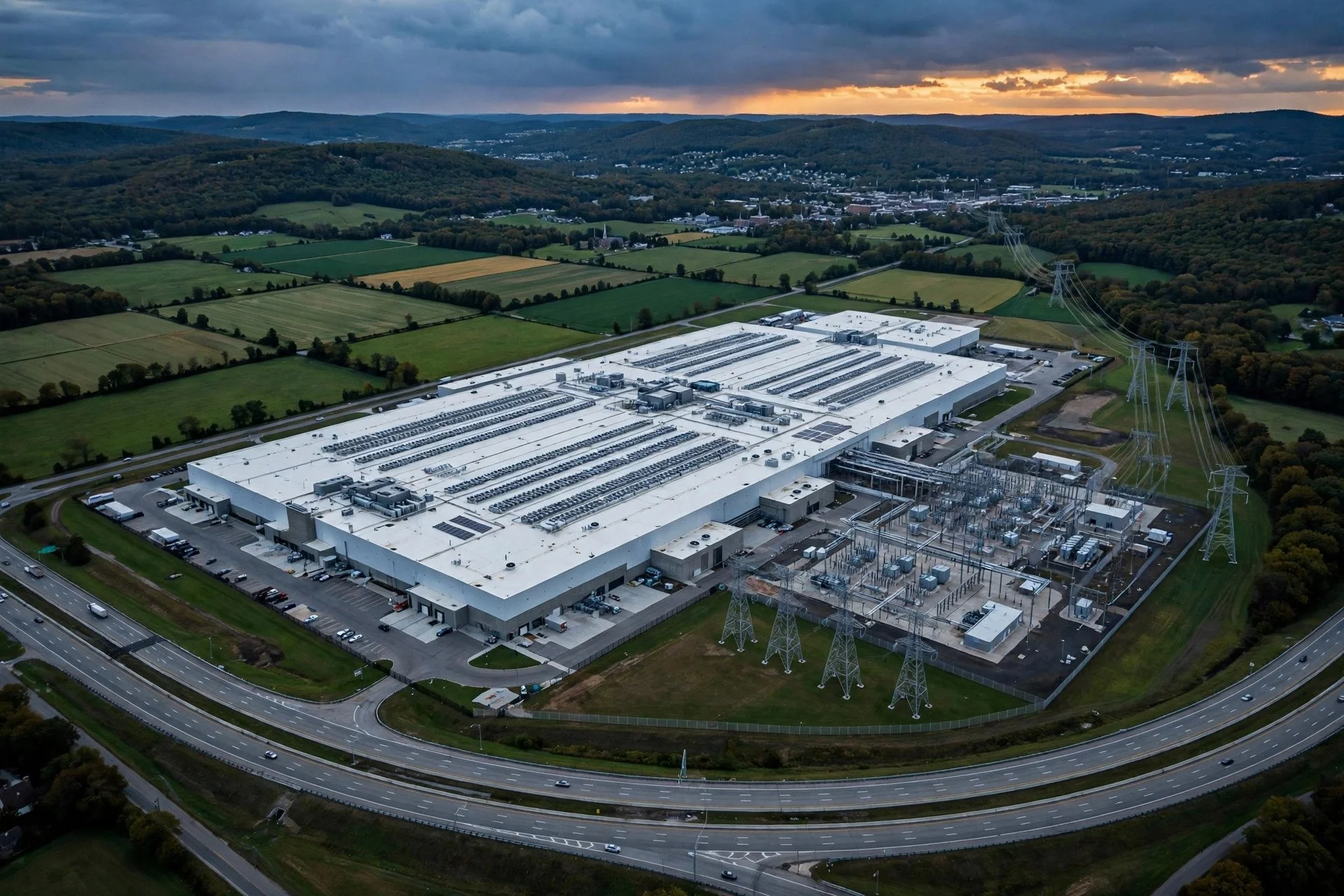
A data center complex at dusk, seen from above.
By Callahan Blackwood
Discovery: What the Grid Queue Said
The number appeared in a state grid queue, not in any planning board agenda. Roughly 1,000 megawatts, requested by an entity called Donovan Drive Holdings for a parcel near Interstate 84 and Lime Kiln Road in East Fishkill, New York. Someone checked the New York Independent System Operator's public interconnection queue and found it there.
That is how a town of about 30,000 people in Dutchess County, roughly 70 miles north of Manhattan, first learned that someone wanted to place one of the largest data center complexes ever proposed in New York State at the edge of their community. The information came from a database, not from the developer or the town.
No data center application had arrived at town hall. No permit had been filed. No public hearing had been scheduled. Town Supervisor D'Alessandro said as much directly in June 2026: "There is no application before the Town. There has never been an application for a datacenter."
He was correct. The opposition that followed was organized against something that, by the town's own reckoning, had never formally been proposed to anyone with authority to approve or deny it.
Donovan Drive Holdings is connected to Treetop Companies, a real estate developer whose portfolio spans industrial, residential, leisure, affordable housing, and office properties. Treetop is not a data center operator.
Two Accounts of the Same Property
Treetop had purchased land in East Fishkill and pursued approvals for a warehouse. The building it described in public filings totaled 1,161,515 square feet, as reported by A Little Beacon Blog. That is a large industrial structure. For a region where warehouse development has tracked the I-84 corridor for years, it is not an extraordinary one.
The story on Treetop's own website was different. A drawing there showed a data center at the same footprint: 1.16 million square feet spread across roughly 143 acres, according to reporting by Data Center Dynamics and The Guardian. The two accounts described the same land. They described different buildings.
Standalone data centers were not permissible under East Fishkill's existing zoning. That may explain why no data center application arrived at town hall. It does not explain the gap between the public-facing warehouse narrative and the gigawatt request in the grid queue. A warehouse does not need 1,000 megawatts.
The Arithmetic of a Gigawatt
The scale requires comparison to register.
According to figures cited by the Times Union and reported by A Little Beacon Blog, 1,000 megawatts represents roughly the electricity 800,000 homes use. That is more than six times the electricity used by all the homes in Dutchess County combined. For East Fishkill itself, the proposed facility would have drawn on the order of 80 times what the town's homes use.
The Poughkeepsie Journal put it in power plant terms: the draw would nearly equal the output of the Cricket Valley Energy Center in nearby Dover, a 1,100-megawatt facility. The Guardian placed it in population terms: more electricity than the entire city of Buffalo, which has a population of roughly 275,000.
The comparison to existing data centers is starker still. The largest operating data center in New York State, Lake Mariner CB-3, runs 53 megawatts, according to the Poughkeepsie Journal, citing Cleanview. Dutchess County's existing colocation facility, CyrusOne NYM7 in Wappingers Falls, is rated at 10 megawatts of total power capacity. The proposal was more than ten times the scale of the largest data center operating in the state, according to WAMC Northeast Public Radio.
The grid connection would run through Con Edison's network. NYISO's interconnection study examined effects on both Central Hudson and NYSEG systems, according to the Highlands Current. Neither serves only East Fishkill. The load would have reached well beyond the town line.
The Hearing and the Vote
Residents did not wait for an application before organizing. By June 25, 2026, petitions had circulated, letters had been submitted, and town meetings had filled with people, as Food & Water Watch documented. The public hearing that evening ran roughly two hours.
The concerns on record covered a lot of ground: electricity rates, groundwater and water consumption, noise from mechanical cooling systems, diesel backup generators, property values, wetlands, and what residents described as the rural character of the community. These were not abstract objections. The town already lived with a compromised aquifer. Adding heavy industrial electrical load to a grid that serves households, farms, and small businesses would not be a neutral event for anyone paying a Central Hudson bill.
The town board voted unanimously for a three-year moratorium: no data center exceeding 20 megawatts may receive a permit or any consideration until July 1, 2029. Narrow exceptions apply for facilities ancillary to existing or permitted uses below 20 megawatts, and for projects eligible for an Economic Development Special Permit.
Supervisor D'Alessandro framed the pause plainly: "to give our community certainty and allow time for further study and discussion." The town formed a task force to examine power consumption, water use, noise, and heat output. The moratorium creates a window for that work. Councilmember Marianne Flores described it as temporary, not final.
By the time the board voted, the NYISO interconnection request had already been withdrawn. It no longer appeared in the queue as of June 26, 2026, according to WAMC. The vote came anyway. A proposal with no formal application and no active grid request still prompted a unanimous board to freeze an entire category of development for three years. That is a measure of what the number in the queue meant to people who knew the land.
Melissa Hoffmann, an East Fishkill resident and Food & Water Watch organizer, credited months of sustained community pressure for extending a proposed seven-month pause into a three-year moratorium. Her summary was brief: "People are winning. Communities that fight these datacenters are winning."
What IBM Left Behind
East Fishkill has absorbed large-scale tech before. IBM ran a 460-acre campus in town for about 50 years, with semiconductor research, development, and manufacturing that employed thousands of workers. That scale of employment shaped the local economy for a generation. It drew families, supported services, and gave the town a reason to describe itself as a place with an industrial future.
The campus is now iPark 84, a mixed-use redevelopment that still houses tech companies. What IBM also left behind were contaminated groundwater plumes and several Superfund sites. The town's moratorium resolution notes that groundwater has been affected by three separate Superfund sites, according to The Guardian and WAMC. That legacy is still being managed.
Resident Fran Caracappa, a county legislature candidate, asked the question the IBM comparison raises directly: data centers "won't provide work to keep people here like previous tech businesses. So what's the benefit to the town?" Hoffmann put the same point from an organizing perspective, saying the facility would provide "very few jobs." Data centers at hyperscale are built to minimize human staffing. The machinery runs the building. A small crew monitors the machinery. Where IBM once required thousands of people to do semiconductor work, a gigawatt data center requires a skeleton staff to watch servers.
Resident Tanya Radford, a professor, pushed back on the framing of opposition as technophobia. "This is not an anti-tech town. I'm an educator. I use technology." What she asked for was time to examine impacts on "long-term community cohesiveness, environmental quality, and character."
The scale question stands apart from the jobs question. One tenant at iPark 84 was seeking roughly 150 megawatts of data center expansion at the former IBM site, and that proposal drew no comparable organized opposition, as The Guardian reported. The fight was not about data centers as a category. It was about 1,000 megawatts in a town of 30,000, proposed by a developer that had not built data centers before, on land where the previous large-scale industrial occupant left three Superfund sites as a parting condition.
The Maximization Problem
The efficiency argument will be made, so it deserves a direct answer.
As computing hardware grows more efficient, data centers consume less energy per unit of work. This is true. The inference typically drawn from it is that the grid burden will ease as the technology matures. That inference fails at the scale of a permitted gigawatt, and the NYISO queue figures suggest why.
A facility permitted to draw 1,000 megawatts draws 1,000 megawatts. Around the clock. Every efficiency gain inside the fence is an opportunity to run more machines within the same permitted envelope. This is not pessimism. It is the basic economics of capital-intensive infrastructure: unutilized capacity costs money, so operators fill it. Efficiency is spent on density. It is not returned to the grid.
Governor Hochul's executive order, signed July 14, 2026, cited roughly 12 gigawatts of data center load requests in the NYISO queue, with more than 8 gigawatts entering in 2025 alone. That figure describes the same logic applied across dozens of sites statewide: secure as much permitted capacity as the grid will allow, then fill it with the most machines that fit.
The hardware design problem runs alongside the capacity problem. A facility sized and built for today's air-cooled computing density faces a structural mismatch with the liquid-cooled hardware that efficiency trends increasingly require. Buildings engineered around brute-force air cooling cannot cheaply convert to precision liquid-cooling infrastructure. A town that permits a 1,000-megawatt air-cooled shell does not inherit a facility that gracefully modernizes with the industry. It inherits a building sized for one moment in computing history, carrying a gigawatt grid reservation tied to its address, long after the hardware it was designed for has been superseded.
Albany's Partial Answer
East Fishkill moved in June. Albany moved in stages, and not as far.
The state legislature passed the Responsible Data Center Development Act on June 4, 2026, sponsored by State Senator Kristen Gonzalez. The bill would impose a one-year moratorium on permits for data centers exceeding 20 megawatts, alongside efficiency standards, host community public benefit requirements, project labor agreements, and mandatory public hearings. Both chambers passed it. As of early November 2026, the governor had not signed it. New York City Mayor Zohran Mamdani called on the governor to sign in October 2026.
The governor acted by executive order. EO No. 62, signed July 14, 2026, pauses discretionary state environmental permits for hyperscale data centers of 50 megawatts or more while the Department of Public Service prepares a generic environmental impact statement. The order does not apply to local permits. Towns acting on their own, as East Fishkill did, receive no cover from it.
On October 6, 2026, Hochul toured Fishkill Farms in Hopewell Junction, within East Fishkill, alongside U.S. Representatives Alexandria Ocasio-Cortez and Pat Ryan. The visit included a roundtable on hyperscale data center impacts with local farmers, advocates, and businesses. Supervisor D'Alessandro later said he would have welcomed the chance to share the town's perspective, but had been advised not to comment because of a notice of claim the town had received from Treetop.
East Fishkill is not alone in reaching for local controls. Oneonta enacted a moratorium. Allegany and Dryden adopted permanent bans, according to The Cooldown and WAMC. The pattern suggests something beyond scattered local resistance. It points to a gap between how state land-use and energy planning accounts for hyperscale development and what towns actually face when a developer shows up with a gigawatt request and no application.
Where the Clock Stands
The moratorium runs to July 1, 2029. The town is now studying what zoning should look like for a building class it had not previously imagined inside its borders. That study may produce rules that allow data centers at a scale the community can absorb, or conditions most developers cannot meet, or something in between. The process is now legitimate in a way it was not during the warehouse-and-queue period. The town is making rules rather than reacting to a number someone found in a database.
Treetop responded with a 17-page objection letter to the town board, reviewed by The Guardian. The letter argues the moratorium unlawfully targets the company's property, amounts to a de facto permanent prohibition rather than a legitimate temporary planning measure, and disregards years of investment in environmental reviews, wetlands investigations, traffic studies, and utility coordination. A notice of claim has been filed. That dispute is part of the public record now.
The original NYISO request is gone. No application was ever submitted. What remains is a town of about 30,000 people, with three active Superfund sites inherited from the last major tech employer to leave, and a three-year moratorium on the next one. The fight that produced it began when someone checked a list. The number was 1,000 megawatts. For a town of 30,000 people, that is not an incremental question. It is a structural one. East Fishkill decided to treat it that way.