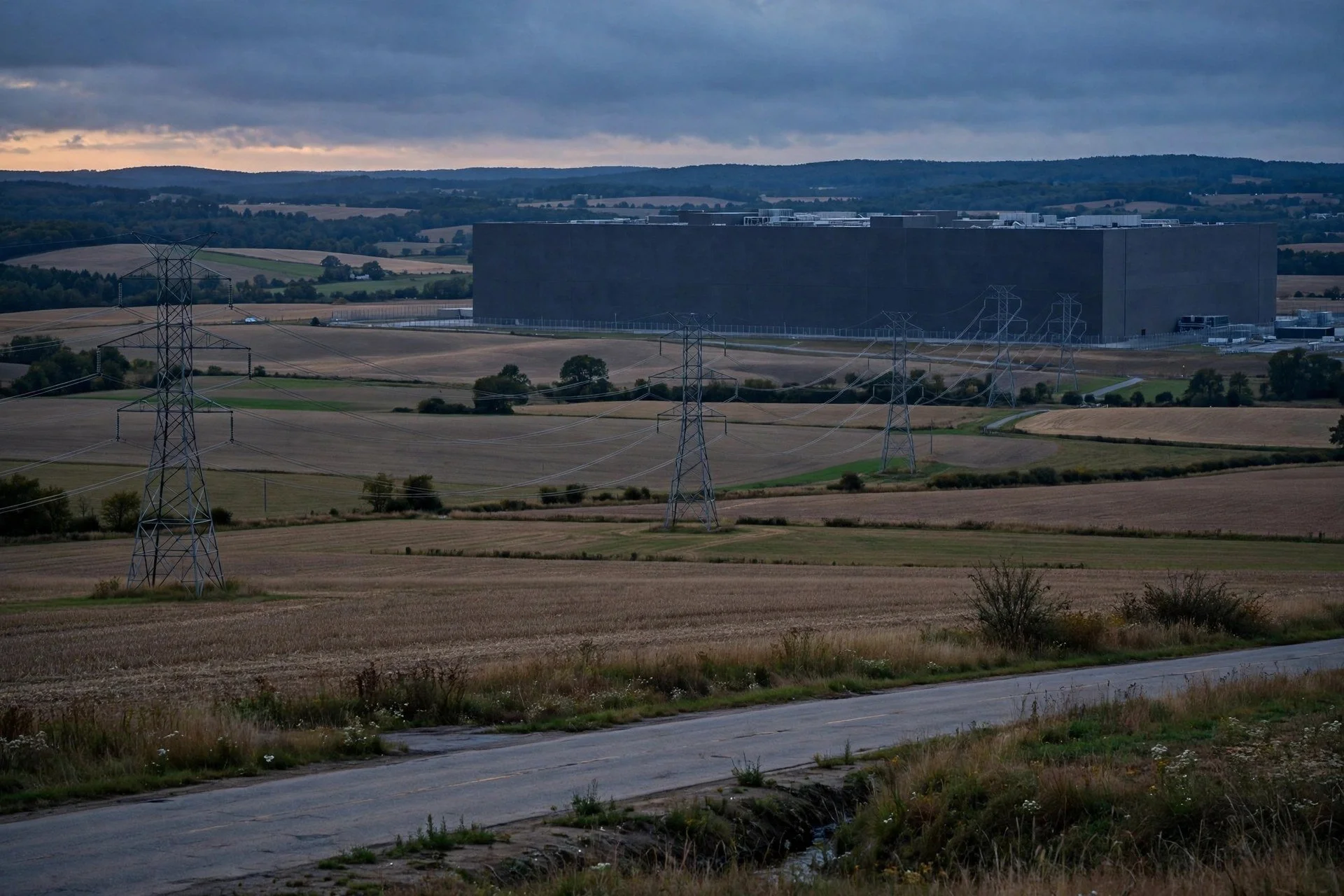
The gigawatt, still in the queue.
By Callahan Blackwood | November 15, 2026
East Fishkill voted five to zero. The board passed a law. Data centers above 20 megawatts cannot receive approval in the town until July 1, 2029. The Treetop Companies' roughly one-gigawatt campus concept is blocked from local approval, and the town has stated that no formal data-center application was ever filed.
That should settle it.
It does not.
As of November 14, 2026, the New York grid operator's interconnection queue still carries an active entry for a one-gigawatt data center in East Fishkill. Watt Street, a firm that tracks New York energy and policy filings, lists the entry as "1 Gig Data Center East Fishkill, NY," at 1.0 gigawatt, status active, in the NYISO queue.
The moratorium is law. The queue entry is real. Both can be true at once, because they belong to separate regulatory systems that do not synchronize. The town controls permits. The grid operator controls queue entries. A town vote does not reach into a grid database and remove a name.
Residents who read the moratorium as a closed chapter are looking at a live gigawatt entry in a tracker that affects how New York's grid is planned and allocated. Nobody has explained this discrepancy publicly. This article explains it.
The Law East Fishkill Passed
The Town of East Fishkill's board voted five to zero on June 25, 2026, to adopt Local Law No. 3 of 2026. The law took effect November 3, 2026. According to the Calyx register of the law and reporting by Data Center Dynamics, board members Marinaro and Arco are listed in connection with the measure.
The law bars data centers exceeding 20 megawatts from receiving approval in the town. It runs through July 1, 2029. The exceptions are narrow: a facility ancillary to an existing use, a project eligible for an Economic Development Special Permit, or a facility drawing under 20 megawatts. Any proposed data center that clears none of those bars cannot receive a permit under current law.
A separate provision, Section 2(a) of Local Law No. 3, places a moratorium on applications for data centers on undeveloped industrial land. That provision expires December 31, 2026. The more sweeping restriction on 20-megawatt-plus data centers runs three years longer, through mid-2029.
The layered structure matters. The Section 2(a) freeze on undeveloped industrial land applications lapses at the end of this year. The broader moratorium does not. Residents and developers should not read the December 31 date as the end of restrictions.
Data Center Dynamics covered the moratorium's passage in direct connection with Treetop's proposed campus. The town's official position, cited in that reporting and confirmed in related documentation, is plain: no formal data-center application was ever filed.
The Treetop Concept and Its Local Status
The Treetop Companies had developed a concept, not a formal application. As reported, the plan called for roughly 1.16 million square feet of data center space with an estimated capacity near one gigawatt. The concept was large enough to represent, by itself, nearly the entire large-load interconnection queue for Dutchess County.
It never entered the town's formal permitting process. The town received no application. Local Law No. 3 was nonetheless crafted to address exactly this scale of project. Under the law as written, a facility of Treetop's reported scope cannot receive local approval before July 1, 2029.
That is the picture at the local level. No application, no permit, no path forward through town channels for the foreseeable future.
The grid picture is a different matter.
What a Grid Queue Entry Actually Is
The New York Independent System Operator manages the state's bulk electricity transmission grid. When a company intends to connect a large new electricity load to that grid, it submits a large-load interconnection request. NYISO uses that filing to study whether the grid can handle the new demand, what infrastructure upgrades might be needed, and who pays for them.
A queue entry is a request for a study.
It is not a building permit. It is not site plan approval. It is not a zoning clearance. It is not a construction authorization. A project does not break ground because it holds a queue position. A developer does not gain any right to operate a facility in a town by filing with NYISO. The queue and local land use operate in separate lanes, governed by separate bodies, subject to separate rules.
NYISO does not require that an applicant demonstrate local approval before accepting a large-load interconnection request. Towns do not receive notice when a company files with NYISO. The two systems were not designed to coordinate, and they do not.
A queue position does have real value. It secures a place in line for a grid study. That study determines the cost and feasibility of connecting to the transmission network. Developers sometimes hold queue positions for years while local or regulatory conditions shift. Positions can be transferred. They are not automatically voided when a local ordinance changes.
Watt Street's Load Ledger, which tracks large-load interconnection requests across New York, listed 76 such requests statewide as of November 14, 2026. In Dutchess County, seven large-load requests total roughly 1.1 gigawatts. The East Fishkill entry at one gigawatt accounts for nearly all of that county total. The entry is categorized as use type DAT, the designation for data center loads.
The Discrepancy: One Status in June, Another in November
The public record gets confusing here.
Earlier reporting in June 2026 indicated that the Treetop-linked interconnection request had exited the NYISO queue. A withdrawal from the queue would mean the filing was terminated, the position surrendered. Projects do withdraw. Market conditions change. Sites fall through. Companies restructure their plans.
But the Watt Street tracker pulled on November 14, 2026 does not reflect a withdrawal. The entry appears, labeled and carrying an active status.
There are possible explanations. The entry may never have actually been withdrawn, and the June reporting may have reflected a misread of queue status data. The project may have been reinstated under a new filing after an earlier withdrawal. The tracker may have a data gap between those two points in time.
This report does not assert that Treetop filed a new application after June. The documented facts do not support that conclusion. The facts support a simpler conclusion: a one-gigawatt East Fishkill data center entry appears in a publicly accessible tracker with an active status, and no one has offered a plain accounting of how that entry relates to the project that Local Law No. 3 was written to block.
That explanation is owed to residents who read the board vote as a final answer. They are entitled to know that the grid database did not get the same memo.
A Town Vote Does Not Touch the Grid Queue
This distinction requires direct statement because it runs against intuition.
When East Fishkill's board voted five to zero and adopted Local Law No. 3, that vote carried the full force of local law. It governs what the town can permit. It governs what applications the town will entertain. It tells any would-be applicant that a data center above 20 megawatts will not receive local approval until July 2029.
The vote did not alter NYISO's queue. The board has no mechanism to do so. NYISO is a state-level independent system operator. Its queue is managed under federal and state tariff rules. Towns do not submit queue withdrawal notices on behalf of private applicants.
A developer holding an active queue entry in East Fishkill cannot build a data center there under current law. The moratorium prevents that path. But holding the queue position costs the developer something, and that position may have value if conditions change. The moratorium runs through July 1, 2029. The entry in the queue may outlast the moratorium, depending on how both are managed between now and then.
The practical implication: a banned project can hold a grid queue position. Those are not contradictory facts. They are parallel facts that exist in different regulatory columns.
State and Federal Signals
East Fishkill did not move in isolation.
On July 10, 2026, New York State passed a one-year statewide moratorium on data centers exceeding 20 megawatts. That measure was pending the governor's signature as of mid-July 2026. This report presents that status as confirmed at the time; whether the governor subsequently signed the bill is not confirmed in the materials available for this article.
On October 13, 2026, the Dutchess County Legislature voted unanimously to support a statewide moratorium using the same 20-megawatt threshold. The resolution urged municipalities to adopt their own local measures and directed the County Planning Department to provide model language. Highlands Current reported on that session on October 16, 2026.
At the federal level, the Federal Energy Regulatory Commission has open proceedings addressing the surge in large-load connection requests. FERC docket RM26-4 addresses large-load interconnection directly. On June 18, 2026, FERC issued section 206 show-cause orders to all six regional transmission organizations, including NYISO, under docket EL26-69, requiring them to justify existing cost-sharing frameworks for large loads.
The Public Service Commission opened a large-load data center proceeding in New York in February 2026, following an announcement by Governor Hochul. NYISO is simultaneously drafting reforms to its large-load interconnection rules.
None of these proceedings reach into the queue and remove existing entries. They shape the regulatory environment that future queue movements must navigate. A project in the queue today faces scrutiny at every level of government. That scrutiny may eventually lead to a withdrawn entry or a denied study. But it has not done so yet, at least not for the East Fishkill entry visible in the November 14 tracker data.
What the Discrepancy Means for Residents
The situation in East Fishkill on November 15, 2026 is this.
Local Law No. 3 is adopted and in effect. It bars large data centers from local approval through July 1, 2029. The Treetop Companies' one-gigawatt concept has no local path forward under that law. The town states that no formal application was ever filed.
The NYISO queue entry labeled "1 Gig Data Center East Fishkill, NY" is also in effect. It carries a one-gigawatt capacity figure and an active status as of November 14. It appears in Watt Street's publicly accessible tracker. It has not been withdrawn, at least not in the data that tracker presents.
A queue entry is not permission to build. A local moratorium does not purge a grid study filing. Both of those statements are accurate, and together they explain how a town that passed a ban can still have a gigawatt-scale project active in a grid database.
What residents deserve is a straight account of that gap. The town board acted. The grid queue did not automatically follow. The June reporting that said the entry was gone conflicted with what the November tracker shows. Someone, whether NYISO, Treetop, or a successor entity, has information that would clarify the status of that entry. That information has not been made public.
A five-to-zero vote is not the same as a cleared queue. Residents should know the difference, and they should know that the entry sitting in that database is theirs to track.
Sources
- Calyx Register: East Fishkill Local Law No. 3 of 2026, Data Center Moratorium
- DataCenterDynamics: Three-Year Data Center Moratorium Passed in Town of East Fishkill
- Watt Street: New York Data Center Moratoriums and Large Load Tariffs, 2026 Tracker
- Watt Street: Load Ledger
- Highlands Current: Dutchess Votes to Cover Flock Cameras (October 16, 2026)