Google Put Four AI Chips in Orbit. They Can Only Think for 15 Minutes at a Time.
On October 1, 2026, a refrigerator-sized satellite lifted off from Vandenberg Space Force Base aboard a SpaceX Falcon 9 Transporter-18 rideshare carrying 130 payloads. The satellite, built by Google in partnership with Planet Labs, reached a dawn-dusk sun-synchronous orbit at roughly 650 kilometers above Earth. Google confirmed contact the same evening. Travis Beals, Google Senior Director of Paradigms of Intelligence and the project lead, wrote on the Google blog that the satellite was operating as expected.
Inside the satellite are four Google TPUs. They will run inference. They can only do it for about 15 minutes at a stretch. Then they have to stop and let the heat dissipate.
That constraint tells you almost everything you need to know about what this mission is and what it is not.
What Project Suncatcher Is
Google announced Project Suncatcher in November 2025 as a research moonshot. The October 1 launch is its first hardware test in orbit. Planet commissioned the satellite bus first. Google will start TPU tests in the coming weeks once the platform is checked out.
The mission has a narrow, honest goal: find out whether commercial AI accelerator chips can survive launch loads, cosmic radiation, and the brutal thermal swings of low Earth orbit, then actually run useful inference when they get there. Beals described it as a minimal survival test, not a product launch. This is not an orbital data center.
The satellite draws about 1 kilowatt of solar power. In a dawn-dusk sun-synchronous orbit, the solar panels track near-continuous sunlight, which is one of the deliberate design choices. Google modeling suggests that orbit geometry can yield up to 8 times more annual solar energy than panels at mid-latitudes on the ground. No land acquisition. No grid interconnection queue. No cooling water. That is the long-run hypothesis, anyway. The near-term reality is more constrained.
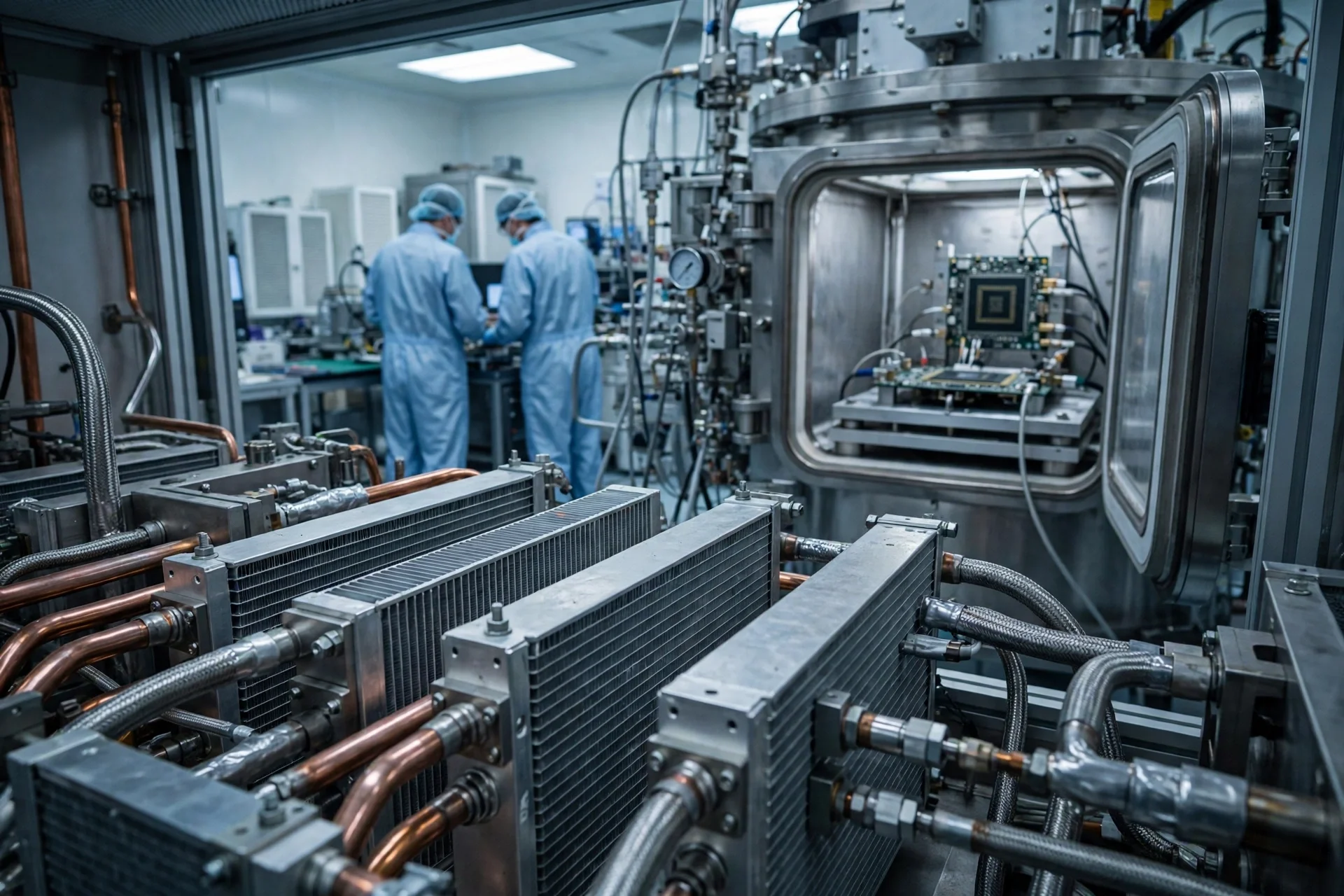
A satellite in orbit must shed chip heat by radiation alone. That limit sets the 15-minute inference cycle.
The Heat Problem Is the Story
There is no air in orbit. That sentence sounds obvious, but its engineering consequences are significant.
On the ground, cooling a chip means moving heat into air, water, or some combination. In the vacuum of low Earth orbit, the only way to shed heat is radiation, infrared energy emitted into space. Project Suncatcher uses heat pipes and radiators for this, but the physics of radiative cooling cap how much waste heat the system can remove per unit time.
Four TPUs running inference generate heat. Run them long enough without adequate cooling and the chips either throttle, shut down, or fail. Google's current answer is a duty cycle: run inference for roughly 15 minutes, then pause until the radiators catch up. That cycle means the chips are idle more than they are working. How often they can run, and how much useful compute accumulates per orbit, will be one of the key results this mission reports. The chips are reported to run Gemma and Gemini inference in those bursts.
What the Ground Radiation Tests Showed
Before launch, Google tested Trillium (V6e) generation TPUs at the UC Davis Crocker Nuclear Laboratory using a proton beam. The test exposed the chips to doses above the estimated shielded five-year mission radiation dose. According to reporting, Trillium performed well at the target dose level.
Some secondary coverage reported a small number of details worth noting carefully. High-bandwidth memory irregularities appeared at higher dose levels, though no hard failure was recorded. Most bit flips were recoverable by restart. One silent data corruption event was reported in secondary coverage. That detail warrants caution because silent corruption, unlike a detectable crash, does not announce itself.
A note on chip generation: Google's ground testing was confirmed to involve Trillium (V6e) chips. Some reports describe Trillium as the chips aboard the satellite. Others do not specify the generation in the October 1 launch announcement. The distinction may matter for interpreting radiation performance data later, so treat specific chip generation claims from pre-launch documentation as ground-test context rather than confirmed flight configuration until Google publishes more detail.
The Numbers in Context
Orbit altitude: about 650 km, or about 400 miles, sun-synchronous.
Solar power: about 1 kW.
Inference duty cycle: about 15 minutes on, then pause.
Solar energy advantage: up to 8x versus mid-latitude ground panels, per Google modeling.
Radiation test facility: UC Davis Crocker Nuclear Laboratory.
Cost-parity threshold, modeled: launch cost below $200 per kg by the mid-2030s.
Next milestone: two-satellite laser-link test in 2027.
Ground laser-link speed in bench test: 800 Gbps each direction, not yet demonstrated in orbit.
The launch cost figure deserves attention. Google's own Joule paper modeling says orbital AI compute would need launch costs to drop below $200 per kilogram by the mid-2030s to approach energy-cost parity per kilowatt-year against ground-based data centers. That depends on launch cadence and vehicle reuse rates that have not yet been demonstrated. Beals told NPR, via reporting summarized in coverage: I don't see this being something where it's cheaper to do this in the next five years. I think it will take longer than that. The project lead is not overselling the near-term economics.
What Comes Next, and Why It Matters
Google has described a 2027 test involving two satellites and free-space optical laser links. A ground bench test has already demonstrated 800 gigabits per second in each direction. Moving that to orbit, where pointing accuracy, thermal drift, and relative satellite motion all become real constraints, is a different problem. That test will be more informative than the current mission about whether orbital compute clusters could ever function as coherent systems.
The longer concept, described as illustrative rather than a deployment plan, involves clusters of roughly 81 satellites with dozens of TPUs each, all laser-linked. The economics of that scale hinge on the launch-cost trajectory described above, plus heat rejection math that the current satellite's 15-minute duty cycle makes concrete.
The competitive context is real but should be kept in proportion. Starcloud has reportedly put an Nvidia H100 in orbit. SpaceX and Nvidia have reported plans in the same area. This is an active area of experimentation, not a Google-only hypothesis.
The Skeptics Have Specific Objections
Not everyone finds orbital AI compute credible as a business model. Neil deGrasse Tyson, as reported in coverage of the launch, has called orbital data centers a failed business model. Jonathan McDowell, an astrophysicist at the Harvard-Smithsonian Center for Astrophysics, has warned about reentry and atmospheric impact concerns in the context of congested sun-synchronous orbit. That orbit band is already under pressure from the proliferation of small satellite constellations. Adding compute satellites with limited operational lifetimes raises genuine questions about debris management and controlled deorbit reliability.
The thermal constraint is not just a near-term engineering nuisance. It is a structural limit on how much compute an orbital satellite can deliver per unit time. A ground-based data center does not pause its GPUs to let radiators catch up. Any honest comparison of orbital versus ground compute economics has to include the effective utilization rate, not just peak chip performance.
What to Watch, Not What to Celebrate
The launch went well. That is worth noting, but launches often do. What this mission needs to answer is harder: do the TPUs still respond correctly after months of thermal cycling? Do radiation-induced errors accumulate in ways the ground tests did not predict? How does the 15-minute duty cycle evolve, if it does?
The 2027 laser-link test is the more meaningful checkpoint. If two satellites can maintain an optical link in orbit through realistic pointing and thermal conditions, the case for networked orbital compute becomes testable rather than theoretical. If that link proves fragile or intermittent, the cluster concept stays in the modeling phase.
Project Suncatcher is a legitimately interesting experiment run by people who are, by their own account, not expecting near-term commercial returns. That framing is the right one. Watch the data over the coming months, not the launch-day headlines.
Sources and Further Reading
Google Research blog, Travis Beals, Oct 1, 2026, Project Suncatcher launch post, blog.google.
TechTimes, Oct 2, 2026, Google Project Suncatcher Reaches Orbit: Cooling, Not Radiation, Now Defines Mission, https://www.techtimes.com/articles/328482/20261002/google-project-suncatcher-reaches-orbit-cooling-not-radiation-now-defines-mission.htm
RuntimeWire, Oct 2, 2026, Google Project Suncatcher TPU Satellite in Orbit, https://runtimewire.com/article/google-project-suncatcher-tpu-satellite-orbit
AI Stock Wire, summarizing NPR reporting, Google Suncatcher TPU Satellite, Planet Labs contact, October 2026, https://aistockwire.com/blog/google-googl-suncatcher-tpu-satellite-orbit-planet-pl-contact-october-2026