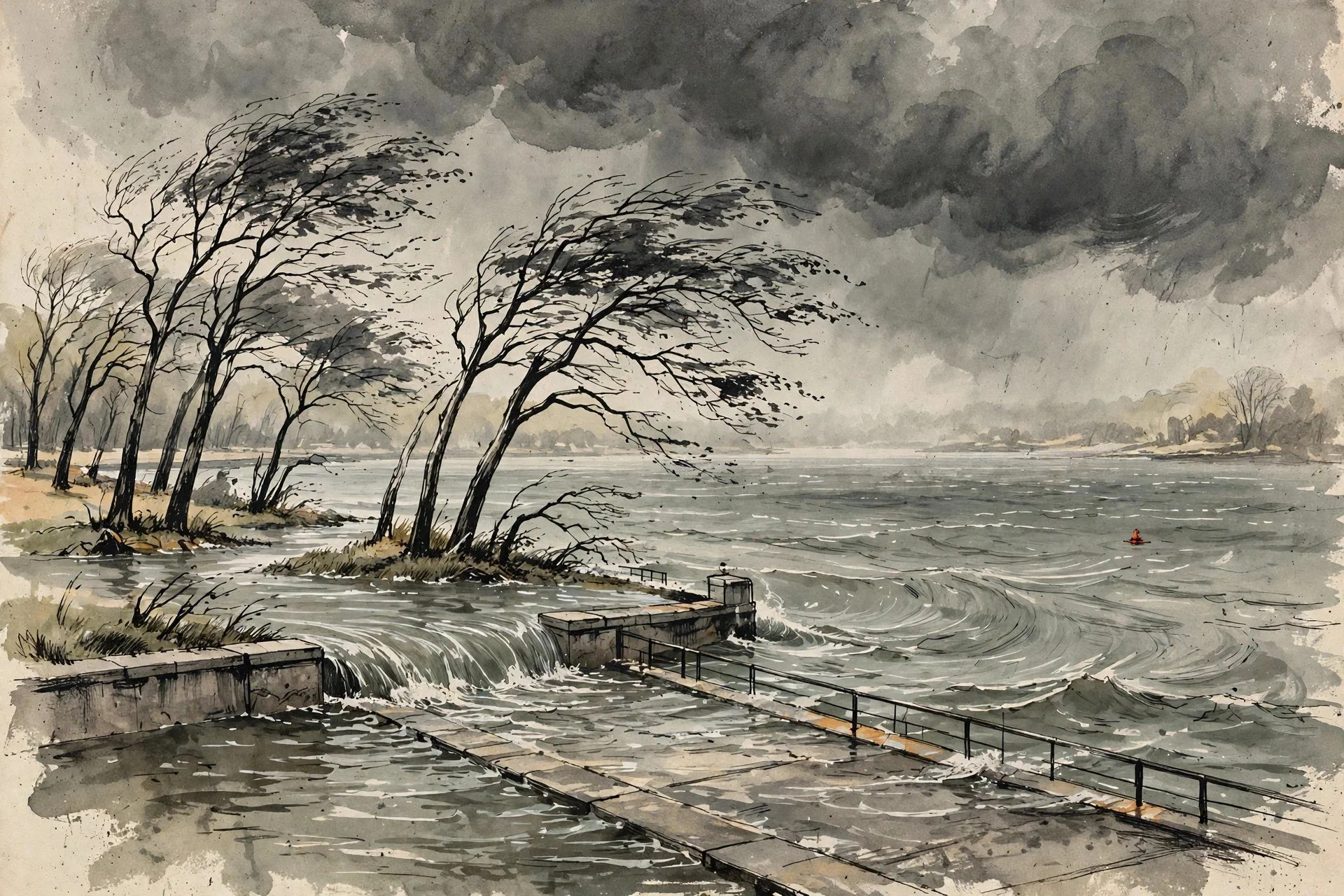
High water on the Hudson.
By Ellis Ward | November 27, 2026
Two active alerts are running over Dutchess County today, Friday, November 27. The National Weather Service Albany issued a Flood Warning at 9:57 PM EST on November 26 for Dutchess and Ulster counties, with minor flooding forecast along the Hudson River near Poughkeepsie. The warning runs until 8:00 PM EST tonight. A Wind Advisory from NWS Albany was in effect for Eastern Dutchess County until 7:00 AM EST this morning, with east winds of 15 to 25 mph and gusts up to 50 mph. Rain showers and temperatures in the mid-to-upper 50s are expected countywide: Clinton Corners at 55F, Poughkeepsie at 58F, Beacon at 57F, per the NWS government digest. Residents need to take these steps.
Driving and Travel
Step 1: Never drive, walk, or swim through floodwater.
The National Weather Service and Ready.gov both lead with this rule: "Turn Around, Don't Drown." The numbers are specific. Six inches of moving water can knock a person off their feet. One foot can sweep a vehicle away. NWS adds: 12 inches of floodwater can carry off a small car; 18 to 24 inches can take larger vehicles, including trucks, vans, and SUVs. More than half of all flood-related deaths, according to the National Weather Service, involve someone driving or walking into floodwater. The Flood Warning covers the Hudson River near Poughkeepsie through 8:00 PM tonight. Any standing water on a road should be treated as potentially lethal.
Step 2: Do not drive around barricades.
Ready.gov states the reason plainly: "Local responders use them to safely direct traffic out of flooded areas." Barricades go up because responders know the road is compromised, not just wet. The road bed below the water may be washed out entirely. From inside a vehicle, you cannot see what the water is covering. The NWS notes an added hazard after sunset: flooded stretches are harder to spot in the dark, so caution at night is especially important.
Step 3: Avoid highway dips, bridges, and low-lying roads.
The Dutchess County Department of Emergency Response's standing storm tips, published on dutchessny.gov, state: "Do not attempt to drive over flooded roads - turn around and go another way. Water moving at two miles per hour can sweep cars off a road or bridge." The county's standing storm tips also direct drivers to watch highway dips, bridges, and low areas where rivers and streams can rise quickly. If water rises rapidly around your car while you are already in it, abandon the vehicle immediately and move to higher ground. Ready.gov draws one important distinction for a different scenario: if you are trapped in rapidly moving water and cannot safely exit, stay inside the vehicle, and get to the roof only if water rises inside the car. Do not step out into fast-moving current.
Step 4: Plan your route before you leave.
Before traveling today, Ready.gov and the NWS both recommend learning which local roadways flood and identifying an alternate route in advance. Stay current through weather.gov, local news, NOAA Weather Radio, and local alerting systems. If your trip took you out early this morning during the wind advisory period, NWS Albany's advisory carried a specific caution: "Winds this strong can make driving difficult, especially for high profile vehicles. Use extra caution."
Home, Water, and Electrical Safety
Step 5: Move up, not out - unless ordered to evacuate.
Ready.gov's flood guidance is clear: if water reaches your home, move to a higher floor. If authorities order an evacuation, leave immediately. If you are trapped in a building, get to the highest level you can reach. Get on the roof only if necessary. Do not climb into a closed attic - rising water can trap you there with no way out. Move valuables to higher levels before water arrives and keep important documents in a waterproof container.
Step 6: Check drains, gutters, and sump pumps now.
Ready.gov recommends clearing drains and gutters, installing check valves in plumbing, and considering a sump pump with a battery backup. For homeowners with basements, the Dutchess County Department of Emergency Response's standing storm tips go further: "If you have a basement, check sump pumps to ensure they are operating and be prepared to use a backup system." With heavy rain today and the Flood Warning running to 8:00 PM, there is still time to clear blockages and confirm your pump works before conditions worsen.
Step 7: Treat electrical equipment as a life-safety hazard.
Ready.gov states: "Be aware of the risk of electrocution. Do not touch electrical equipment if it is wet or if you are standing in water. Turn off the electricity to prevent electric shock if it is safe to do so." The NWS adds: do not enter a basement or room where water covers electrical outlets or where cords are submerged. If you see sparks or hear buzzing, crackling, snapping, or popping, leave immediately. Stay out of any water that may carry an electrical charge. Ready.gov also warns that floodwater can be contaminated, can hide debris, and can carry electricity from underground or downed lines. The CDC, in guidance updated August 24, 2026, advises washing with soap and clean water as soon as possible after any contact with floodwater.
Wind and Power
Step 8: Secure outdoor objects and shelter correctly.
NWS Albany's advisory directs residents to "secure outdoor objects." The Dutchess County Department of Emergency Response's standing storm tips spell out what that means: "Tie down or bring inside lawn furniture, trash cans, tools and hanging plants that could be projectiles during the storm." While the storm passes, stay inside and away from windows and glass doors. Close interior doors for added protection and move to an interior room on a lower floor if winds strengthen. Keep an emergency kit with non-perishable food, water, a portable radio, flashlights, and extra batteries. Charge your phone. Check on neighbors, especially elderly or disabled residents who may need help securing their property.
Step 9: Follow a clear protocol if you lose power.
NYSEG reported 6,398 customers without power across the Brewster division - which covers Dutchess, Putnam, and Westchester counties - at 8:15 PM on November 26. The company's November 26 storm notice for the Brewster division urges customers to stay away from storm debris, which may contain downed wires. Assume every downed wire is energized. Stay at least 30 feet from any downed line. NYSEG's emergency line is 1.800.572.1131.
The Dutchess County Department of Emergency Response's standing storm tips outline the protocol for the outage itself: call your utility first for area repair schedules. Turn off or unplug lights and appliances to prevent a circuit overload when service returns, but leave one light on so you know the moment power is restored. Keep the refrigerator and freezer doors closed. Ready.gov gives the food-safety thresholds: a refrigerator keeps food cold for about four hours; a full freezer holds temperature for about 48 hours. Throw out any food held at 40 degrees Fahrenheit or higher for two hours or more. The rule from Ready.gov is straightforward: "When in doubt, throw it out."
For generators, Ready.gov and the county standing storm tips agree: run your generator outdoors only, at least 20 feet from windows, doors, and attached garages, with working carbon monoxide detectors on every level of the home. The county's standing storm tips add one more direction - run generators outside and downwind - and prohibit two common cold-weather mistakes: never use a gas oven to heat your home, and never use charcoal indoors.
Sources
- Wind Advisory product - National Weather Service Albany
- Floods - Ready.gov (FEMA)
- Power Outages - Ready.gov (FEMA)
- Storm safety tips - Dutchess County Department of Emergency Response
- Safety Guidelines: Floodwater - CDC, updated Aug 24, 2026
- Turn Around Don't Drown - National Weather Service
- NYSEG Responding as Damaging Winds Persist - NYSEG, Nov 26, 2026