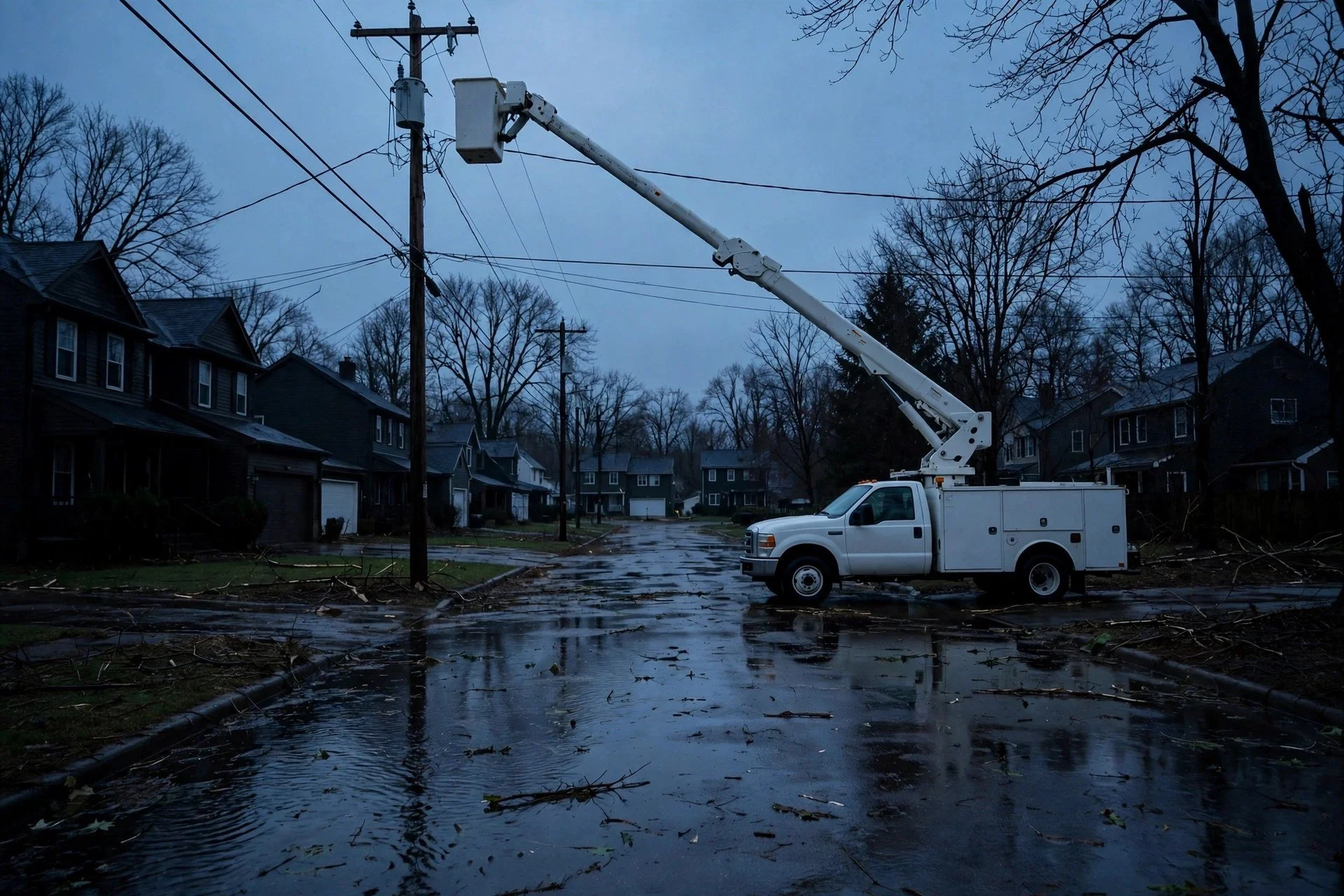
A utility crew at work on a Dutchess County road after the Thanksgiving storm: reporting early is what gets a street on the restoration list.
By Ellis Ward | November 28, 2026
A Thanksgiving power outage puts two clocks in motion at once. The food in your refrigerator and your personal safety both have deadlines. Dutchess County residents served by Central Hudson or NYSEG can act right now. Report the outage, track restoration, and protect your household before either clock runs out.
Report to Central Hudson and Track Your Restoration
Central Hudson Gas and Electric Corporation supplies electricity to a large portion of Dutchess County and neighboring Hudson Valley communities. The utility offers several ways to report and monitor an outage, according to Central Hudson outage and restoration guidance.
Report the outage. Call Central Hudson at 1-800-527-2714 or 845-452-2700, report through the utility's website, use the Central Hudson mobile app, or text OUT to 236483.
Answer safety questions if you can safely do so. Central Hudson may ask whether your neighbors are also without power, whether lines are down, whether poles are broken or wires are sparking, and whether trees or limbs are contacting wires. Only observe those conditions if it is safe to look.
Check status as crews work. Restoration estimates are not available immediately, Central Hudson advises. Crews must assess damage and develop repair priorities first. Once that work is underway, check status online, text STAT to 236483, or call either number listed above. For severe outages affecting large numbers of customers for more than a couple of days, Central Hudson activates C.H.E.C.K., the Central Hudson Emergency Communication networK. Updates go to local radio, social media, email, and the utility's website.
Prepare your home before power returns. Leave one indoor light switched on so you will notice when power comes back, Central Hudson recommends. After dark, leave an outdoor light on to help crews confirm restoration at your address. Unplug major appliances ahead of restoration to protect them from a surge.
If your neighbors have power but you do not. Check your circuit breakers or fuses, Central Hudson advises. The problem may be on your side of the meter.
Report to NYSEG and Track Your Restoration
NYSEG, New York State Electric and Gas, serves parts of Dutchess County through its Brewster division, which also covers Putnam and Westchester counties, according to NYSEG outage and safety guidance.
Report the outage or any hazard. Call NYSEG at 1-800-572-1131. For downed wires, also call 911. The free NYSEG app is available by searching "Avangrid" in the Apple or Android store and selecting NYSEG. Use it to report outages and check status.
Sign up for automatic restoration updates. NYSEG Outage Alerts send restoration information by phone, text, or email. Sign up through the utility's website or app. NYSEG's Outage Central page at NYSEG.com also tracks active outages.
Check your own home before logging a call. NYSEG recommends confirming that neighbors are also affected and inspecting your breaker panel or fuse box. A tripped breaker can mimic a utility outage.
Understand how restoration works. NYSEG prioritizes downed-wire reports first, for public safety, according to NYSEG guidance. Crews then assess the damage, build a restoration plan, and begin repairs in that order.
Downed Power Lines: Keep at Least 30 Feet Away
Treat every downed wire as live and lethal. NYSEG advises staying at least 30 feet from any fallen power line and treating all downed wires as energized and dangerous. Call 911.
If a downed wire lands on your vehicle, stay inside and wait for emergency crews, NYSEG advises. If fire or another immediate threat forces you to exit, jump clear of the vehicle without touching it and the ground at the same time. Land with both feet together, then hop or shuffle away from the area.
The CDC adds further electrical safety rules: never drive through standing water if downed lines are nearby, call 911 if anyone suffers an electric shock, and use battery-powered flashlights or lanterns indoors. Do not use candles, gas lanterns, or open-flame torches.
Generators and Carbon Monoxide: Outdoors Only, 20 Feet from the House
Place any generator at least 20 feet from windows, doors, and attached garages, and always outdoors. Ready.gov and the CDC both hold firm on this point. Never run a generator inside a home, basement, or garage, the CDC states, even with doors and windows open. The same rule covers pressure washers and any gasoline-powered engine.
The CDC also prohibits camp stoves, charcoal grills, hibachis, and propane lanterns indoors. Never use a gas stovetop or oven to heat your home, Ready.gov warns. Doing so raises the risk of carbon monoxide poisoning, fire, and burns.
Carbon monoxide is colorless and odorless, the CDC notes. It can cause sudden illness and death. Install CO detectors with battery backup on every level of your home. Symptoms of CO poisoning include headache, dizziness, weakness, nausea, vomiting, chest pain, and confusion. People who are asleep or have been drinking may die before experiencing any symptoms at all. If anyone shows signs of CO poisoning, call 911 or Poison Control at 1-800-222-1222 right away.
Before refueling a generator, let it cool completely, Ready.gov advises. Fuel on hot engine parts ignites. Keep the generator dry and protected from rain and flooding; a wet generator can deliver a fatal shock. Use heavy-duty extension cords rated for the load.
Protecting Your Food
Keep the refrigerator and freezer closed. A full refrigerator holds safe temperature for about four hours, according to both Ready.gov and the CDC. A full freezer holds for roughly 48 hours. A half-full freezer holds for about 24 hours, the CDC adds.
If the outage runs longer, use coolers with ice and monitor temperatures with a thermometer, Ready.gov advises. Discard any perishable that has reached 40 degrees Fahrenheit or stayed above that mark for two or more hours. Ready.gov states the standard plainly: "When in doubt, throw it out."
The CDC offers one field test for frozen food: items from the freezer are safe if they still have ice crystals and feel as cold as refrigerated food.
Medicine, Medical Devices, and Staying Warm
If the outage lasts more than one day, discard refrigerated medications unless the label says they can be kept safely at room temperature, according to both Ready.gov and the CDC. Contact a doctor or pharmacist immediately for a replacement supply. If a medication is life-critical and stored at room temperature, the CDC advises using it until a new supply is available, but replacing all refrigerated drugs as soon as possible.
Talk to your healthcare provider now about alternate refrigeration plans for medicines and power-dependent medical devices, Ready.gov recommends.
If cold in your home becomes extreme, go to a community location with power and heat, Ready.gov advises. Check with local officials for the nearest heating or warming center. Hypothermia, a drop in body temperature below 95 degrees Fahrenheit, is a medical emergency, the CDC notes. Call for help immediately if someone shows signs.