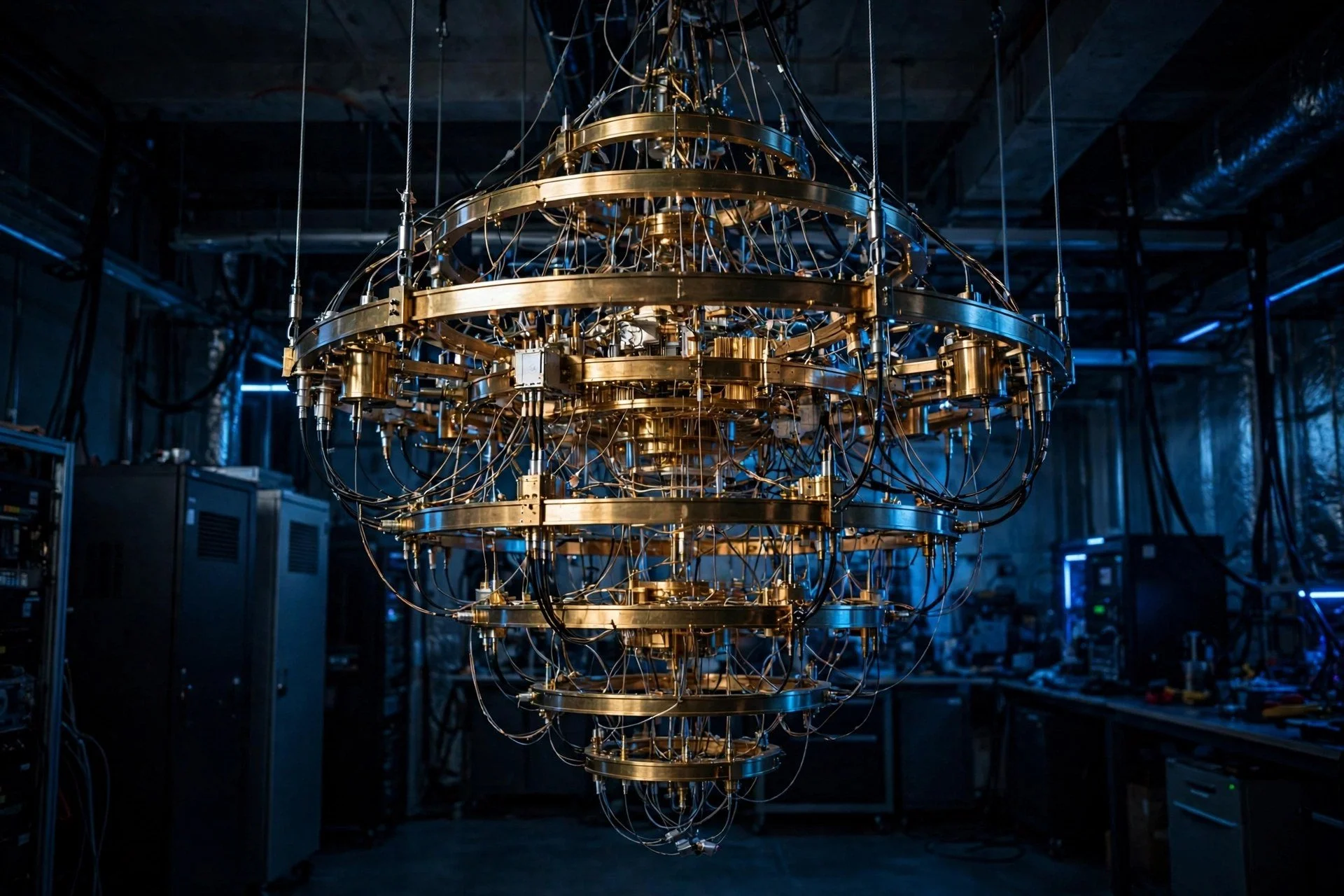
The chandelier, listening to itself.
By Mara Quinn | November 15, 2026
The quantum computer at IBM's Poughkeepsie campus does not wait. It fires 100,000 circuits per second, and every shot produces a stream of error signals, called syndromes, that need a decision before the next shot arrives. Send that data to a cloud server and the round-trip takes milliseconds too many. The machine falls apart. The only fix is to put the classical computing hardware in the same room.
IBM, Oak Ridge National Laboratory, and AMD have done this at 2455 South Road. The result is the first co-located quantum error correction platform of its kind in the United States, running on a 120-qubit processor called Nighthawk r2 and feeding syndrome data directly into AMD's Umbra compute module without leaving the building.
A 120-Qubit Processor and Its Classical Shadow
Nighthawk r2 runs on a square lattice topology. That geometry matters for error correction: qubits arranged in a grid let researchers extract syndromes from neighboring pairs systematically, which is the backbone of topological error correction schemes. The processor supports dynamic mid-circuit measurement, meaning researchers can read out individual qubit states mid-computation and reset those qubits without collapsing the full register. Fast reset is not cosmetic. It allows the machine to recycle physical qubits within a single shot, stretching the effective computational depth without adding more hardware.
At 100,000 circuits per second, Nighthawk r2 generates a volume of classical data that most remote computing setups cannot process in time. The syndrome readout from each shot has to be decoded, a decision has to be made, and a correction has to be fed back into the processor, all within a sub-millisecond window. Cloud latency, even on a fast connection, runs in the range of tens of milliseconds for a round trip. That gap is fatal for real-time error correction.
The Umbra Module
The classical co-processor handling the decode-and-correct loop is AMD's Umbra system. It pairs an MI355X GPU with a 5th Generation EPYC processor. The MI355X runs GPU-accelerated decoders that execute in step with the QPU's repetition rate, keeping pace with the 100,000-circuit-per-second output. The 5th Gen EPYC manages memory and system coordination. Together they close the sub-millisecond round-trip feedback loop that makes active error correction practical at this repetition rate.
The MI355X uses AMD's ROCm software stack. ROCm pipelines syndrome readout data directly into GPU memory, bypassing the slower system memory path. That matters because every nanosecond saved in the data transfer is a nanosecond available for the decode computation itself. AMD's Versal adaptive SoCs handle the syndrome extraction step, pulling raw qubit measurement data out of the processor and formatting it for the GPU pipeline. The chain from physical qubit measurement to decoded correction stays inside the building, and inside the millisecond.
Two Layers of Error Correction, Each Doing a Different Job
The error correction design at Poughkeepsie uses a hierarchical code structure. The inner layer is a topological code. It protects localized physical clusters of qubits from errors that affect nearby qubits, the kind of errors that arise from imperfect gates or qubit crosstalk within a small region of the chip. Topological codes work by encoding a logical qubit across many physical qubits arranged in a pattern, so a single physical error shifts the syndrome but does not corrupt the logical information.
The outer layer handles a different problem: correlated errors that span multiple modules. When you scale a quantum computer by linking modules together, errors can appear across the boundaries between them. A single module's topological code does not see those. The outer code watches the aggregate error pattern across the full multi-module system and corrects the correlated spatial errors that the inner code misses.
This two-layer design lets the system address errors at two different length scales. The inner code handles local noise. The outer code handles spatial correlations. Neither layer has to do both jobs, which reduces the computational overhead on each.
The AMD Versal adaptive SoCs feed syndrome data from physical qubit measurements into GPU memory via the ROCm pipeline. The GPU then runs the decoder for both the inner and outer codes in sequence. Doing that decode within the sub-millisecond feedback window is what makes the architecture functional rather than theoretical. Without the co-location, the outer code's correction would arrive too late to matter.
Poughkeepsie Talks to Oak Ridge
The Poughkeepsie testbed connects directly to the Oak Ridge Leadership Computing Facility, known as OLCF, at Oak Ridge National Laboratory in Tennessee. That link matters for two reasons.
First, it creates a path for quantum-classical hybrid computation at national scale. The QPU at Poughkeepsie handles computations that classical supercomputers cannot perform efficiently. The OLCF's classical systems handle workloads that require massive parallel compute. Connecting the two lets researchers divide a problem across both machines according to what each does well, without routing data through commercial cloud infrastructure.
Second, the data and architecture decisions coming out of this testbed inform IBM Quantum Starling, the company's next-generation processor planned for 2029. Starling is not simply an upgraded Nighthawk. It draws on what the error correction system learns in Poughkeepsie: which code constructions hold under real hardware noise, what decoder speeds are actually achievable in production, and where the outer hierarchical code needs refinement before the next scale step.
DOE Quantum Genesis Mission Targets
The Department of Energy's Quantum Genesis Mission sets the near-term benchmark for this work. The baseline target is 70 logical qubits executing 438 operations reliably. By late 2028, the mission calls for scaling to 100 logical qubits running 100,000 operations.
The Poughkeepsie platform sits on the path for meeting those targets. The move from 438 operations to 100,000 is not a software update. It requires sustained, real-time error correction at scale, which is what the co-located classical hardware is designed to provide.
One specific application target is the Spallation Neutron Source at Oak Ridge, which produces neutron beams used to probe material structures. Quantum simulation of frustrated magnetic materials, where competing interactions prevent the material from settling into a simple ordered state, requires a computational approach that classical machines struggle to scale. In frustrated magnetic systems, local magnetic moments cannot all align simultaneously because the geometry of the lattice creates contradictory constraints. Classical simulation of their ground states requires exponentially growing resources as the system size increases. A quantum processor with 100 reliable logical qubits running 100,000 operations could model these systems directly, at a scale that no classical machine reaches. The Poughkeepsie-to-OLCF connection positions the quantum testbed to feed into that work at the Spallation Neutron Source.
What 300,000 Square Feet in Poughkeepsie Actually Means
The facility sits at 2455 South Road in the Town of Poughkeepsie, Dutchess County. The build-out covers approximately 300,000 square feet. IBM reports approximately 2,300 employees at the site currently. The company has disclosed a $2.5 billion investment figure for the expansion, and preliminary site work has reportedly begun.
The physical requirements for a cryogenic quantum computing facility are demanding. Quantum processors operate near absolute zero, which requires industrial cryogenic infrastructure on-site. The build-out includes a dedicated cryogenic plant and renovation of Building 416 at the existing campus. That renovation is not simply an upgrade of office space. Building 416 has to support the vibration isolation, electromagnetic shielding, and temperature control that laboratory-grade quantum hardware requires. The engineering tolerances for a dilution refrigerator are unforgiving. Vibration from nearby mechanical systems, fluctuations in ambient temperature, and stray electromagnetic fields all degrade qubit coherence times. Meeting those tolerances inside a renovated industrial building is an infrastructure challenge in its own right.
$104 Million in Tax Incentives and a School District's Question
The project has received $104 million in reported tax incentives. Those incentives drew the attention of the Spackenkill Union Free School District, whose board sent a letter to Think Dutchess on September 28, 2026. The letter raised concerns about the financial impact of the PILOT arrangement on school district revenues.
A PILOT, or payment in lieu of taxes, replaces standard property tax assessments with a negotiated annual payment. For a project of this scale, the difference between assessed property tax revenue and the PILOT amount can be significant for a school district that depends on property taxes to fund operations. The Spackenkill board's letter put those concerns on the record. It did not block the project or represent a formal ruling against it.
Think Dutchess, the county's economic development agency, was the named recipient of the letter. As of this writing, the PILOT terms and their resolution have not been publicly settled in a way that the available reporting confirms. That item remains open. The school district has raised a legitimate question about how much of the economic benefit from a $2.5 billion expansion flows to local public institutions. That question does not have a public answer yet.
Why the Distance Problem Changes Everything
The case for co-location comes down to physics and math. A quantum processor running at 100,000 circuits per second generates syndromes continuously. Each syndrome measurement tells the decoder whether a qubit likely flipped or suffered a phase error. The decoder has to decide whether and how to correct before the next cycle starts.
If the classical decoder sits in a remote data center, the syndrome data travels out, the decode happens, and the correction instruction travels back. Even on a low-latency dedicated fiber link, a round trip across a wide-area network takes far longer than one millisecond. The decoder falls behind. Errors accumulate faster than corrections apply, and the logical qubit state degrades.
Co-location at the same facility eliminates that propagation delay. The syndrome data moves within the building, from the cryogenic processor to the Umbra module's GPU memory via the Versal SoC pipeline. The round trip runs in sub-millisecond territory. The decoder keeps pace.
This is a prerequisite for the DOE Genesis targets. Reaching 100,000 logical operations requires that every one of those operations happens under active error correction. Active error correction requires sub-millisecond feedback. Sub-millisecond feedback requires co-location. The whole architecture at Poughkeepsie follows from that chain.
The comparison to cloud-based approaches is direct. A cloud-connected QPU sends syndromes to a remote decoder and waits. The wait time, measured in tens of milliseconds, dwarfs the coherence time available for correction. The result is that cloud-connected error correction can work for research demonstrations at low circuit depths. It cannot sustain 100,000 operations on 100 logical qubits. The facility at 2455 South Road is built around that constraint.
What Comes Next
The Poughkeepsie facility is an attempt to build the classical infrastructure that quantum computing has always required but rarely had close enough to matter. The hardware works at the speed of the problem, not at the speed of the network.
Whether the economic terms satisfy the Spackenkill school district, and whether the DOE's late 2028 targets hold as the program scales, are questions that will get answers over the next two years. The technical architecture at 2455 South Road is now running. The measurements are coming in. What they show will shape IBM Quantum Starling, and through Starling, the next round of DOE benchmark attempts.