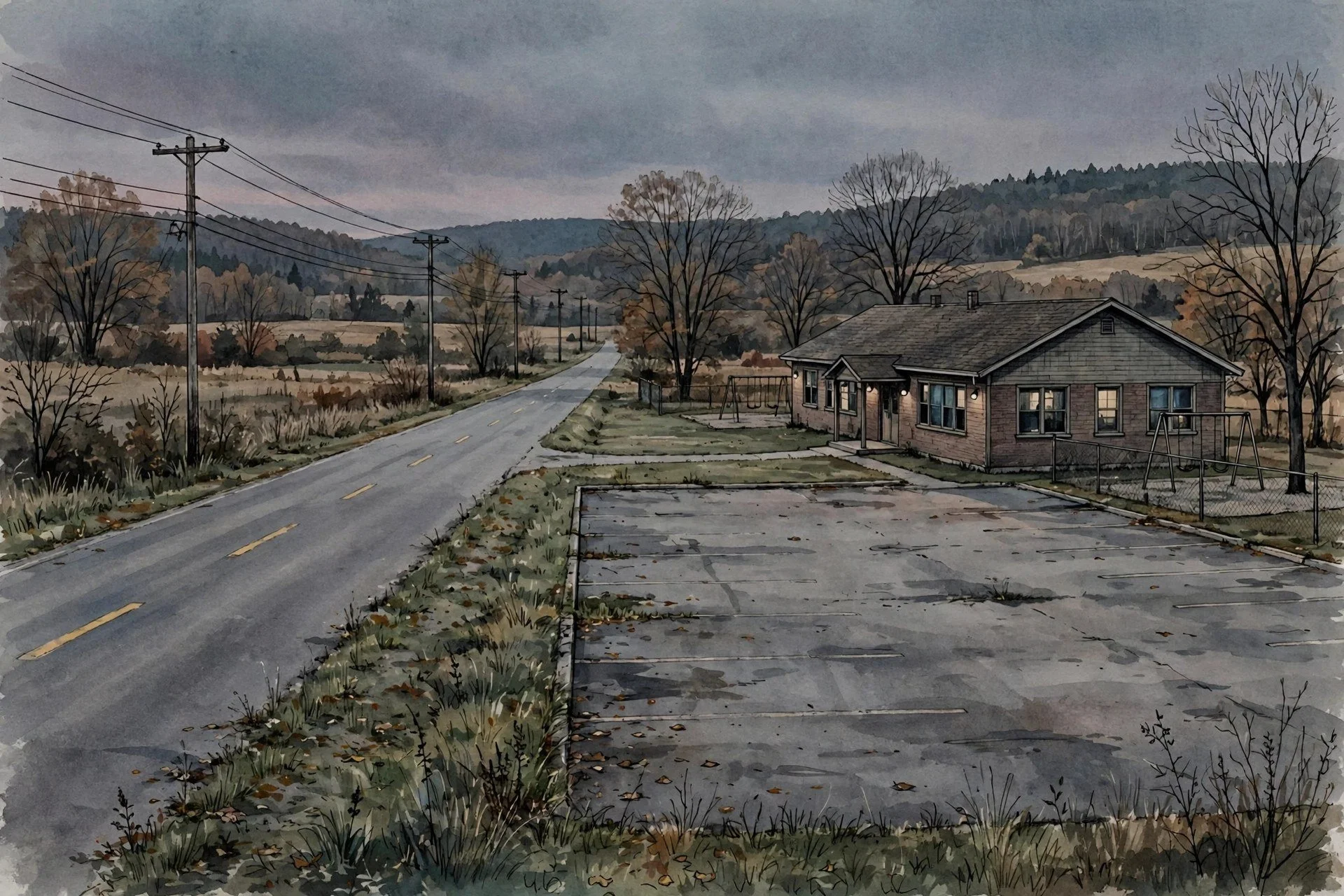
The school on the rural road.
By Callahan Blackwood | November 23, 2026
The person arrested for alleged child abuse at Blooming Grove Academy last Wednesday was not a low-level aide. She was Lisa Rinaldo, 54, of Newburgh, the school's director and chief executive officer, the person who had run the institution since 2018. A second employee, Brian M. Smith, 34, of New Windsor, was arrested the same day. New Windsor police told News 12 Hudson Valley that Rinaldo faces first-degree endangering the welfare of an incompetent or physically disabled person, a class E felony, plus endangering the welfare of a child and second-degree harassment. Smith faces the same felony, plus criminal obstruction of breathing or blood circulation and second-degree harassment. Both were arraigned and released without bail, according to police. The school serves 27 autistic students between grades five and eight in New Windsor, New York.
The charges are on the record. Much of the rest of this story is about what is not.
The Charges Are Public. The School Is Silent.
The arrests took place on Wednesday, November 18, 2026. According to police, the investigation began a week earlier, on November 11, after the department received a complaint of suspected child abuse at the school; detectives worked with the Orange County Child Advocacy Center and the Orange County District Attorney's Office. Police gave the charges to News 12 Hudson Valley, which published them on November 20, and police say the incidents and arrests were reported to the New York State Education Department. No standalone police press release or district attorney statement has been published, and no court date has appeared in the public record.
The school itself has said nothing. News 12 reported that its calls to Blooming Grove Academy went unanswered, that the school's voicemail box was full, and that when a reporter went to the facility and asked to leave contact information for the owner, people at the school declined to take it. No statement from the academy, its board, or any representative has been published. The employment status of Rinaldo and Smith, whether they remain employed, have been suspended, or have been terminated, is unknown. Whether the school remains open and students are currently attending has not been stated in the available record.
So the record is split. Law enforcement put the charges on the record within two days. The institution at the center of the case, five days after its own director was arrested, has not said a word that any parent can read.
What One Father Reported
One account anchors the public record. Chris Acevedo, the father of an 11-year-old autistic student, told News 12 Hudson Valley on November 20, 2026, two days after the arrests, what the school's surveillance footage shows. His son, who is partially verbal and had attended the school for only a couple of months, was allegedly pushed to the ground, had paper towels shoved in his face, and was force-fed chocolate. Acevedo said the video shows Smith holding his son down and pushing him to the ground, then pushing the paper towels into his face and forcing him into his seat. He said it also shows Rinaldo grabbing the boy, pushing him into a chair and forcefully crossing his arms before both went to the ground, and then taking him out of the camera's view. He has since withdrawn his son from Blooming Grove Academy.
News 12 also reported that a school employee came forward about the alleged abuse and described additional conduct not captured on camera, including an allegation that someone tried to force chocolate into the boy's mouth. No other parents have been quoted in published reports available for this article. Whether the footage has been secured as evidence, and what the school has done to preserve it, has not been stated.
The surveillance camera itself is an asset that belongs to, and presumably is controlled by, the institution. Its footage, to the extent it exists and is preserved, is evidence in a child abuse case at a school whose director stands accused.
A School Built for Trust
Blooming Grove Academy is a private special education school. It serves students in grades five through eight, all with autism diagnoses. By its own description, it offers direct instruction, intervention and remediation, and social skills curriculum. The school is nonsectarian and coeducational.
The numbers are small. Twenty-seven students. Four teachers. That works out to roughly a seven-to-one student-to-teacher ratio. For context, that ratio reflects an intent to deliver intensive, individualized support. Parents who enroll a child at a school like this are not choosing a large campus where their child will have dozens of adults available. They are choosing a small, controlled environment where they expect every adult to know their child by name, to understand their needs, and to be held closely accountable by the people around them.
When the person at the top of that structure is arrested on child abuse charges, the breach extends to the institution's core. Rinaldo was not an employee supervised by an executive she had never met. She was the executive. She had run the school since 2018.
The school sits on Blooming Grove Turnpike, also designated as Route 94, in New Windsor, New York. The specific street number varies across public records, appearing as 422, 537, or 539 depending on the source. This article uses only the road name because no single number has been confirmed across sources. That minor discrepancy is a small illustration of how basic details about a small private school can be difficult to pin down from the outside.
New York's Protections for Students Like These
New York State bans corporal punishment in schools. That prohibition has been in state law for many years, but on October 25, 2023, the state sharpened the classification: corporal punishment in schools now constitutes child abuse under Education Law sections 1125 and 305. The legislature made a judgment call. It decided that a teacher or director who strikes, shoves, or physically mistreats a student is not committing a disciplinary excess or a lapse in judgment. That person is committing child abuse.
The conduct described by the father who spoke to News 12 Hudson Valley, a student being pushed to the ground by staff, falls squarely within the conduct that statute addresses.
The 2023 reclassification did not stand alone. Beginning with the 2024-25 school year, covered schools in New York must report annually to the New York State Education Department on their use of physical restraints and timeout procedures. They must also report on substantiated and unsubstantiated allegations of prohibited interventions, which include corporal punishment as newly defined. For students placed at approved private special education schools, the district of residence collects that data and transmits it to the state.
Blooming Grove Academy is a private special education school. Some of the students it serves were placed there through their home school districts. That means the reporting structure for those students runs through those districts. A parent in an Orange County community whose child attends Blooming Grove Academy would, under this framework, have their child's school data routed from the academy through the home district to NYSED.
The System That Should Have Known
The reporting regime described above was designed precisely for situations like this. A small private school serving disabled students, operating outside the daily scrutiny of a large public campus, depends on formal oversight mechanisms to surface misconduct that internal culture might suppress or ignore.
Autistic students, particularly those in grades five through eight, may not reliably communicate abuse to parents or guardians. Some may lack the verbal language to describe what happened. Some may not have a framework to recognize that a staff member's physical conduct crossed a line. Some may fear retaliation or simply not understand that reporting is possible. The school's surveillance system, as described by the father, captured at least some conduct on video. But a camera the school controls is not independent oversight. It is evidence that someone at the institution must choose to preserve and disclose.
That is exactly why the annual reporting requirements exist. The state built a paper trail. Schools must document prohibited interventions. Districts must collect and transmit that documentation. NYSED must hold the aggregate record. If Blooming Grove Academy had prior allegations of prohibited interventions, that information should exist in the reporting chain.
What happened to that data? That question is unanswerable at this moment. No NYSED record of allegations or prohibited intervention reports at Blooming Grove Academy has been published or confirmed. No district of residence has stated publicly that it received or transmitted reports from the school. No annual report data for 2024-25 or the current school year has been publicly connected to this case.
That gap does not prove the reporting system failed. It does prove that no institution has yet shown it worked.
Who Has Spoken, and Who Has Not
To their credit, New Windsor police did the basic thing: they gave a reporter the defendants' names, the charges, and the shape of the investigation. That is how the public knows what it knows. The district attorney's office worked the case with detectives, according to police, but has published no statement of its own. No court date has been announced.
The state has been quieter. Police say the incidents and arrests were reported to the New York State Education Department. NYSED itself has published nothing: no acknowledgment of the arrests, no statement about the school's approved status, no word on whether any review of the institution's oversight compliance is underway. No child protective services agency has published a statement about the case.
And the school, the one institution that owes its 27 families a direct account, has said nothing at all.
What Remains Unknown
Accountability reporting requires stating plainly what it cannot tell you. The charges, the arraignment and the release without bail are on the record through News 12's police reporting. What is not known: the next court date, which no public filing available for this article has scheduled. Whether any students beyond Acevedo's son are alleged victims has not been stated. The full contents of the surveillance footage, beyond the father's description of it, have not been released.
Smith's role at the school has not been published. Whether he was a teacher, an aide, an administrator, or held some other position is unknown.
The school's current operational status is unknown. Whether families of enrolled students have been formally notified by the school is unknown. Whether any state agency has placed Blooming Grove Academy on a watch list, initiated a review of its approved status, or recommended that families consider alternatives is unknown. Whether Orange County child protective services or the state has opened a broader investigation beyond the criminal charges has not been confirmed publicly.
Whether any prior complaints about staff conduct at Blooming Grove Academy exist in official records has not been confirmed.
Why the Gaps Are Not Acceptable
The students at Blooming Grove Academy are autistic children. Many of them, served in a specialized private placement precisely because of the intensity of their needs, have communication profiles that make self-reporting of abuse difficult. They depend on adults to protect them and, when protection fails, to tell the truth about what happened.
The father who spoke to News 12 Hudson Valley made the decision to withdraw his son after seeing surveillance footage. He went public. That is an act of advocacy for his child and, by extension, for other families who have not yet seen the footage or heard the charges. Other parents do not have his information. They do not know whether their child was present during the alleged incidents. They do not know whether their child was a witness or a victim. They do not know whether the school is currently safe.
That uncertainty is not a byproduct of a complex investigation still unfolding. Five days is enough time to publish an arrest report. Five days is enough time to tell parents what charges have been filed. Five days is enough time for a school to inform the families of 27 students that two of its employees, one of them its director, have been arrested on child abuse charges.
New York law has laid out what these students are owed. The 2023 reclassification and the reporting requirements that followed reflect a legislative judgment: disabled students in specialized placements deserve the full force of the state's protective machinery, and the adults who work with them must be held accountable when that machinery engages. The arrests of Rinaldo and Smith suggest the machinery engaged. Whether it engaged in time, and whether it will produce a public record families can rely on, remains to be established.
The charges are confirmed, and they are public because one police department answered a reporter's questions. The conduct on the record is a father's account of surveillance footage and an employee's account of what the cameras missed. The silence that remains belongs to the school and the state.
Sources
- Two arrested for abuse at school for autistic students - Mid Hudson News via Muck Rack
- New Windsor school director, employee charged in alleged abuse of 11-year-old boy with autism - News 12 Hudson Valley
- Reporting Student Behavioral Interventions 2024-25 - New York State Education Department
- Blooming Grove Academy
- Blooming Grove Academy LLC profile - Private School Review
- Blooming Grove Academy listing - OpenGovNY