Class is in session.
By Callahan Blackwood | November 23, 2026
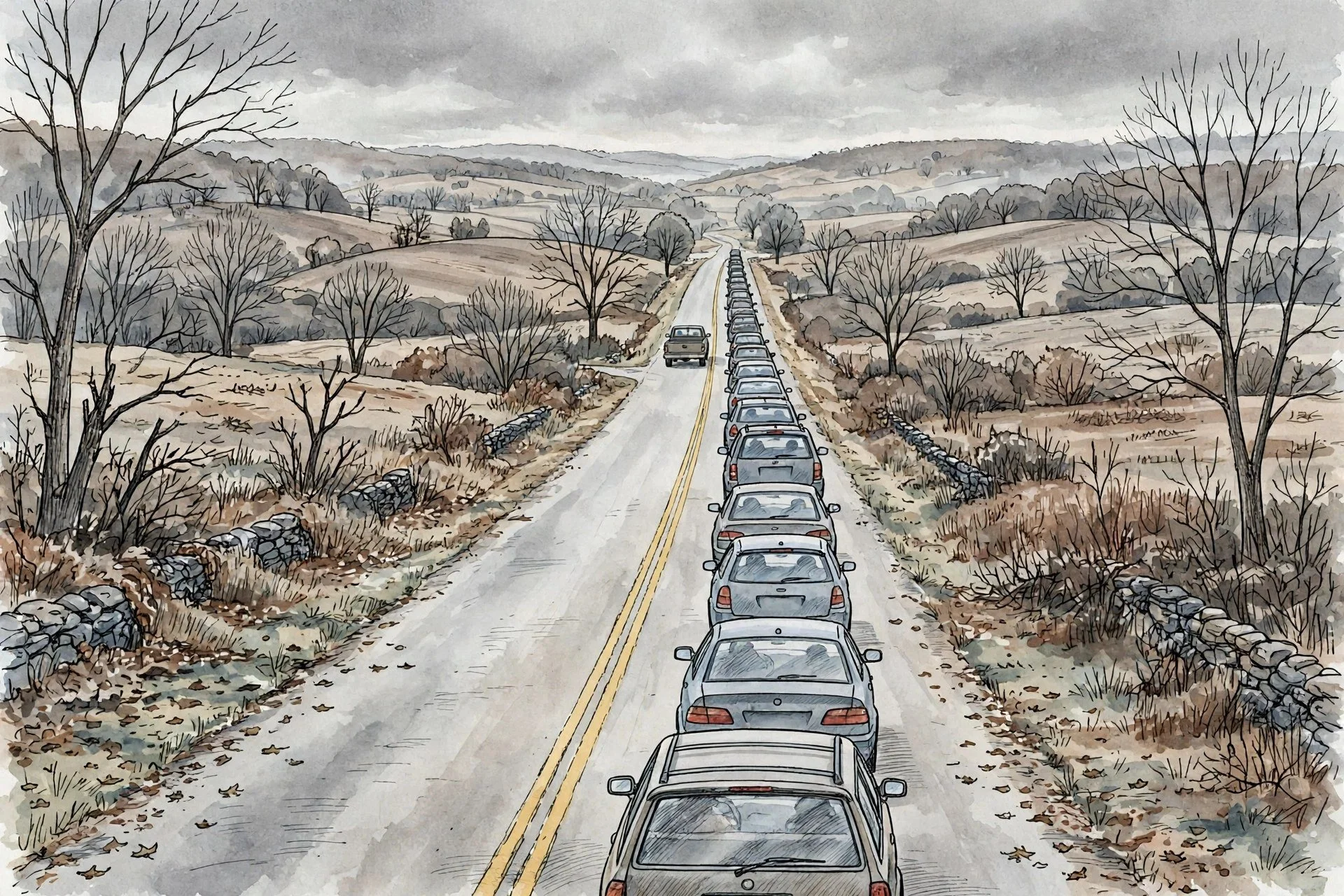
There's a man in front of me on Route 9W doing 47 miles per hour. He's been doing 47 for the last nine miles. He's not on a phone. He's not lost. He's not hurt. He is content. He is at peace with himself and with God and with every obligation on his calendar. He has nowhere to be and all the time in the world to not be there.
I signal left. I move to pass.
And something shifts.
The speedometer in that Ford F-150 awakens. Fifty. Fifty-five. Sixty. This man who could not crack fifty on a clear road with no traffic is now pacing me door-to-door like we're running a qualifier at Daytona. He cuts back in front. He slows to 48. The lesson is over. I have been corrected.
This is what I live with driving upstate New York. The road is not a road to these people. It is a classroom. They are tenured. You are enrolled whether you signed up or not.
I am a Black man driving in upstate New York, and I want to be careful here, because I don't know your experience. Maybe it's just me. Maybe I'm lucky. But the driving instructors I meet up here are almost always white and older – usually a 70-year-old in a Buick or a 55-year-old in a pickup who woke up this morning with a calling. And I genuinely wonder, the way you wonder about something you can't prove but you feel in your molars, whether other Black drivers and other minorities on these roads are noticing the same thing. Or whether I just keep winning the lottery no one wants to win.
I know the behavior. The lane vigilante. The speed-limit missionary. The man who has decided his job on this two-lane road is to hold the line against anyone moving with purpose. He was doing 47 going nowhere. The second I tried to get somewhere, he had a problem with me.
I think this is what is actually happening.
These people are bored. Not stuck-in-traffic bored. Existentially bored. They built a life that looked exactly like the catalog promised, and somewhere around the third decade they noticed the catalog lied. The cul-de-sac is quiet and soulless. The spreadsheet job pays the mortgage and nothing else. The weekends are tasks. And then they get in a car, and the road is the one place left where you can feel like a protagonist. Some guy tries to pass you, and suddenly you have an enemy, and an enemy means you have a plot. Grand Theft Auto for men who would never touch a video game. The left lane is their open world.
I get it, actually. I don't like it. But I get it.
Meanwhile, somewhere in a television studio, a senator or a cable news personality is asking why GDP is down and shouldn't more people be working, and what is wrong with this generation, and are we really going to let video games rot the country from the inside out. These are the people defending the American life at the highest possible volume. They are almost universally people who have not lived it at ground level in thirty years, if ever.
Most people I know get up every morning and go to a job they did not choose for a corporation that does not know their name for twenty dollars an hour. Twenty. Dollars. An hour. They do this because rent exists. They do this because the alternative is worse. They come home tired and they sit in front of a screen, because tired people need somewhere to go, and the people on TV want to have a whole conversation about whether that screen is the problem.
The screen is not the problem.
Then there's the salary lie, which is a personal favorite. Every form asks what you make. On paper I make $75,000 a year. That sounds like something. After federal and state tax, it's closer to fifty. After rent, insurance, food, gas, the car that needs new rotors, the subscription I forgot to cancel and the one I need but hate paying for, it's not fifty anymore. It's a number I don't want to look at directly. But the form has my $75,000 and the form is satisfied, and the whole country nods along because we need the fiction to hold. The number on paper is two deductions away from a completely different life, and nobody wants to do that math out loud.
And then there's the self-made myth, which is the fiction I enjoy destroying the most. The poster child is your overlord Mark Zuckerberg. He took someone else's idea – and I'm not being loose with language here, the founding dispute is documented – built a billion-dollar machine on it, and has been performing generosity ever since. Theft, theft, theft all the way up, and now he's giving it away. Giving it away while making everyone's lives more miserable in the process. So my question is a simple one: if the wealth is being given away, where exactly is his money?
And while we're asking questions, where was the relief for businesses like mine during COVID? The money was supposed to be for every business. That's what they said. What actually happened was that the connected took it, the outright fraudsters took it, and real businesses got the runaround until the program ran dry. The generosity always seems to find the people who already have things.
Zuckerberg is just the name on the door. The pattern runs everywhere. Someone got an inheritance at the right time. A relative died and the timing was merciful. A deal got made in a room that wasn't recorded. A ring got kissed. Something happened that the LinkedIn bio doesn't mention. You can see it if you look at the trajectory and ask where the ramp was.
The people who actually grind, the ones who work like it means something, some of them get kind of successful. And then they work until they die.
I don't hate this place. I live here. I work here. I'm building a life here, in the Hudson Valley. And the tools everybody brags about — the ones that are supposed to make this the greatest place on earth to build something? You can use them in almost any developed country now. The tools are everywhere. The tools are not the miracle. I keep coming back to the same question, driving behind a 70-year-old missionary who found God at 47 mph, and I keep asking it about all of it.
What are you people thinking?