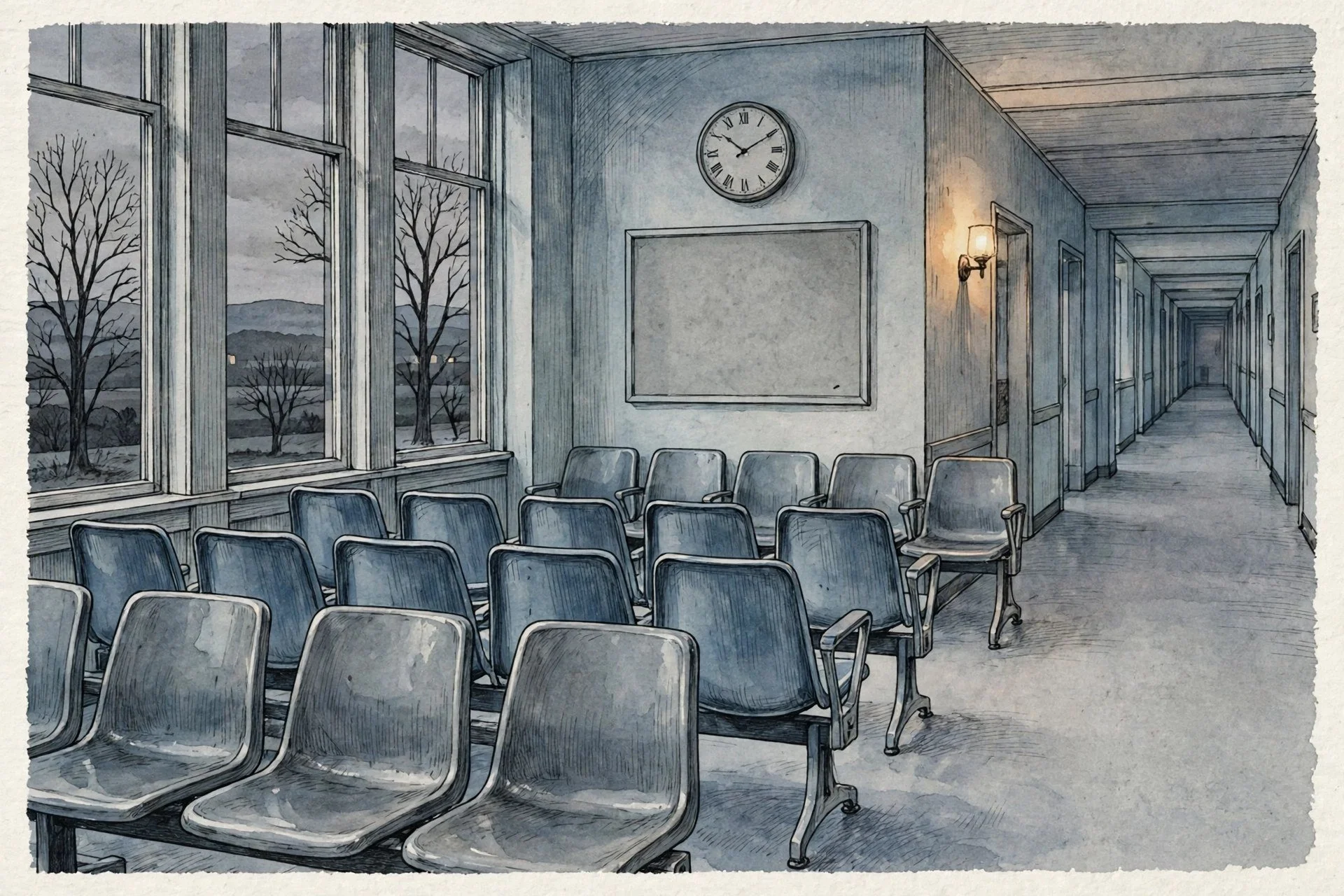
The waiting room, eighteen months on.
By Mara Quinn | November 23, 2026
You book the appointment four weeks out. You wait again when you arrive. Then you get fifteen minutes in the exam room. That arc describes American primary care in 2026, and it is the pattern patients describe in reviews of Northwell practices – eighteen months after Northwell Health absorbed the system that runs Vassar Brothers, Northern Dutchess, and Putnam hospitals.
The national numbers make the arithmetic plain. AMN Healthcare's 2025 survey of fifteen metro areas found the average wait for a physician appointment reached 31 days, the longest since the survey began in 2004 and up 19 percent from 2022. For family medicine, the average was 23.5 days. A study of more than 21 million visits put the median primary care exam at 15 minutes. No acquisition moves those numbers. They are structural: not enough physicians, too many patients, too little time per slot.
Northwell's takeover of Nuvance did move the financial stability of three Hudson Valley hospitals that were losing money at an accelerating pace. That is real and cannot be minimized. Whether the patient in the waiting room in Poughkeepsie or Rhinebeck has felt any of it yet is a different question entirely.
A System Running Out of Time
By the time Northwell announced the merger in February 2024, Nuvance Health had posted $153.3 million in losses in fiscal 2022 and $121.5 million in fiscal 2023 – more than $220 million across two years. The operating loss in fiscal 2024 reached $98.1 million. Vassar Brothers Medical Center alone had lost $40 million in fiscal 2023. Putnam Hospital lost $32.5 million. Merger filings raised the prospect of bankruptcy if the deal collapsed.
The New York and Connecticut attorneys general approved the transaction in part because the alternative was service cuts or closures. The deal closed May 1, 2025. Nuvance's seven hospitals – Vassar Brothers, Northern Dutchess, Putnam, Danbury, New Milford, Norwalk, and Sharon – joined Northwell, bringing the system to 28 hospitals, more than 1,050 ambulatory sites, 73 urgent care centers, and roughly 104,000 employees. Northwell operates on a $22.6 billion budget and serves 13 million people. It is New York's largest health care provider and largest private employer.
Patients in Dutchess and Putnam counties did not get a vote in any of that. The merger happened because the numbers demanded it. What they got in return is the question.
What Was Promised
The regulatory approvals came with specific conditions. Northwell pledged at least $1 billion in investment over five years, with annual progress reports to verify it. An independent monitor, the firm PYA, would file semiannual reports for five years. Commercial price growth would be constrained. No real-estate sale-leaseback deals for five years. All inpatient services and union contracts would stay intact. Northwell's more generous financial assistance policies would apply across the merged system. Labor and delivery at Sharon Hospital would remain open for at least five years. Staffing levels at Putnam would be maintained.
That oversight structure was deliberately built to outlast the honeymoon phase of a corporate integration. Five years, twice-yearly reports, binding investment commitments: the regulators built in accountability mechanisms precisely because promises made at a merger closing are easy to make and easy to defer.
What Has Improved
The monitor's most recent report, filed August 31, 2026 and covering the first half of this year, found no instances of substantial noncompliance. That is a meaningful result. A system that absorbed seven hospitals while managing twenty-one others operates under real integration pressure, and a clean compliance record eighteen months in is not guaranteed.
The clinical investments have begun to show up in the region. Physician recruitment is underway in oncology, digestive health, women's health, and vascular surgery. Vassar Brothers performed its first robotic spine surgery. A new rehabilitation suite opened at New Milford Hospital with expanded hours. The network launched a unified online physician-search and scheduling tool covering the full merged system. Patient grievance processes were integrated across all sites. Vassar Brothers tied for nineteenth in New York in U.S. News and World Report's 2025–26 Best Hospitals rankings.
In Northern Dutchess, county legislators are in preliminary talks with Northwell's ambulance arm – one of the state's largest nonprofit ambulance services – about a pilot program that would put advanced-life-support ambulances in underserved rural areas including Milan and Pine Plains. No agreement has been reached. Northwell's two current Dutchess County ambulances handle inter-hospital transport, not emergency response. If those conversations produce a deal, rural residents in Northern Dutchess could gain response capacity they have not previously had. That gap has been real and dangerous for a long time.
The financial rescue alone matters. Without the merger, some combination of service reductions, facility closures, and catastrophic financial failure was the documented alternative. Those hospitals are open. That counts.
The Waiting Room Has Not Changed
There is one open finding from the monitor: appointment wait times for Medicaid patients seeking neurology appointments. The finding carried from the first monitor's report into the second. Northwell entered a corrective-action process and reported substantial initial improvement. The third report, expected March 2027, will assess whether the finding can be closed.
A single specialty's access problem may sound narrow. It is the monitor's own unresolved item, carried forward because it represents a documented failure to reach some of the most medically vulnerable patients in the system. Its continued presence in the second report means the problem was real enough and persistent enough that the monitor chose not to close it.
Broader patient experience patterns have not demonstrably shifted. Online reviews are anecdotes, not a survey, and should be read as color rather than data. The pattern they show, however, is consistent: individual physicians praised, front-end operations criticized. Central scheduling cannot answer basic questions. Patients describe days of phone tag. Portal messages reportedly take one to two weeks for responses, against a stated 48-hour turnaround. Northwell's Trustpilot profile carries 1.9 out of 5 stars across 38 reviews – a small sample, dominated by complaints about scheduling, phone access, and billing. That pattern predates the Nuvance merger. It reflects system-wide conditions that the acquisition did not create and has not yet corrected.
Why the Front End Is the Hardest Part
Consolidation fixes balance sheets before it fixes waiting rooms. Capital moves fast; staffing economics move slowly. Appointment wait times respond to panel sizes, physician ratios, and scheduling structures. None of those factors bend quickly to investment dollars, however large the commitment.
The $1 billion Northwell pledged is weighted toward facilities and technology. Those investments are visible: a robotic surgery system at Vassar Brothers, a rehabilitation suite in New Milford, a unified scheduling platform. What they cannot directly purchase is enough physician time to close a 31-day average wait. The Association of American Medical Colleges projects a national physician shortfall of up to 86,000 by 2036. That shortage does not stop at county lines.
Physician recruitment in oncology and vascular surgery addresses gaps at the top of the complexity ladder. Primary care access – where most patients first encounter a health system – is a harder problem. Building panel capacity in primary care takes years: training pipelines, competitive pay, and practice conditions that make Dutchess County attractive to physicians who could practice anywhere. National averages for family medicine hold at 23.5-day waits. Getting meaningfully below that requires more than a merger.
The five-year monitor runway reflects this reality. The oversight period was set to five years because that is roughly the minimum needed to assess whether integration produced durable change, not just compliance on paper.
What to Watch
The clearest near-term marker is the third monitor report, expected March 2027. If the neurology appointment finding closes, Northwell will have resolved its only documented access failure on the regulator's timetable. If it does not, the finding enters year three of a five-year period with unanswered questions about whether corrective action translated into lasting improvement for Medicaid patients who need neurology care.
Northwell's annual investment reports will show how the $1 billion breaks down by year and category. Patients have a direct interest in the ratio between facilities spending and staffing investment. A new wing is different from a larger physician panel, and only one of those changes what a patient waiting four weeks for an appointment can actually feel.
The Northern Dutchess EMS discussions, if they produce an agreement, would extend Northwell's reach into a gap that no previous arrangement has closed. Rural towns like Milan and Pine Plains sit far from hospital campuses. Advanced-life-support response time is not an abstraction in cardiac emergencies. That conversation is worth watching.
Eighteen months in, the Northwell-Nuvance merger delivered what it promised first: financial stability for hospitals that needed rescue. The investments in clinical capacity are real. The compliance record is clean. The waiting room remains what it was – a place where the structural pressures of American health care arrive, regardless of what name appears on the door.
Sources
- Northwell, Nuvance complete merger - Healthcare Dive
- Northwell, Nuvance merger clears final regulatory hurdle - Healthcare Dive
- Another financial distress merger: Nuvance and Northwell - HealthLeaders
- Putnam Hospital to join Northwell - Highlands Current
- Nuvance and Northwell reach agreed settlement - Connecticut Office of Health Strategy
- Monitor finds Northwell-Nuvance hospitals compliant, Medicaid access issue improving - Hartford Business Journal via Connecticut Hospital Association
- Nuvance Health is now Northwell - Northwell Health
- Pilot program with Northwell Health could ease Northern Dutchess EMS crisis - New Pine Plains Herald
- This is why your earliest doctor's appointment may be weeks away - ConsumerAffairs
- Reviews - Northwell Health Physician Partners at White Plains
- Northwell, Nuvance's 28-hospital merger notches final regulatory approval - Fierce Healthcare