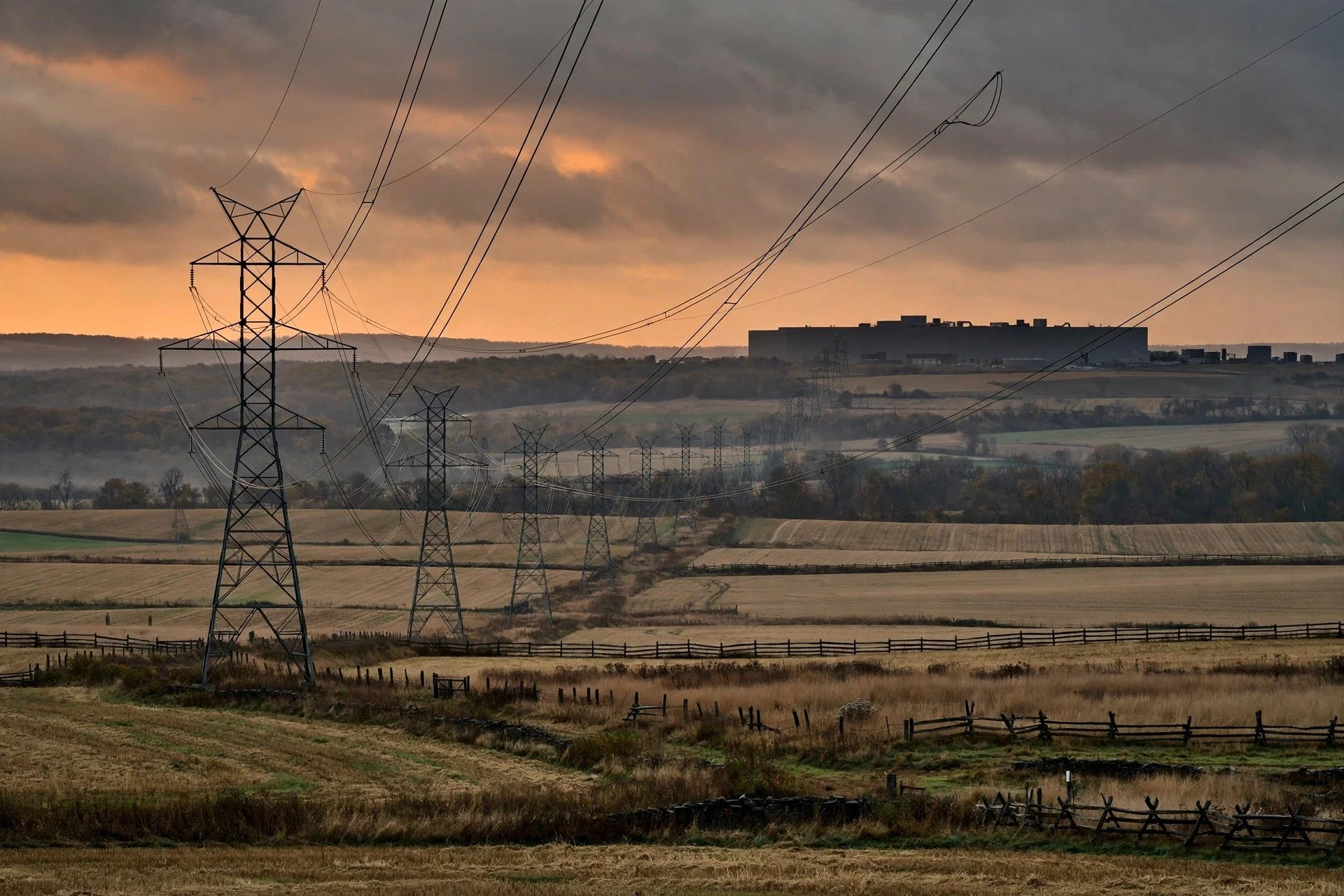
Transmission lines over Hudson Valley farmland.
By Mara Quinn | November 19, 2026
New York's grid has a formal shortfall problem in the Lower Hudson Valley, and the state says it starts in 2032. That matters because a 1-gigawatt data center in East Fishkill, large enough by itself to outpace the entire statewide power gap the assessment documents, remains listed as active in the state interconnection queue.
The New York Independent System Operator released its final Reliability Needs Assessment on November 18, 2026. The document, dated November 17, identifies a statewide resource shortfall beginning in 2033. It separately calls out the Lower Hudson Valley as a transmission-constrained area with its own reliability needs beginning one year earlier, in 2032. Those two findings, arriving in the same week that tracking data shows seven Dutchess County large-load requests totaling 1.1 gigawatts still on the books, draw a sharp line between state planning and local reality.
The state's document and the queue data do not resolve what happens next. They make the question harder to defer.
The Assessment's Contents and Assumptions
The Reliability Needs Assessment is not an editorial. NYISO issues it as a planning instrument, one that shapes decisions about new generation, transmission upgrades, and demand management across the state. The November 17 version is the final assessment in the current planning cycle and carries the weight of a formal determination.
According to an RFTUV Local Tech Radar scan of the assessment conducted November 19, 2026, the statewide resource shortfall stands at approximately 225 megawatts by 2033. That figure grows to roughly 1,850 megawatts by 2036. The trajectory is steep. A system that runs lean in 2033 runs critically short three years later.
The numbers are more striking for what they already include. NYISO built its demand forecast with approximately 1,700 megawatts of data-center load and roughly 1,000 megawatts of industrial load already factored in. These are not worst-case additions layered on a baseline. They are loads already in the queue or under active study at the time of the assessment. The projected shortfall emerges even after modelers accounted for a substantial portion of the anticipated demand growth in this region and statewide.
The separate, transmission-constrained finding for the Lower Hudson Valley goes beyond the statewide number. The valley has structural grid constraints of its own. Even if New York closes its statewide gap through new generation capacity elsewhere in the state, those electrons still need to reach Dutchess, Putnam, and Westchester counties through a transmission network the assessment says falls short starting in 2032. Transmission constraints are a physical problem. They bind in ways that distant generation additions cannot fix without matching infrastructure investment.
The New York Post reported November 18, 2026, citing the same NYISO study, that the state's power grid will not keep pace with demand within five years, with a potential blackout crisis on the horizon. JBizNews reported the same day that the grid study projects a statewide power supply gap starting in 2033. That is the statewide frame. For the Lower Hudson Valley, the specific finding is earlier by a year and rooted in transmission capacity, not generation alone.
The East Fishkill Project: Active, Contested, and Unresolved
The proposed data center in East Fishkill is large by any standard. At 1 gigawatt, it would draw more power than the entire statewide shortfall NYISO projects for 2033. It sits in a region the state just formally flagged for transmission constraints. And as of November 18, 2026, it remains listed as active in NYISO's large-load interconnection queue, according to WattStreet, a tracker that monitors New York interconnection filings.
WattStreet's November 18 data shows seven large-load requests in Dutchess County totaling approximately 1.1 gigawatts. The East Fishkill proposal accounts for the dominant share of that figure.
East Fishkill has responded through local law. On June 25, 2026, the town board adopted Local Law No. 3 of 2026 by a 5-0 vote. That law prohibits data centers exceeding 20 megawatts from locating in town until July 1, 2029. A separate moratorium on applications in the town's industrial district runs until December 31, 2026. The two measures together reflect a formal decision: halt further large-load development while the grid picture comes into focus.
The developer identified in prior reporting as Treetop has challenged the moratorium. The Guardian reported October 9, 2026, that Treetop had filed an appeal. As of the RFTUV scan completed November 19, 2026, no ruling on that appeal had been located. The moratorium stands. The appeal is open. The project occupies a contested middle ground between local restriction and state queue activity.
What Queue Status Means
An active listing in NYISO's large-load interconnection queue is not an approval. It is a request for a grid impact study, nothing more. Entities that remain on the queue have not been granted permission to draw power. They have not received local permits. But they are being modeled.
That modeling matters. When NYISO forecasts demand, it draws in part on queue filings to estimate future load. If a 1-gigawatt project remains active in the queue, it registers in the planning picture as a potential future demand, one that contributes to the conditions the assessment describes, even if no shovels have broken ground.
For East Fishkill, the moratorium was designed to interrupt exactly that logic, to prevent a project from reaching the permitting stage while grid questions remained unsettled. The state's assessment this week confirms those questions are not settled. For 2032 to 2036, the valley's transmission constraints are now a matter of formal state record.
IBM in Poughkeepsie: Research Load in a Stressed Region
Not every power draw in the Lower Hudson Valley fits the commercial data-center model. IBM's campus in Poughkeepsie represents a different category of industrial presence, one with decades of history in the region and a research mission oriented around quantum computing rather than commercial cloud workloads.
On November 5, 2026, IBM, Oak Ridge National Laboratory, and AMD co-located a system called Umbra alongside IBM's 120-qubit Nighthawk processor at the Poughkeepsie site, according to an RFTUV desk scan. Quantum computing systems require precise environmental conditions: stable temperature, low vibration, continuous power delivery. They are not equivalent to conventional data-center loads in their operating profile, but they are not minimal consumers of grid capacity either.
The Town of Poughkeepsie Planning Board has been considering a related expansion. A Phase II build-out of IBM's Building 003 for Quantum System II was the subject of a hearing adjourned to November 19, 2026. No outcome from that hearing was available at the time this article was prepared.
IBM's presence in Poughkeepsie long predates the current grid debate. The company remains one of the larger industrial employers in the Hudson Valley. The quantum expansion is a continuation of a long institutional relationship with the region. It arrives, however, during a period when the valley's grid capacity is under formal review by the state.
The NYISO assessment accounts for roughly 1,000 megawatts of industrial load in its demand baseline. The specifics of which facilities contribute to that figure are not detailed in the available summary. The full assessment document would contain that level of specificity.
A Tracking Gap That Has Not Been Resolved
One of the cleaner facts about the East Fishkill project is that the available data sources do not agree on its status.
WAMC, the public radio station serving the Capital Region and Hudson Valley, reported in June 2026 that the Treetop request had dropped off the NYISO large-load queue. The WattStreet tracker, which aggregates NYISO queue data and was updated November 18, still carries the filing as active.
That is a discrepancy. This article does not resolve it. RFTUV does not have independent confirmation of whether the Treetop request was withdrawn and subsequently re-filed, whether the WAMC report and the WattStreet tracker reflect different snapshots of a queue that fluctuates over time, or whether one source has more current information than the other. Both the WAMC reporting and the WattStreet data are reported here as the records they are, not as a settled agreement about the project's status.
The discrepancy matters for a specific reason. If a project is active in the NYISO queue, it figures into the demand forecast the grid assessment models. If it was removed at some point and re-added, its treatment across planning cycles may be inconsistent. Neither the available assessment summary nor the tracker data addresses this directly. Readers tracking this project should treat current queue status as a data point subject to revision.
The uncertainty around the Treetop appeal adds another layer. No court decision or administrative ruling on the October 2026 appeal was found in the RFTUV scan as of November 19. The moratorium is in effect. The appeal is pending. The queue status is contested. Three separate threads about the same project remain open.
No new information about CyrusOne's activity in Dutchess County or any action by a Dutchess County AI oversight committee emerged in the November 19 scan. Those threads remain dormant as of this reporting.
What the Assessment Requires Next
NYISO does not issue a reliability needs determination and leave it unaddressed. The document triggers a formal process in which transmission owners, generators, and state regulators work to identify solutions to identified shortfalls. For the Lower Hudson Valley's transmission-constrained finding beginning in 2032, that process now has a formal start and a public record behind it.
What that process yields takes time. Transmission infrastructure takes years to plan, permit, and build. A finding that shortfalls begin in 2032 leaves some runway, but not an unlimited amount. Projects that could address the gap are not on standby. They require capital commitments, regulatory approvals, and construction timelines that begin well before the shortfall date.
The local picture in East Fishkill turns on two upcoming decisions. If the Treetop appeal succeeds, the moratorium falls and the 1-gigawatt application could advance through local permitting. If the appeal fails, the freeze holds until July 2029. The IBM Building 003 hearing, adjourned to November 19, will produce its own record once the planning board acts.
The NYISO assessment provides something none of these local deliberations had before Tuesday: a formal state document that places the Lower Hudson Valley on a grid shortfall map, names 2032 as the year transmission constraints bind, and does so after already accounting for large data-center and industrial loads in its demand baseline.
The valley's grid question was always a local one. It is now also a state finding.
Sources
- New York Post, November 18, 2026: NY power grid won't keep up with demand in five years as blackout crisis looms
- JBizNews: New York grid study projects statewide power supply gap starting in 2033
- WattStreet: New York large-load interconnection queue tracker
- WAMC, June 26, 2026: East Fishkill passes 3-year data center freeze