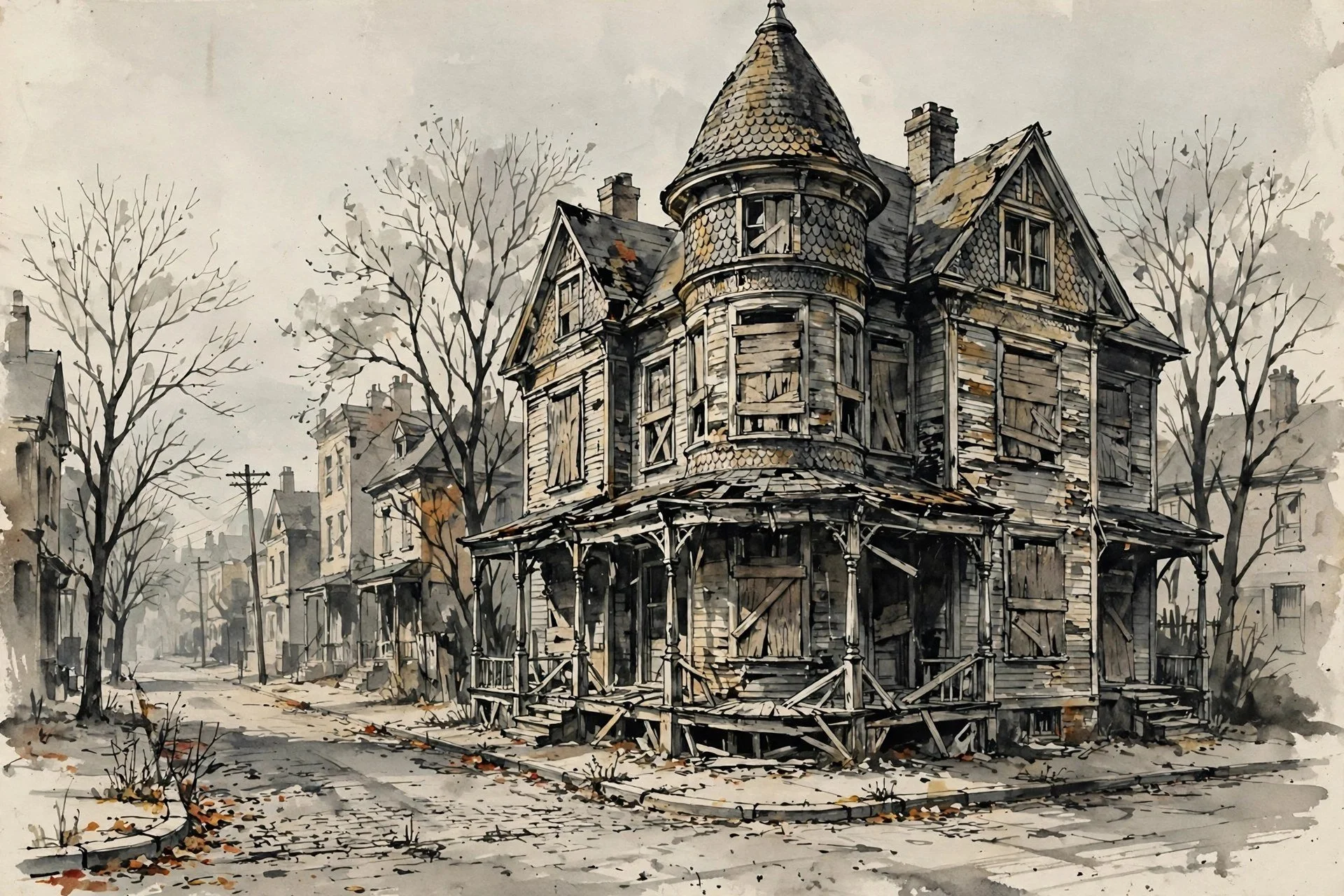
The Cannon House, standing empty.
By Callahan Blackwood | November 27, 2026
The windows of 204 Church Street are boarded. Where the boards have failed, the glass is broken. Inside, according to a video recorded by local observer Ben Nandy on November 26, 2026, piles of trash and debris fill the rooms. Fire damage marks the walls. Graffiti covers what remains. People reportedly use the building to stay warm.
This is 204 Church Street, also called Cannon House. It sits on the corner of Church and Academy in Poughkeepsie, New York. It is a locally designated landmark. It sits within a nationally listed historic district. The city sold it in 2021 for $1,000 on the written promise that a developer would rehabilitate it. Five years later, the record shows that nothing of the kind happened.
The Times Union reported on November 26, 2026, under the headline "Poughkeepsie saved this historic home from demolition. Now it's falling apart," that "a decade of failed redevelopment plans has left a historic Poughkeepsie home deteriorating, fueling concerns about preservation across the city." This desk did not access the full text of that article.
The record raises a question. It is not whether the building is in disrepair; that much is documented. The question is how a building with a name on the National Register, a name on the city's Local Landmark List, and a sale made on a stated plan of rehabilitation reached this condition. Each layer of protection had a defined role. The record shows what each one did with it.
The Architect and His Corner
Arnout Cannon Jr. built the house in 1887. He was 48 years old and Poughkeepsie's most prominent practicing architect. Between 1885 and 1887 he developed much of the 200 block of Church Street as a Queen Anne row. He placed his own residence and office at the most prominent corner location.
The building was designed to be noticed. Scalloped shingles and decorative paneling cover the exterior. Projecting bays and dormers break the roofline. A turret rises at the corner, capped by an ornate iron finial. Spindlework details line the porch. A Statement of Significance prepared by former preservation commission member Holly Wahlberg in September 2014 documents the architecture in detail.
Cannon's other Poughkeepsie work is spread across the city. He redesigned Wilderstein in Rhinecliff from Italianate to Queen Anne. He designed the Masonic Temple on what is now Cannon Street, today operating as Revel 32. He designed Wallace's department store, a Queen Anne row on Garden Street, and the Brinckerhoff House on South Hamilton Street. The street bearing his name recognizes that contribution. During the Civil War he served as Lieutenant Colonel of the 97th United States Colored Infantry.
By the mid-1890s, Cannon had developed eye trouble and retired from practice. He died on March 31, 1898. The Hudson Valley Observer published an account of his biography and career in May 2022.
The office portion of the building was removed before 1980. What survives is the family home, on a parcel of 0.05 acres, according to PropertyShark parcel records.
Nine Buildings, Three Layers of Protection
Cannon House sits within a row of nine residential buildings on the south side of Church Street between Academy and Hamilton, built between 1855 and 1895. The National Park Service describes the group as "the city's largest collection of brick houses in one place." The collection was listed as the Church Street Row historic district on the National Register of Historic Places in the early 1980s. Its National Register identification number is NRIS 82001126.
National Register listing is largely honorary for a privately owned building. It does not bind an owner to maintain the property. It does not prevent demolition. It triggers federal review under Section 106 of the National Historic Preservation Act only when a federal agency is involved. The listing places Cannon House in a category of significance. It does not place it in a system of enforcement.
The city's Historic Preservation Ordinance creates a second layer. Locally designated landmarks in every ward are protected under that ordinance. A volunteer body called the Historic Districts and Landmarks Preservation Commission oversees them. Changes to locally designated landmarks require commission review and approval before work can proceed.
In September 2014, Wahlberg, then a commission member, prepared a formal nomination for 204 Church Street. The City of Poughkeepsie Local Landmark List, published as of July 23, 2020, carries the entry: "204 Church St.: Cannon House." That designation remains in place.
A third layer exists at the state level. The State Historic Preservation Office, known as SHPO, reviews projects involving state or federal funding, licenses, or permits. When the developer submitted rehabilitation proposals following the 2021 sale, those proposals went to SHPO for review, according to the Hudson Valley Observer's May 2022 account.
Three layers existed simultaneously. The National Register established the building's significance in the early 1980s. The local ordinance required commission approval for any changes from that point forward. SHPO reviewed the rehabilitation plans directly. Each layer had a defined function. None of them, the record shows, produced a rehabilitated building.
What Each Layer Was Supposed to Do
The National Register was never designed as an enforcement tool. Its function is recognition, not compulsion. A listing does not bind a private owner, and absent federal involvement, it generates no mandatory review of maintenance decisions. For 204 Church Street, it established that the building mattered. It did not establish what would happen if maintenance stopped.
The local landmark ordinance carries more teeth, at least in principle. The Historic Preservation Ordinance governs changes to designated properties. What it requires of an owner who allows a landmark to deteriorate rather than altering it, what enforcement authority the volunteer commission holds in that circumstance, and whether that authority was exercised between 2021 and 2026 are questions this record does not answer. The local landmark designation for Cannon House stands. The building's condition does not reflect it.
SHPO reviewed and presumably accepted the rehabilitation proposals. Its role in the process, as reported by the Observer, was to evaluate those plans. What SHPO's review required after the developer failed to act, and whether any state process was triggered by the building's subsequent deterioration, is not established by the available record.
The Deed Chain and the $1,000 Promise
Before 2021, the property changed hands several times. PropertyShark parcel records show a transfer on January 7, 2014, for $12,269. A second transfer followed on September 13, 2017, for $3,000. A third was recorded December 31, 2019. Party names in the PropertyShark records are redacted, so no buyer or seller can be identified by name from that source alone.
By May 2022, the Hudson Valley Observer reported the building "appears abandoned with pieces missing" after "years of neglect." That deterioration was documented and visible well before the rehabilitation promise produced any work product.
On July 23, 2021, the City of Poughkeepsie sold 204 Church Street for $1,000. The quit claim deed was recorded July 28, 2021. The buyer was Baxter Building Corporation, LLC. The purpose was explicit: the company would "rehabilitate the landmark and return it to productive commercial use as well as an appropriate historic appearance," according to the Observer's May 2022 account. Preservation proposals had been approved by the local historic commission. They were being submitted to SHPO at the time of that report.
This arrangement follows a familiar pattern in municipal preservation. A city sells a distressed landmark at a nominal price. The buyer commits to rehabilitation. The local commission and state office review the plans. The idea is that a developer brings capital and expertise, the city retains oversight through its landmark ordinance, and the building survives. The leverage a $1,000 sale gives a city over a buyer who fails to perform is a different question. What recourse the city retained, and whether it pursued any before December 2024, is not established by the verified record.
What the Assessment History Shows
The property tax record offers a measure of the gap between promise and performance. PropertyShark's assessment history shows the building at $30,000 in 2020 and 2021, rising to $30,600 for 2022 and 2023, then to $33,700 in 2024, and $35,000 for tax year 2025. The annual property tax for 2025 stands at $884.
PropertyShark records no recently recorded permits for the property.
The assessment climbed $5,000 over five years. Routine adjustments, not construction activity. A locally designated landmark on a prominent corner, nationally recognized, assessed at $35,000 in 2025 after a sale promising rehabilitation in 2021. The numbers do not suggest a building under renovation.
The Reversion
A deed dated December 11, 2024, recorded December 12, 2024, appears in PropertyShark records. Party names are again redacted.
According to Ben Nandy, in his video account posted to Instagram and Facebook on November 26, 2026, the property reverted to city ownership after the developer failed to act. That account is consistent with the December 2024 deed recording, but party identities are not established by the deed record alone, and the account has not been confirmed by any official city statement in the verified record available to this desk.
A second speaker in the Nandy video discusses what are described as failed attempts to sell the property to developers since 2021. That speaker expresses concern the building may be demolished. These are on-camera opinions, not official findings or confirmed reports.
The Times Union's November 26 Threads post stated that the building "has been allowed to deteriorate after ten years of unsuccessful redevelopment efforts" and was "previously rescued from demolition but is now falling into disrepair," raising "broader worries within the city about historic preservation." That framing aligns with what the deed chain and the Nandy account together show, but this desk did not access the full Times Union article and cannot attribute any further detail to it.
What the Record Shows in November 2026
Nandy states in his video that the building has been vacant approximately twelve years. The video documents boarded windows, broken glass, graffiti, fire damage, and accumulated debris inside. Nandy describes the condition as "demolition by neglect" and calls it "an embarrassment to the city." He notes that the building survived Poughkeepsie's urban renewal period.
That last detail carries weight. Poughkeepsie's urban renewal years cleared large portions of the city. 204 Church Street survived them. It survived them and then, under active landmark protection and after a sale made on a stated plan of rehabilitation, reached the condition the Nandy video documents.
No verified city plan, request for proposals, council action, or demolition application appears in the public record available to this desk. No verified rehabilitation cost, demolition cost, or city maintenance expenditure beyond the $1,000 sale price has been established. This desk cannot report what the city intends to do next, because no such intention is documented in the verified record.
Questions the Record Leaves Open
Who is responsible for securing a locally designated landmark when the owner fails to act? What does the city's Historic Preservation Ordinance require of an owner who allows a landmark to deteriorate rather than proposing alterations? What authority does the volunteer Historic Districts and Landmarks Preservation Commission hold to compel maintenance or repairs? Has that authority been exercised here, and if not, why? Those questions sit in the gap between the protections the record shows on paper and the condition the record shows on the ground.
The assessment history does not suggest the city treated the property as a rehabilitation project. The deed chain shows nominal-price transfers across a decade. The local landmark designation shows no visible enforcement result. The SHPO review produced plans that were never executed. Each layer operated within its defined scope. None of them closed the gap between a commitment to rehabilitate and a building that, by November 2026, local observers describe as a ruin.
The house Arnout Cannon Jr. designed for himself in 1887 still stands at 204 Church Street. It is 139 years old. It has a name on the local landmark list and a number in the National Register. It has a deed history stretching back decades and a 2021 sale made on a promise of rehabilitation in that history. By every account in the verified record, it does not have a next step that anyone has yet put in writing.
Sources
- Times Union headline, deck and Threads post, Nov 26, 2026 (full text not opened in this run)
- Shared History: Arnout Cannon's 204 Church Street - Hudson Valley Observer, May 27, 2022
- Statement of Significance: 204 Church Street, Holly Wahlberg, Sept 26, 2014
- Locally Designated Landmarks - City of Poughkeepsie
- Parcel record, 204 Church St, Poughkeepsie - PropertyShark
- Church Street Row, NRIS 82001126 - National Park Service
- Ben Nandy video account, Nov 26, 2026 - Instagram