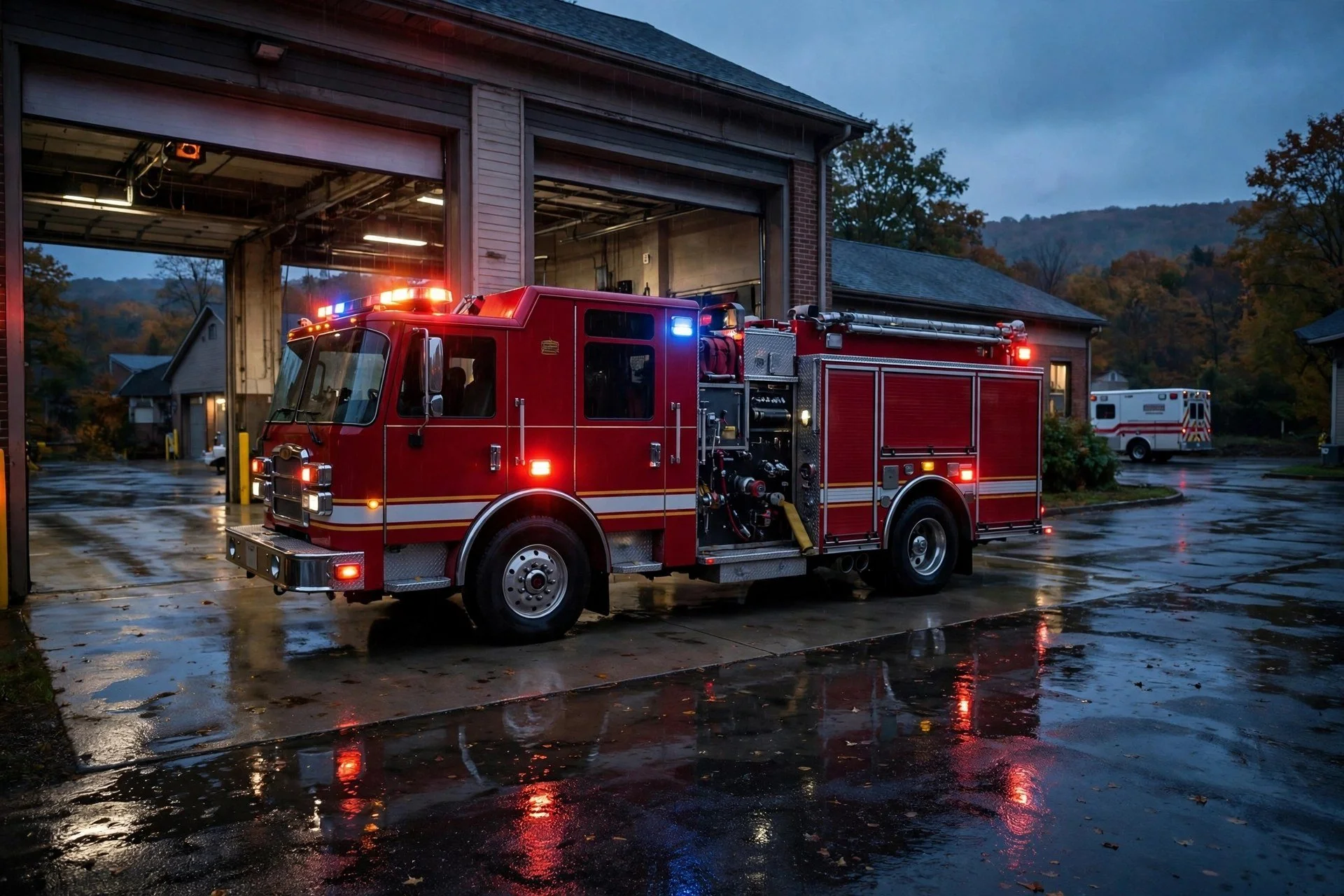
A fire engine at the station.
By June Mercer | November 10, 2026
When an ambulance could not reach a patient in time, Poughkeepsie firefighters did not wait for backup. They reached for a medication they had just been trained to use, administered it, and helped reverse the effects of the patient's respiratory distress.
Engine 1 firefighters with the City of Poughkeepsie Fire Department responded to a medical emergency in the city last week. An advanced life support unit and a transporting ambulance were both delayed and could not get to the scene quickly. The Engine 1 crew administered epinephrine. The medication helped reverse the patient's respiratory distress, according to a report from Local 596, the City of Poughkeepsie Fire Department's firefighters' local, posted on Hudson Valley Country.
The post did not specify a date, address, or the reasons the ALS unit and ambulance were delayed.
When the Backup Could Not Get There
Emergency medical response in a city depends on multiple layers arriving in sequence. Engine companies reach scenes quickly. Advanced life support units carry paramedics trained for complex medical situations. Transporting ambulances move patients to hospitals. When all three are available and working in order, the system functions as designed.
Last week in Poughkeepsie, the system did not work that way. The ALS unit and the transporting ambulance could not get to the scene fast enough. A patient was in respiratory distress, a condition in which the body cannot draw adequate oxygen and can deteriorate rapidly without intervention. Engine 1 was on scene. Its firefighters had recently received training in administering epinephrine. When the specialized units could not get there, the Engine 1 crew acted on that training.
Epinephrine is an emergency medication used to treat severe respiratory distress and anaphylaxis. It works by opening constricted airways and countering the physiological cascade that can block normal breathing. Administering it quickly can slow a patient's decline and buy time until advanced care arrives. According to Local 596, the drug helped reverse the effects of the respiratory distress the patient was experiencing at the scene.
Three Medications, an Expanding Role
The epinephrine call was the product of deliberate preparation. The City of Poughkeepsie Fire Department now trains its firefighters in three different medications or treatments, Local 596 reported. The department's stated purpose is to better serve the residents and visitors of the city.
Local 596 did not name the other two medications or treatments covered in the training program. The post made clear that the firefighters on Engine 1 had completed the epinephrine training recently, in advance of last week's call. The incident put that preparation to an immediate test.
The department's decision to build competency in multiple pharmaceutical interventions positions its crews to cover gaps that emerge when ALS and EMS resources are unavailable or delayed. Last week was a live illustration of that gap, and of a department that had already prepared for it.
The Patient's Condition Is Not Known
The patient's current condition is not known. Local 596's report did not include an update on the patient's status after the emergency. No further information is available from the source reporting.