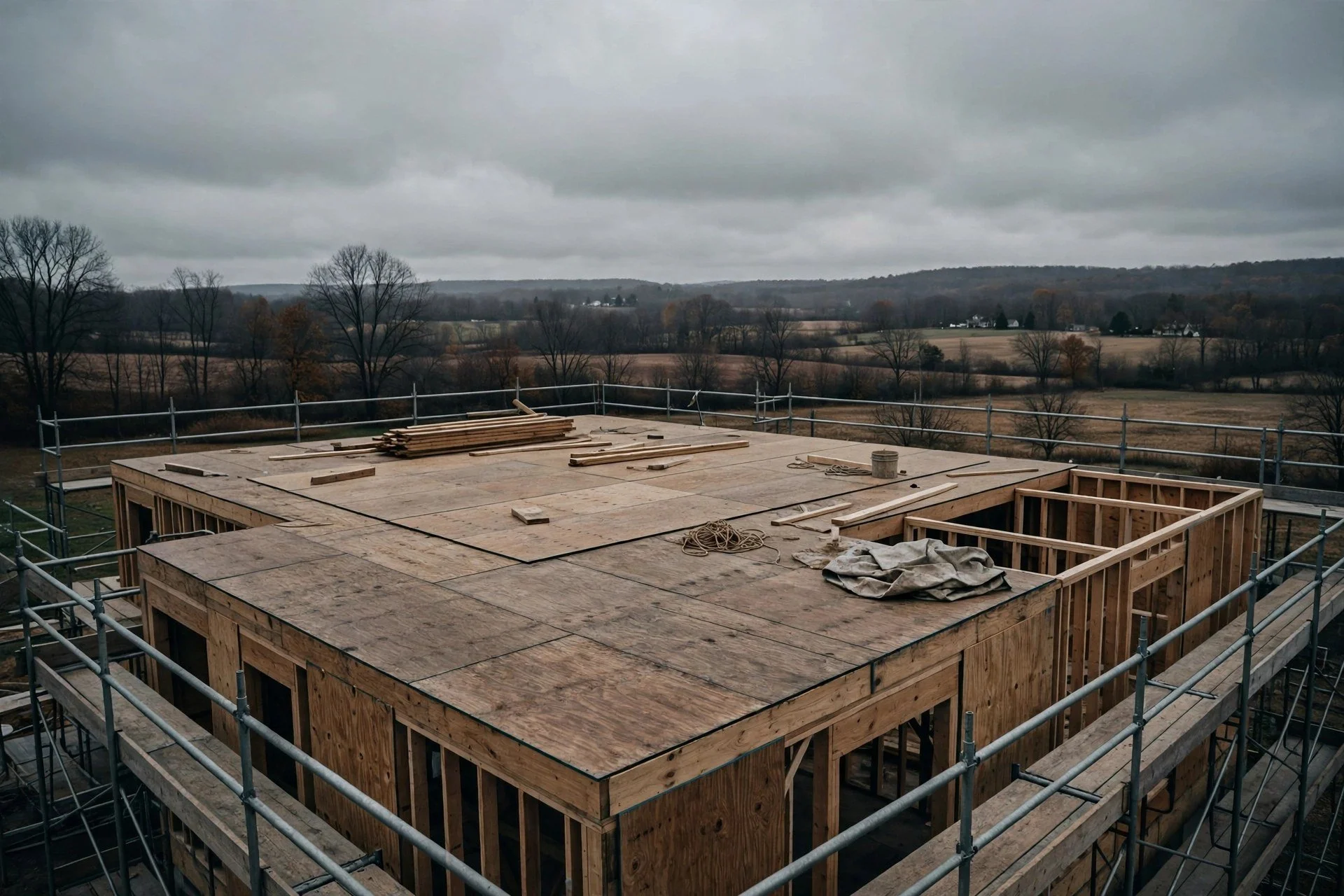
The roof, as the work left it.
By Callahan Blackwood | November 24, 2026
Two Falls, Minutes Apart
On Thursday, November 19, 2026, two construction workers fell from the same roof at a job site in Rhinebeck, New York. The falls did not happen at the same moment. They happened minutes apart, one man falling, then another from the same surface. Kilmar Quintanilla Sanchez, 20 years old, from Newburgh, died. A second worker, 21 years old, whose name has not been released, was transported in critical condition. As of this writing, he remains so.
No employer has been named, no cause has been released, and no one with authority over that worksite has stood in front of a camera and accounted for what happened.
New York State Police Confirmed
New York State Police investigated the incident and published a news release. That release confirmed the death of Kilmar Quintanilla Sanchez and identified him by name, age, and place of residence. It confirmed the second worker's injuries and his age. It placed the incident at a construction site in Rhinebeck, Dutchess County, on the date in question.
The release did not contain a substantial list. The employer of the workers on the site that day was not named. No contractor, general or sub, was identified in any official communication. The cause of the first fall was not stated. The cause of the second fall was not stated. The sequence of events that led from an active construction workday to two men down from a rooftop was not reconstructed in any official document reviewed for this article.
The lohud.com coverage of the incident drew from the state police release and confirmed the same core facts. Hard Hat Report likewise covered the incident and noted the absence of employer identification in the official record. The gap there is not a minor omission. The employer is the entity that holds legal responsibility for worker safety under federal law. That entity remains unidentified.
As of this writing, police have not said whether OSHA has opened an inspection into the deaths and injuries at the Rhinebeck site.
The Project: Locust Hill
The job site where the falls occurred sits within the Locust Hill development in Rhinebeck. Kearney Realty is the developer of the project. That distinction requires care. Kearney Realty's role is that of developer, not employer. The employer of Kilmar Quintanilla Sanchez and the 21-year-old worker who fell minutes after him has not been identified in any verified source reviewed for this article. Those are separate legal and practical categories, and conflating them in a situation where accountability is already thin adds confusion rather than clarity.
Locust Hill is planned at 80 units. The project has been described in coverage as an affordable housing development. That framing carries particular weight in the Hudson Valley, where rising housing costs have pressed working-class households outward from established employment centers and transit corridors. The workers building affordable housing in Dutchess County are frequently themselves members of the population such housing is meant to serve: hourly wage earners, often working for contractors and subcontractors at the bottom of a layered hiring structure where supervision can grow thin and safety compliance can become someone else's problem.
Kilmar Quintanilla Sanchez was 20. He was from Newburgh. He went to work at a construction site in Rhinebeck on a Thursday morning. Neither official communications nor coverage of this incident establishes how long he had worked at the Locust Hill site, what his specific role was that day, or which employer or subcontractor held his wages. Those facts remain unknown.
The stage of the Locust Hill project at the time of the incident, specifically which portions of the development were under roof construction on November 19, was not established in official records reviewed for this article. The specific area of the roof from which the falls occurred has likewise not been identified in any official communication.
The Sequence
The sequence reported across multiple outlets, including The Daily Catch and Hard Hat Report, describes two falls from the same roof within a matter of minutes. The first fall sent one man off the structure. The second fall followed before the situation was resolved. Two falls from the same roof, minutes between them.
That sequence is not incidental. It raises a question the official record has not answered: what were the conditions on that roof between the two falls? If the first man fell because a physical condition on the roof had not been corrected, the second fall may share that cause. If the second worker went to assist the first man after his fall and was himself then exposed to the same hazard, that is a distinct fact pattern with distinct legal and regulatory implications. If the two falls had unrelated causes, that also matters. None of these possibilities have been ruled in or out by any official communication reviewed for this article.
Emergency medical services responded to the scene. At least one ambulance transported workers from the site. Kilmar Quintanilla Sanchez, 20, did not survive. The 21-year-old worker was taken to a hospital in critical condition.
An Account from Emergency Responders
The Daily Catch reported an account from an emergency medical technician who responded to the scene at Locust Hill on November 19, speaking on condition of anonymity. That account addressed the question of fall protection equipment, specifically the status of protective gear in relation to the workers involved in the falls.
This publication relies on that reporting as attributed: a single-source anonymous account from an EMT who was present at the scene. Because neither official records nor named sources have confirmed the specifics of fall protection equipment status at the time of the falls, the content of that account should be read within those limits. The Daily Catch has reported it; readers should consult that source directly for its full detail.
That account establishes, within its limits as a single-source anonymous report, that the question of fall protection status was visible and notable to emergency personnel on scene within minutes of the incident. The significance of that observation turns on what federal law requires.
Federal Law and the 6-Foot Rule
Federal regulations governing construction safety are specific. Under 29 CFR 1926.501(b)(1), employers engaged in construction work must provide fall protection for employees working at heights of six feet or more above a lower level. Six feet is the legal threshold, not a recommendation, not a guideline, not a standard that depends on the type of work or the conditions of the day.
OSHA recognizes three accepted methods of compliance for most fall protection scenarios: guardrail systems, safety net systems, and personal fall arrest systems. The employer must implement one of them. Each method has its own technical specification. None of them are optional in the presence of a six-foot or greater drop.
Guardrail systems must meet height and strength requirements. The top rail of a compliant guardrail must be positioned between 39 and 45 inches above the walking or working surface level. The system must be constructed to withstand a force of at least 200 pounds applied outward or downward at any point along the top rail. These specifications define a physical barrier between a worker and the edge of the structure. A guardrail that cannot withstand 200 pounds is not a compliant guardrail. It is a suggestion of infrastructure.
Personal fall arrest systems work differently. They do not prevent a worker from reaching the edge. They are designed to stop a fall after it begins. A compliant personal fall arrest system includes a full-body harness, a connecting lanyard or deceleration device, and an anchor point rated to withstand the forces of arrest. The system must be rigged so that a worker cannot free-fall more than six feet and cannot contact a lower level during the arrest sequence. The harness must be properly fitted and donned. The lanyard must be connected to a compliant anchor before the worker approaches the fall hazard. Equipment sitting unused on a roof provides no protection to anyone.
Safety nets represent the third accepted method. Net systems are deployed below the working surface and must be positioned no more than 30 feet below it. They must extend beyond the outermost projection of the work surface to catch a falling worker before contact with a lower level. Like guardrails and personal fall arrest systems, their protection exists only if they are present, properly installed, and maintained.
Roof work, particularly on structures under active construction, sits among the highest-risk categories in the construction industry. OSHA data consistently identify falls as the leading cause of construction fatalities nationally. The federal standard at 29 CFR 1926.501(b)(1) did not emerge from abstraction. It emerged from the documented pattern of workers dying on roofs and from surfaces just like the one at Locust Hill.
Whether the roof at Locust Hill met federal fall protection requirements on November 19, whether the workers on it were equipped with compliant systems, and whether those systems were in use at the time of the falls - none of that has been established by official sources.
What No One Has Said
Five days after two men fell from the same roof in Rhinebeck, the core accountability questions remain unanswered.
The employer has not been named. Police have not said whether OSHA has opened an inspection. No agency has confirmed whether a formal investigation into fall protection conditions at the Locust Hill site is underway.
The cause of the falls has not been released. The sequence, two falls from the same surface minutes apart, is documented across multiple outlets. What produced those falls, whether a structural failure, a missing or inadequate guardrail, workers without arrest systems, or some other condition entirely, has not been stated by any official source.
No contractor with responsibility for the site on November 19 has been publicly identified. An 80-unit development involves a developer, Kearney Realty, and presumably a chain of general and subcontracted labor below it. The specific contractor or contractors whose workers were on that roof remain unknown.
Kilmar Quintanilla Sanchez was 20 years old. He went to work. The man who fell from that same roof minutes later is 21, and his condition as of this writing is critical. Both men were on a construction roof that was at least six feet above a lower level. Federal law required that their employer protect them from falls. Whether that protection was in place, whether it met regulatory specifications, and whether anyone will be held responsible for what happened on a Thursday in November in Rhinebeck - none of it is established. The employer has not been named.
That is where the official record ends. That is where this account has to stop, until it does not.
Sources
- State Police investigate fatal construction site incident in Rhinebeck - New York State Police
- One construction worker dead, another critically injured in fall at Locust Hill site in Rhinebeck - The Daily Catch
- Rhinebeck NY construction accident roof fall - lohud
- Rhinebeck Locust Hill roof falls - Hard Hat Report
- Falls: Guardrail Systems - OSHA Construction eTool