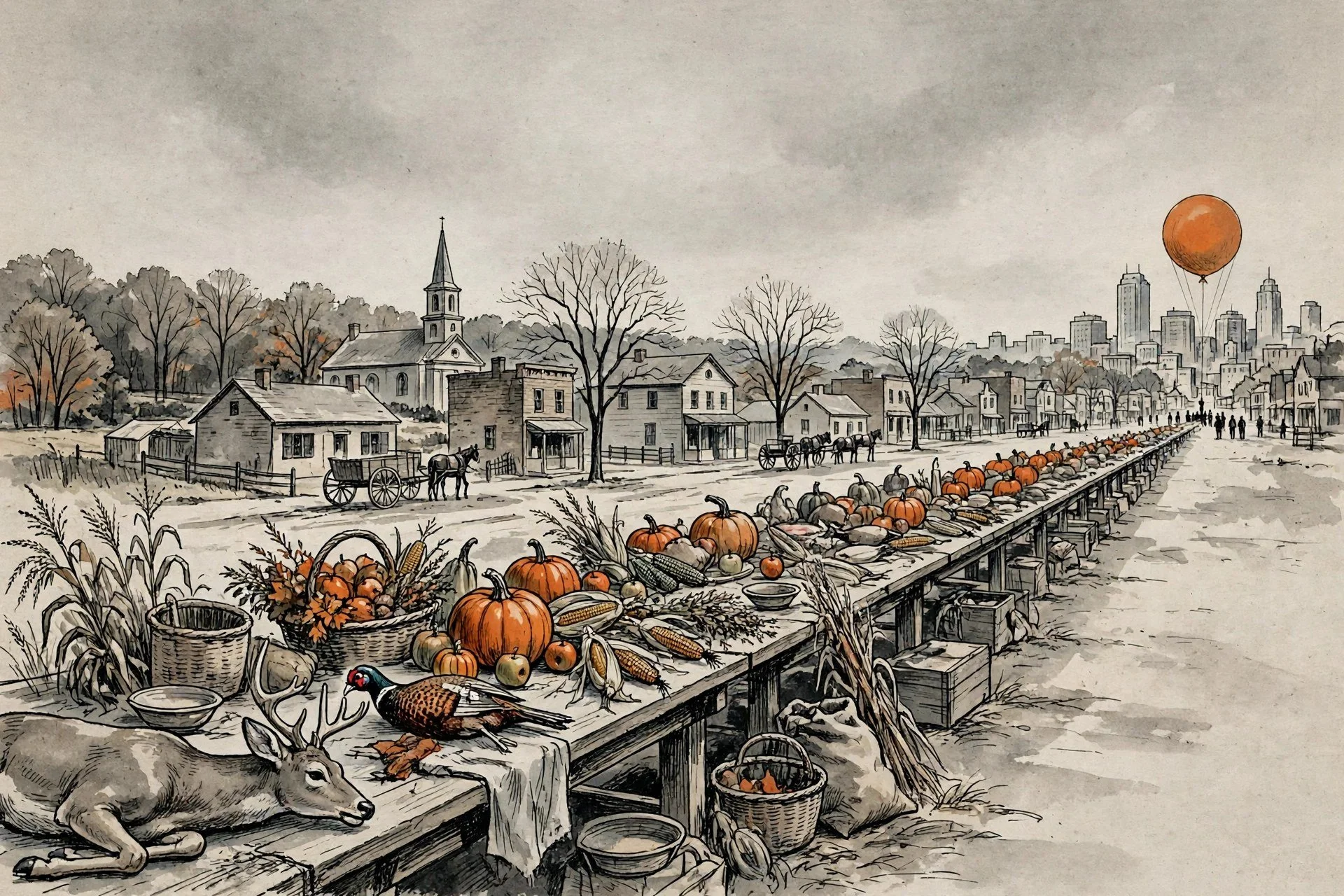
One table, four centuries.
By Ellis Ward | November 26, 2026
Plymouth gave America its most familiar Thanksgiving story. The Civil War gave it an annual national observance. A fight over Christmas shopping gave it the date we use today.
On Thanksgiving Day 2026, the Macy's parade didn't march. That didn't mean the parade was canceled. It meant it had been moved to Saturday, November 28. The distinction sent people back through a century of parade history looking for a precedent. But the more revealing precedent isn't in the parade's history at all. In 1939, the president moved Thanksgiving itself, and Americans couldn't agree which Thursday to celebrate. If the holiday's date could change that recently, what else about the supposedly timeless tradition was assembled after the fact?
Before Plymouth, people already gave thanks
Indigenous peoples had their own traditions of gratitude long before contact with Europeans. English settlers also knew the difference between a harvest celebration and a formal religious day of thanksgiving, which might be called in response to a particular event. At Plymouth in 1623, for instance, the colonists declared a day of thanksgiving after rain ended a drought. That was not the same occasion as the three-day harvest feast two years earlier.
There are earlier colonial candidates, too. At St. Augustine, Florida, Spanish settlers held a Mass of thanksgiving on September 8, 1565. At Berkeley Hundred, Virginia, investors instructed English settlers arriving in December 1619 to keep the anniversary as an annual day of thanksgiving to God. The Virginia Museum of History & Culture describes a service on arrival; the Jamestown-Yorktown Foundation cautions that no surviving evidence confirms the settlers actually carried out the directive. What's certain is that the instruction existed. Neither episode establishes a continuous line to the federal holiday.
The feast was real. The familiar story came later.
In the fall of 1621, Wampanoag people and English settlers gathered at Patuxet, where Plymouth Colony had been established. Months earlier, Ousamequin and the settlers had agreed to mutual protection. That matters: the Wampanoag were political actors making decisions in difficult circumstances, not extras in a story about English survival. Winslow's account records about ninety men with Ousamequin, three days of feasting, and five deer. It doesn't settle whether the Wampanoag were formally invited, whether turkey was served, or even the exact date.
Nor did three days of feasting guarantee peace. In 1637, during the Pequot War, colonial forces and Indigenous allies killed hundreds of Pequot people at Mystic. Religious thanksgivings marking events in that war were real, but the claim that the massacre created today's holiday confuses those observances with the later history of the national holiday. By 1675-76, land and sovereignty disputes had led to another war, this time between New England colonies and a coalition of Native peoples led by Ousamequin's son Metacom. Remembering the feast without what followed makes it look like an ending. It wasn't.
The story Americans now recognize took shape much later. In 1841, Alexander Young attached the earliest known "First Thanksgiving" label to Winslow's account. By the late nineteenth and early twentieth centuries, paintings, school lessons, and pageants helped turn a particular encounter into a national story about hospitality and cooperation. The misleading part wasn't that the two groups ate together. It was what the story encouraged people to forget: who the Wampanoag were, why they made an alliance, and what happened after the meal.
The national holiday began with war, prayer, and a magazine editor
The first national observances were not annual November holidays. After Saratoga, the Continental Congress recommended December 18, 1777, for solemn thanksgiving and praise. Under the new Constitution, George Washington designated November 26, 1789, for public thanksgiving and prayer. His proclamation thanked God for the end of the Revolutionary War and the opportunity to establish a new government. These were occasions for public gratitude tied to specific events, not commemorations of the Plymouth meal.
Meanwhile, a family-centered Thanksgiving was already taking shape in New England. Sarah Josepha Hale put roast turkey at the head of the table in her 1827 novel Northwood. As a magazine editor, she spent years pressing for states to observe Thanksgiving on the same day. On September 28, 1863, she wrote directly to Lincoln. On October 3, he called for a nationwide observance on the last Thursday in November. He asked Americans to remember those suffering in the Civil War and to pray for peace and union. He did not mention the Pilgrims, the Wampanoag, or the 1621 feast. Congress recognized Thanksgiving among the legal holidays in the District of Columbia in 1870; the nationwide November tradition had already taken hold through presidential proclamations.
The country kept adding to the holiday
- 1876 and 1934 - College football was already a Thanksgiving attraction in the nineteenth century. The Detroit Lions' 1934 game against the Chicago Bears helped establish the pro-football tradition familiar today.
- 1924 and 1927 - The first Macy's procession was billed as a Christmas parade, even though it took place on Thanksgiving Day. The balloons arrived three years later. The event Americans now see as inseparable from Thanksgiving began as a department store's kickoff to another holiday.
- 1939-1941 - Franklin Roosevelt moved the observance up a week in 1939 to lengthen the Christmas shopping season. Some states stuck with November 30; New York observed November 23, and Macy's marched that day. On December 26, 1941, Roosevelt signed the resolution fixing Thanksgiving on the fourth Thursday of November - not necessarily the last.
- 1970 - After anniversary organizers rejected Wamsutta Frank James's prepared speech, Indigenous people and supporters gathered in Plymouth for the first National Day of Mourning. The annual observance challenges the familiar telling of Thanksgiving by centering colonization and Indigenous survival.
- 1989 - George H. W. Bush formalized the presidential turkey pardon as an annual White House tradition. Even one of the holiday's most official-looking rituals is comparatively recent.
There's a straightforward answer to "When did Thanksgiving start?" once you say what you're dating. If you mean the recurring national observance, use 1863. If you mean the date on your calendar, use 1941. If you mean the gathering in the familiar picture, use 1621 - and leave room in that picture for the people whose story didn't end there.
Sources
- Congress Establishes Thanksgiving - National Archives
- Eye-Witness Account of the 1621 Harvest Celebration - Plimoth Patuxet Museums
- Transcript of President Abraham Lincoln's Thanksgiving Proclamation, 1863
- Macy's Thanksgiving Day Parade postponed to Saturday due to expected bad weather - Associated Press
- Sarah Josepha Hale - Plimoth Patuxet Museums
- In Congress, November 1, 1777 - Library of Congress
- Thanksgivings in America - Jamestown-Yorktown Foundation
- Timeline: The "First Thanksgiving" - National Museum of the American Indian
- How to Tell the Thanksgiving Story on Its 400th Anniversary - Smithsonian Magazine
- What did they eat at the 1621 harvest celebration? - Plimoth Patuxet Museums
- Memories of Thanksgiving Across the Centuries - Plimoth Patuxet Museums
- Thanksgiving Proclamation, 3 October 1789 - Founders Online
- George Washington's Thanksgiving Proclamation - Smithsonian Institution
- Sarah J. Hale to Abraham Lincoln, September 28, 1863 - Library of Congress
- Odd Rubber Folk Stage Gay Parade - The New York Times, Nov 24, 1939
- The Year of Two Thanksgivings - Franklin D. Roosevelt Presidential Library
- United American Indians of New England
- Thanksgiving - Plimoth Patuxet Museums homework help
- The "First Thanksgiving": How Can We Tell a Better Story? - National Museum of the American Indian
- The First Thanksgiving - Castillo de San Marcos National Monument, National Park Service
- The First Thanksgiving - Virginia Museum of History & Culture
- How Do Native Americans Spend Thanksgiving Day? - Smithsonian Magazine / National Museum of the American Indian
- Macy's Thanksgiving Parade - This Month in Business History, Library of Congress
- Why Thanksgiving Football Emerged as an American Tradition - Smithsonian Magazine
- The First Thanksgiving Day Football Game in Detroit - Detroit Historical Society
- History of White House Thanksgiving Traditions - White House Historical Association