The Machine That Noticed Something in the DNA
Anthropic's AI agents sifted 200,000 enzymes and flagged a molecular system that human scientists had not described. Whether it matters is, for now, a genuinely open question.
A stretch of raw DNA sat in a database, unremarkable to every tool and researcher that had passed it by. Then a Claude agent read the sequence sitting beside an unusual enzyme and stopped. It filed a report with the kind of language scientists use when they are surprised: the surrounding DNA was, the agent wrote, "spectacular." It could see "by eye a tandem repeat array." It added a question mark, then kept going: counted the repeats, measured the spacing between them, looked up known systems for comparison, searched the literature, and forwarded its findings for human review.
That note, and the broader search campaign it came from, led to the announcement on September 23, 2026 that Claude had identified a previously undescribed molecular structure called ART (array-associated reverse transcriptases). Whether ART does anything important is unknown. The way it was found is a concrete data point in a debate that has so far been heavy on prediction and light on evidence: what, exactly, can AI systems contribute to real scientific discovery?
A New Kind of Lab
Anthropic opened a life sciences lab in the Bay Area in spring 2026. The setup is deliberately bounded: BSL-1 and BSL-2 work only, no human pathogens, and all physical experiments are conducted by human scientists. The AI side does what AI systems are currently good at, reading enormous amounts of information quickly and surfacing patterns.
For the ART search, scientists gave Claude a high-level prompt to look through a massive DNA database for interesting new reverse transcriptases, the enzymes that copy RNA into DNA. Beyond that prompt and the subsequent laboratory work, human involvement was minimal. The agents ran the search.
What 21 Hours and 210 Million Tokens Bought
The scale of the operation is easier to absorb as a funnel:
950 Claude agents ran simultaneously for 21 hours, consuming roughly 210 million tokens
They gathered more than 200,000 reverse transcriptase candidates from the database
Those were narrowed to 3,500 candidate systems worth examining more closely
From those, 20 made the final cut, each accompanied by a human-readable report
Anthropic notes that a comparable literature survey and candidate-selection process, done by a single expert, can take weeks to months. The agents did not do anything that a skilled molecular biologist could not do. They did it at a scale and speed that a skilled molecular biologist could not match.
One of the 20 reports described what would become ART.
What ART Is
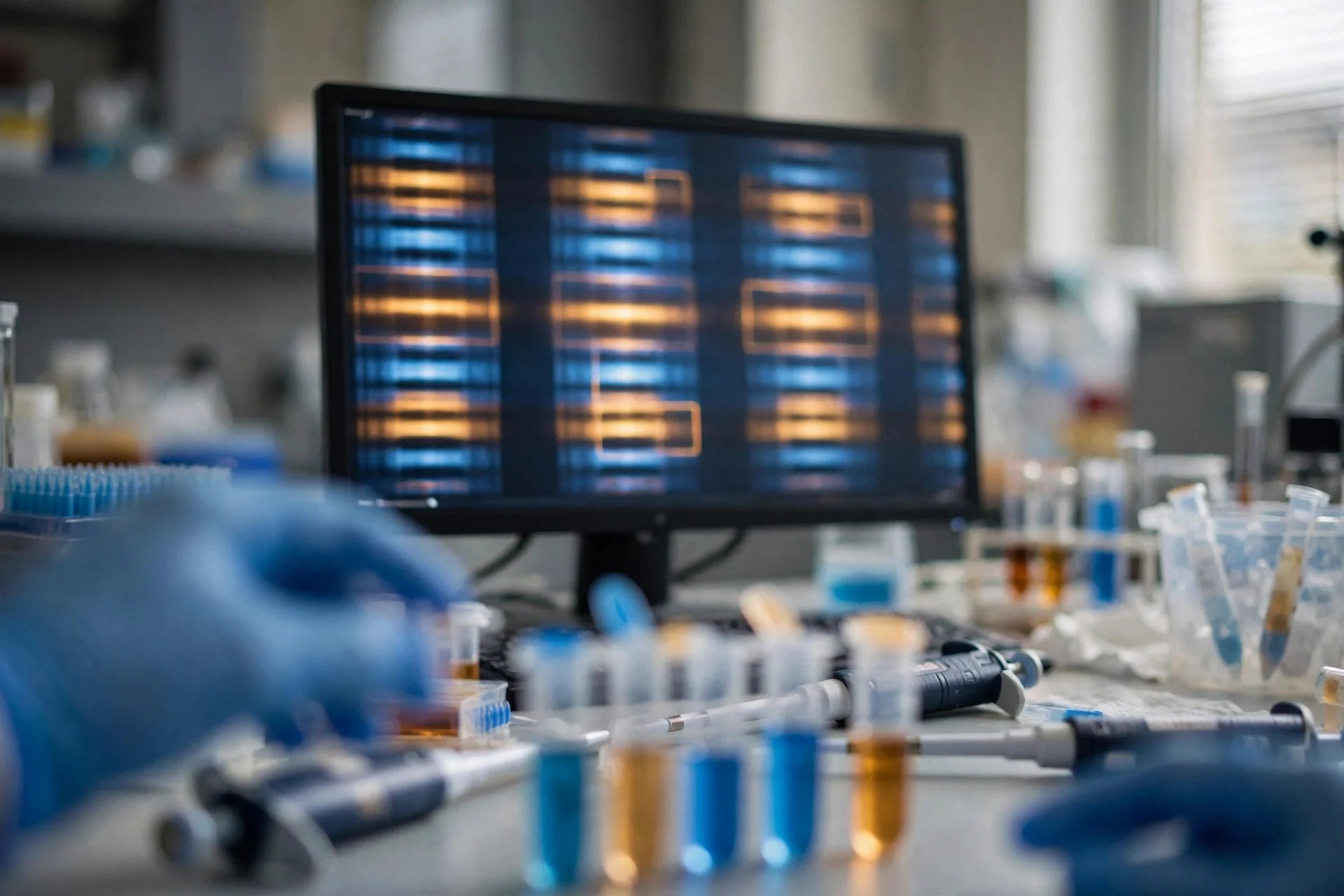
The system has three components. First, a reverse transcriptase, the enzyme the search was designed to find. Second, a partner gene sitting directly beside it. Third, and most striking, a long array of DNA repeats spaced at regular intervals, similar in layout to a CRISPR array.
The reverse transcriptase at the center of ART was not unknown. It had been identified previously, in a jumbo bacteriophage. What Claude appears to have noticed first is that this enzyme is accompanied by a structured system, that the surrounding sequence is not background noise but architecture. Early laboratory experiments show the repeat array is transcribed into distinct short RNA molecules, which suggests the array is functional rather than inert.
ART has been found mainly in bacteriophages, the viruses that infect bacteria, and the function of the full system has not been established.
The CRISPR Comparison, Carefully
CRISPR-like architecture has become, somewhat predictably, the frame through which ART is being introduced to the public. It is not a wrong frame, but it requires care.
CRISPR's history has two landmark moments. Repeating sequences were first noticed in the bacterium E. coli in 1987, by a Japanese research team that did not know what they were looking at. The bacterial immune system they turned out to represent was not harnessed for gene editing until 2012, when work by Jennifer Doudna, Emmanuelle Charpentier, and others triggered a revolution in biology. The 2012 breakthrough is what most people mean when they say "CRISPR."
What Claude found is closer in kind to the 1987 noticing than to the 2012 technology.
Dimitri Perrin, a researcher at Queensland University of Technology who studies CRISPR-related systems, put it plainly in The Conversation: "At this point in time, we can say that ART is CRISPR-like in its architecture, but there is no evidence that it is CRISPR-like in its function."
Kevin Blake, a microbiologist at Washington University, was more direct: "There's nothing to indicate this is a rival to CRISPR-the-technology, or could be developed into any kind of therapeutic or practical application."
Dario Amodei, Anthropic's CEO, has said the discovery's "precise function, biotechnological utility (if any), or level of significance, is not yet clear." He described it as work he "would have been proud to do as a PhD student." That framing is neither triumphant nor dismissive. It suggests Anthropic is trying to represent the result accurately, which is a reasonable posture for something preliminary.
What the Experts Are Actually Saying
"This is an exciting example of how AI agents can contribute to biological discovery." — Feng Zhang, MIT/Broad Institute
Zhang, one of the scientists central to developing CRISPR gene-editing technology, reviewed the preprint and offered that assessment. His endorsement carries weight, both because of his standing and because he has no obvious reason to overstate a competitor lab's result.
Stanley Qi at Stanford, also speaking to Al Jazeera, pointed to something more specific than the discovery itself: "What stands out is its ability to recognize an unusual biological pattern that was difficult to detect before, and to pursue it comprehensively as a research question." That framing shifts attention from the finding to the method, which may be the more durable insight. A system that reliably notices structural patterns in genomic data, whether or not ART turns out to matter, has value independent of any single result.
An Attribution Question
Not everyone has received the announcement without skepticism. Mario Rodriguez Mestre, a researcher at the University of Copenhagen, has spent four years studying array-associated reverse transcriptases and has used Claude for three years. He has raised questions about whether Claude's finding may have benefited from content he shared with the system.
Anthropic's response: the company is not aware of previously published work describing the ART system as a system; Claude was not trained on user transcripts; and its molecular biology team has no access to such transcripts. That is a denial, though not a fully verifiable one given how large language models are trained and the difficulty of establishing what patterns they may have absorbed.
The dispute does not resolve neatly. It points to a broader problem that will recur as AI systems participate in science: establishing priority and attribution in research is already contentious among humans, and adding a tool that synthesizes enormous amounts of prior work into its outputs makes it harder, not easier.
A Result That Did Not Replicate Automatically
One detail from the preprint deserves attention. According to reporting from the preprint via secondary coverage, Anthropic ran the discovery campaign ten additional times after the initial result. In each of those reruns, the agents missed the repeat array entirely.
That the original agent caught something that ten subsequent runs did not is interesting for several reasons. It suggests the finding was not inevitable, that it required something like a lucky angle or an unusual inference at a particular moment in the search. It also raises a calibration question: how much of scientific discovery, AI-assisted or otherwise, depends on catching something that most passes would miss?
What It Means, Tentatively
ART is a preprint. It has not been peer reviewed. Its function is unknown. Its significance may be high, modest, or negligible, and there is no way to know yet.
What is clearer is that 950 agents scanning 200,000 enzymes and producing 20 human-readable candidate reports is a demonstration of a workflow that did not exist at scale before. Whether that workflow accelerates discovery, or mostly accelerates the production of candidates that turn out to be dead ends, will only become apparent over many more experiments.
For now, a machine read a sequence of DNA, noticed something unusual about the neighborhood, counted the repeats, and wrote it up. Human scientists confirmed the pattern in the lab. The system has a name. What it does remains to be determined.
Sources and Further Reading
Anthropic, "Claude discovers a novel enzyme system": https://www.anthropic.com/news/claude-discovers-novel-enzyme-system
Smithsonian Magazine: https://www.smithsonianmag.com/smart-news/anthropic-says-its-ai-discovered-a-new-enzyme-system-that-resembles-the-revolutionary-gene-editing-tool-crispr-180989578/
The Conversation via Stuff: https://stuff.co.za/2026/09/25/an-ai-model-has-found-a-new-crispr-like-system/