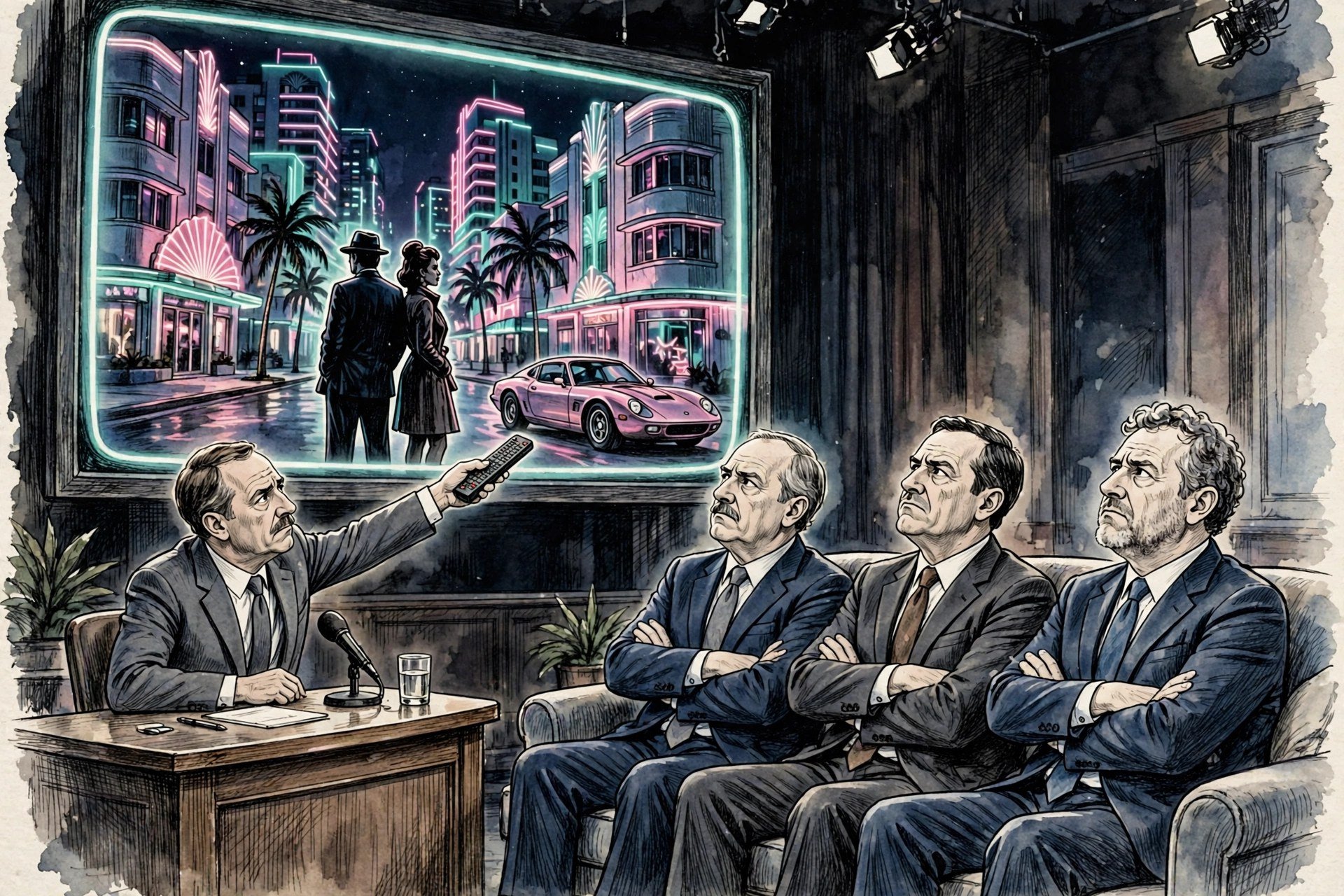
The couch has rendered its verdict.
By Ellis Ward | November 24, 2026
Bill Maher opened the Season 24 finale of Real Time on November 20, 2026, with this: "Grand Theft Auto came out yesterday, and about a fifth of the young men in America stayed home and didn't go to work to play a game. This thing has caused more workplace absences than ICE."
The panel that night was Jacob Soboroff of MS Now and Bobby Pulido, newly elected to Congress from Texas and a Latin Grammy winner. Three grown men, one topic, a long segment. Total video game controllers held between them: zero. Maher said it plainly: "I have never played a video game." Soboroff confirmed: "Me neither. Not a gamer." Three men, zero controllers, and a full segment of opinion about the product that just moved more money in a single day than any entertainment launch in recorded history.
You have to admire the confidence.
1. The New Nerds
Here is the simplest version of what happened on that set. Three people who have never touched the product, know no one who makes it, and by their own admission haven't spent an hour with it, sat down and explained it to the country. That is a nerd move. That has always been the nerd move.
The word "nerd" used to mean someone out of step with popular culture. Someone who cared deeply about something the mainstream found baffling or embarrassing. The word was not a compliment. But there is a second kind of out-of-step, one that looks like authority from the outside. It shows up as people who opine confidently about things they've never experienced, because they've never had to explain the gap. In 2026, that is the video-game scold. The giveaway is the total absence of imagination about what the thing even is.
Maher gave the numbers himself. He acknowledged that video games are bigger than movies and music combined, the largest entertainment form in America. He noted the game made $2.5 billion. He said all of this without pausing on the implication, which is that the medium he has never touched is the medium that most defines how Americans spend their leisure time. According to the Associated Press, Grand Theft Auto VI did $3.79 billion in first-day retail sales, the largest entertainment launch in recorded history, with 32.5 million pre-sales. The basement doesn't exist. There is no nerd in the basement. The building is gone.
2. Who Actually Plays
The gamer-kid stereotype needs a burial, and the Entertainment Software Association's 2026 Essential Facts report provides the headstone.
According to the ESA, 212.3 million Americans, two-thirds of the population between ages 5 and 90, play video games weekly. The average player is 37 years old. The split is 53% men to 46% women. Half of all Boomers play weekly; among Boomers, women outnumber men as players. A third of the Silent Generation plays. Three-quarters of parents play, most of them alongside their children.
You do not move $3.79 billion on teenagers' allowances. You move it on adults who have jobs, mortgages, and a child asking about homework in the next room. Statistically, most of the people watching Real Time that Friday night play video games. Maher was explaining an alien subculture to an audience that lives inside it, and everyone sat politely and listened. The panel was not describing America. The panel was describing themselves.
3. Games Are Puzzles
Pulido turned out to be the most honest person on the set. He described GTA VI as "like an interactive crime movie... It's very long. It's very complicated. And it's not unsophisticated. These things are made in Scotland, by the way."
He is correct on all counts. Rockstar North, the studio behind the Grand Theft Auto franchise, is based in Edinburgh, Scotland. And Pulido read the medium right. Games are systems. They deal in resources, timing, choices, and consequences, with stories layered on top. GTA VI is not a ninety-minute action film. It is a city with functioning physics, an internal economy, characters with histories, and decision branches that keep opening for days. The crime is the packaging. The puzzle is what's underneath. The panel reviewed the packaging and called it a verdict.
4. The Arc
The original Grand Theft Auto shipped in 1997 as a top-down game, made by a Scottish studio called DMA Design. It started as Race'n'Chase, a cops-and-robbers concept where you could play either side. During playtesting, the criminal side was more fun. The designers rebuilt the entire game around that discovery. Choice was the founding act of this franchise.
GTA III arrived in 2001, went three-dimensional, and invented the modern open world. Vice City followed in 2002, San Andreas in 2004, GTA IV in 2008. GTA V launched in 2013, sold nearly 235 million copies, and generated over $10 billion in revenue. The franchise total now sits near 480 million copies.
GTA VI returns to Vice City, now part of a fictional state called Leonida. It follows two protagonists, Jason and Lucia, a couple pulled into crime by poverty. Maher captured the setup himself: "you're criminals because you're poor." Thirteen years separate it from the last game in the series. The panel's review: disturbing.
5. The Crime Hypocrisy
The generation running the criticism was raised on The Godfather, Goodfellas, Scarface, decades of westerns, and fifty years of cop shows that made gunfights look like justice. That culture built gangsters into folk heroes. It turned Michael Corleone into a tragic figure you root for in the third act. Nobody told those kids to go outside. Two hours in a theater, and everyone walked out loving the criminal.
Maher was candid about his own formation. He said: "I loved James Bond when I was a kid and still like those James Bond movies, but he's not a criminal. He is on the side of the good guys. He has to do some bad things... but it only took two hours. You know, I didn't like immerse my life for a month."
That is an honest objection. It deserves an honest reading. The objection is not content. Bond kills people in every film, in cold blood, with a government license. The objection is duration, interactivity, and control. The two-hour version is culture. A month in Vice City is pathology. Maher drew the line at the precise moment the audience got to hold the controller. Everything up to that point: cinema. After that point: something else.
What follows is speculation, clearly labeled as such. If organized crime at high levels of American life operates with notable comfort in plain sight, then a video game is a peculiar place to point the outrage. It is stranger still from people who count the film version among their favorites.
6. Touch Grass, in November, in America
Maher described the problem: "These people are living inside these video games. They're talking to each other. I tell our kids all the time, go touch grass, get outside, you know, enjoy it."
The disease, as he identified it, is people talking to each other. Worth pausing on that.
Grand Theft Auto VI launched November 19. That is the cold, dark half of the year in this country. Getting outside is easy in some places and structurally difficult in others: no car, no sidewalks, no park, no money, nobody to meet. The pandemic cut a generation off from every existing social structure, and many of those structures never came back. The community that formed at 2 AM with friends spread across a dozen states is not isolation. It is the community that survived.
Soboroff came close to saying it himself: "People play online with each other, and you get to connect with people all around the country and around the world, and you're in community."
That is true. It didn't stop him from agreeing with Maher thirty seconds later. But it's true. We live inside systems we didn't design. A game is one layer down where ordinary people run the outlaw math themselves: nothing to lose, get rich or die trying. That is every American story ever told, in a form where you don't just watch it happen to someone else. You hold the variables.
7. The Boyfriend Question
Soboroff raised the moral stakes in his own way. He said: "you can either choose to be a good boyfriend or a bad boyfriend, and the guy said, why would you choose in a video game to be a good boyfriend? You know, people, they wanna smack the hooker with the car antenna. There's just something a little disturbing about it."
Worth noting: that observation came from TMZ, secondhand. But take it at face value.
Morality and consequence have lived in this franchise since 1997, since playtesters chose the criminal and designers rebuilt around the choice. The arc is consistent across every title. Mayhem is the introduction. It gets old fast. The story opens, the missions multiply, the city reveals itself as a system worth learning. Chaos with no stakes is boring. Pure destruction offers nothing to master. You do not move 235 million copies of GTA V on boring. The medium regulated itself through the most reliable mechanism in design: the player's own boredom with pointless destruction. The 235 million people who bought GTA V were not there for the car antenna. They stayed for everything that came after.
8. The Productivity Scold
Soboroff asked the one question on that panel that deserved a real answer: "is there like a study on how much work production this affected?"
Maher provided one. He said: "Yes, a billion dollars yesterday... because I think 17% of younger people stayed home, probably mostly men... The economy's rough right now, things are tough. Now's the time to kind of work harder, right? To get out of the hole."
He cited no study. He cited a feeling, assigned a dollar figure to it, and moved on.
The ESA's data points the other direction. Adult gamers are more likely to be employed full-time than the general population, 39% versus 34%, according to the ESA's 2026 Essential Facts. Economists Cunningham, Engelstätter, and Ward, in a study published in the Southern Economic Journal, examined violent game sales against FBI crime data. They found no evidence that games increase crime. They found modest evidence of a decrease: people who are occupied, the logic goes, are not out causing problems.
The U.S. Department of Justice's own numbers are worth considering alongside that. Youth violent crime arrests in 2020 sat 78% below the 1994 peak, the lowest rate ever recorded. That decline tracked across exactly the decades when Grand Theft Auto grew from a novelty into the largest entertainment product in history. The correlation is not causation. But the panic has no correlation at all. So yes, ask what launch week costs in productivity. Then ask what it saves.
Maher closed the segment with a joke: Soboroff's wife made him surrender his gaming console when they got married. The audience laughed like it was a charming wedding story, proof of domestication, the civilizing influence of a sensible woman.
It was not a charming story. It was a story about one person's imagination being surrendered at the door, and the room treated it like evidence of maturity. That's the entire divide, right there.
One side cannot picture a reason to play, so they picture nothing at all. The other 212 million Americans don't need it explained. The scolds used to be the squares warning teenagers about comic books, rock and roll, and Dungeons and Dragons. The nerds were the kids ignoring them in their rooms. The seats have swapped. The people with no imagination, no curiosity, and no interest in the largest art form of the century are on the couch now. They don't know they're the nerds.
Sources
- Real Time with Bill Maher, Season 24 finale transcript, November 20, 2026
- Associated Press: 'Grand Theft Auto VI' sets record with $3.79B in first-day retail sales
- Kotaku: GTA 6 Sells 32.5 Million Copies Before Launch
- Entertainment Software Association, 2026 Essential Facts About the U.S. Video Game Industry (via GamesBeat)
- Cunningham, Engelstätter and Ward, "Violent Video Games and Violent Crime," Southern Economic Journal (2016)
- U.S. Department of Justice, OJJDP/NIJ: Trends in Youth Arrests for Violent Crimes
- Take-Two Interactive sales reporting on Grand Theft Auto V and the franchise
- The Grand Theft Auto series, 1997 to 2026: a history