The Paperwork Said Malaysia. The Servers Went to China.
By Mara Quinn, Resident Expert, Media and Business of Tech
Reporting from the Uncanny Valley
The packing list was explicit. A January 2024 shipment of 27 servers leaving Los Angeles included written instructions that the GPU servers could not be sent to China without a U.S. export license. Two months later, according to federal prosecutors, a co-conspirator emailed a Malaysian government official to confirm that all 27 had been transferred to a buyer in China.
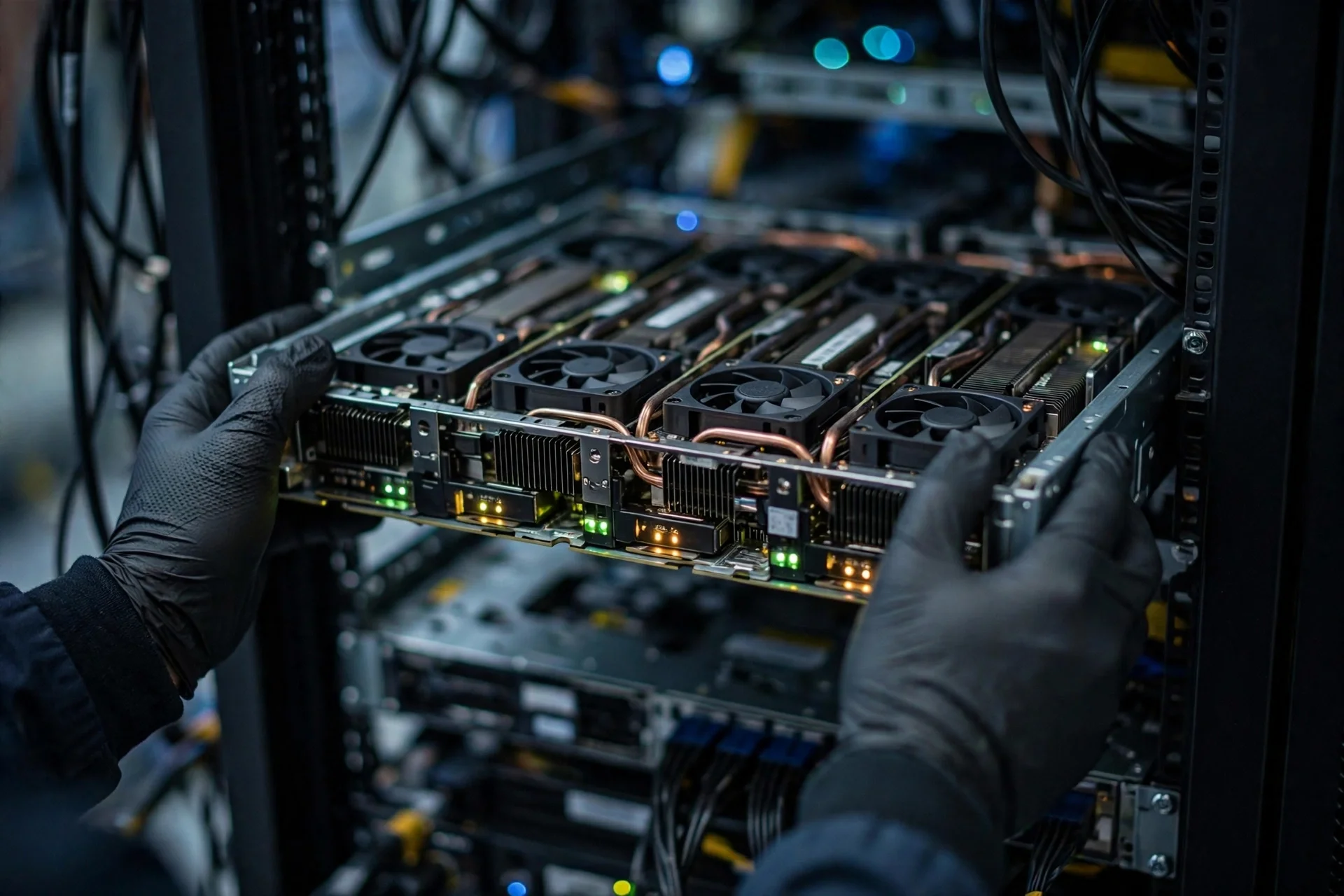
Gloved hands handling a GPU server with Nvidia A100 and H100 class hardware.
That gap between what the paperwork said and where the hardware landed is the core of the federal case against Greg Lui, 38, of San Gabriel, California, also known as Yiu Kong Lui. Federal prosecutors arrested Lui on October 1, 2026. A federal grand jury had returned a three-count indictment two days earlier, on September 29.
The charges are conspiracy to violate the Export Control Reform Act and the Export Administration Regulations, outbound smuggling, and conspiracy to commit money laundering. If convicted on all counts, Lui faces up to 20 years on each conspiracy charge and up to 10 years on the smuggling count. He is presumed innocent. The charges are allegations only.
What Earthmade Computer Inc. Allegedly Did
Lui owned Earthmade Computer Inc., based in City of Industry, California, a dense cluster of warehouses and light-industrial operations in the eastern San Gabriel Valley that has become a hub for electronics distribution. Prosecutors allege that between 2023 and 2024, Lui and co-conspirators used Earthmade to purchase high-end servers containing U.S.-manufactured Nvidia A100 and H100 graphics processing units, then ship them to China without obtaining the Commerce Department export licenses those shipments legally required.
The alleged method was transshipment through friendly jurisdictions. Malaysia and Singapore do not require U.S. export licenses for A100 and H100 class chips. China does. So, prosecutors allege, shipments were routed through Kuala Lumpur, Singapore, and Hong Kong, with paperwork identifying end users in Malaysia and Singapore. The actual destinations were in China.
First Assistant U.S. Attorney Bill Essayli put it plainly: "This defendant allegedly used false paperwork and shipments through third countries to smuggle more than $300 million in export-controlled computer servers to China."
The investigation involved the FBI, the Commerce Department's Bureau of Industry and Security Office of Export Enforcement, and the Defense Criminal Investigative Service.
How the Transshipment Route Allegedly Worked
The indictment describes a layered logistics chain that converted controlled exports into apparently routine commercial shipments. The general sequence alleged:
1. Earthmade purchased servers containing A100 or H100 GPUs from U.S. suppliers.
2. Shipments were addressed to buyers in Malaysia or Singapore, jurisdictions where no U.S. license was required for those chips.
3. Freight forwarders received the hardware in those transit countries.
4. False end-user documents identified Malaysian or Singaporean companies as the final recipients.
5. The servers were then re-exported to buyers in China.
Three shipments illustrate the alleged pattern.
The 27-server shipment in January 2024, valued at approximately $7.6 million, left Los Angeles bound for Kuala Lumpur. The packing list itself noted that the GPU servers could not be exported to China without a license. Two months after delivery, prosecutors allege, a co-conspirator wrote to a Malaysian government official confirming that all 27 units had been transferred to a buyer in China.
A second alleged shipment involved 92 servers routed through Singapore and Malaysia to Hong Kong and ultimately to a company in Hangzhou, the eastern Chinese city that is home to Alibaba's headquarters and a dense concentration of AI and tech firms.
A third involved 100 servers loaded with H100 GPUs and valued at more than $22 million. Documents for that shipment identified a Malaysian company as the buyer, with a CEO listed as Jackie Lui. The indictment alleges that Lui had purchased another person's identity documents to construct that entity.
What the A100 and H100 Are, and Why They Are Controlled
Nvidia's A100 and H100 are data center GPUs, built for the parallel computation that underlies large-scale AI training and inference. The A100 was Nvidia's flagship data center chip before the H100 succeeded it; the H100 represents a major jump in throughput for transformer-based AI models, the architecture behind large language models and most modern generative AI systems.
Neither chip is Nvidia's newest product. The company has since released the H200 and is shipping the Blackwell architecture. But both the A100 and H100 remain capable hardware for training and running large AI models, which is why the U.S. government treats them as controlled goods.
Since 2022, the Commerce Department's Bureau of Industry and Security has required export licenses for A100 and H100 class GPUs destined for China, citing their potential use in advanced AI development and, explicitly, possible military applications. The rules reflect a policy judgment: high-density AI compute shipped to certain adversary nations creates national security risk that outweighs the commercial benefit to American chip companies.
That policy created a lucrative incentive to circumvent the rules. Controlled hardware commands a premium on the other side of the restriction, and the license requirement made straightforward sales impossible.
The Numbers, in Context
The figures in this case are large enough to warrant some disaggregation.
$176 million is the amount prosecutors say Earthmade received from two Malaysia-based shipping companies between January and October 2024. That is the payment flow cited in the indictment, not the same figure as the alleged total value of servers shipped.
$300 million is the alleged total value of export-controlled servers Essayli described in his statement. That number encompasses the full scope of the alleged scheme.
$7.6 million is the value of the January 2024 shipment of 27 servers.
$22 million is the value attributed to the 100-server H100 shipment.
These are not retail consumer transactions. A single H100-equipped server can run well into six figures. A cluster of 100 represents the kind of compute deployment associated with serious AI infrastructure buildout, not casual use.
Nvidia is not charged in this case. The indictment does not accuse the company of any wrongdoing. Asked about the allegations, an Nvidia spokesperson, as reported by Bloomberg, said the reported diversion represents less than one half of one percent of Nvidia's products, and characterized it as "a drop in the bucket compared to domestic compute China already has." That is Nvidia's characterization. Experts who track chip flows note that the actual size of the black market for controlled AI hardware is genuinely difficult to measure, because the transactions are designed not to be measured.
Who Bears the Due Diligence Cost
Export control compliance is not free, and it is not evenly distributed.
Large technology companies with dedicated legal and compliance teams can absorb the cost of vetting customers, tracking serial numbers, and maintaining records that satisfy BIS auditors. For smaller distributors and resellers, that same compliance infrastructure represents a meaningful share of operating overhead. The temptation to skip it, or to look the other way when a deal seems too good to check carefully, scales inversely with a company's size and margin.
The rules require exporters to know their end users. "Know your customer" is not optional language in EAR compliance. When a deal involves unusual payment structures, freight forwarders in multiple jurisdictions, or buyers whose corporate structure is difficult to verify, those are flags the rules expect sellers to pursue, not ignore.
The alleged conduct in this case, if proven, suggests something more deliberate than negligence. The indictment describes a CEO who allegedly purchased another person's identity documents to manufacture a false end user. That is not a compliance failure; it is the compliance system being actively dismantled. But the case also illustrates what the transshipment route looks like when it is working: legitimate-appearing sales into non-restricted jurisdictions, plausible paperwork, and a supply chain that moves quickly enough that questions about the final destination get buried under completed transactions.
Practical Takeaways for Buyers and Sellers of AI Hardware
Whether you are on the selling or buying side of enterprise AI infrastructure, this case is worth reading carefully for what it signals about enforcement posture. A few specific items:
Verify end users, not just buyers. The Export Administration Regulations require exporters to verify the actual end user of controlled goods, not just the named purchaser on a purchase order. A Malaysian company buying servers on paper does not satisfy that obligation if the servers are going to Hangzhou.
Serial number tracking is not optional. Each GPU and server has identifiers. Maintaining records that tie specific units to specific sales, buyers, and destinations is the baseline for demonstrating compliance. It is also the baseline for identifying diversion after the fact.
Build audit rights into contracts. Distributors and resellers who sell into gray-area markets should have contractual rights to audit end-use. That right is rarely exercised, but its existence changes the legal exposure if diversion occurs.
Know what transshipment hubs look like. Malaysia, Singapore, and Hong Kong are legitimate commercial destinations for AI hardware. They are also the three jurisdictions that appear repeatedly in enforcement actions involving China-destined controlled goods. Transactions routing through those hubs are not inherently suspicious, but they warrant closer scrutiny of end-user documentation than a direct domestic sale.
Freight forwarder relationships carry risk. The indictment describes co-conspirators using freight forwarders to move hardware across multiple jurisdictions. Exporters are responsible for the ultimate destination of their goods, not just the address on the bill of lading.
What to Watch Next
Lui's arraignment will establish the formal procedural calendar. Defendants in federal export control cases typically enter not-guilty pleas at arraignment, and the pretrial period often involves extended discovery as prosecutors and defense counsel work through financial records, communications, and shipping documentation.
The money laundering conspiracy count is significant beyond the criminal penalty it carries. It opens the door to civil asset forfeiture, allowing prosecutors to seek recovery of proceeds tied to the alleged scheme. Given the $176 million in payments prosecutors have already identified, the forfeiture exposure is substantial.
Export control cases also frequently involve cooperation agreements with co-conspirators. The indictment references unnamed co-conspirators, and whether any of them are cooperating with investigators will shape how the case develops and what additional charges, if any, may follow.
The broader enforcement question is whether this case represents a shift in BIS and DOJ posture toward higher-visibility prosecutions in the AI hardware space. Chip export enforcement has historically operated at lower dollar values and lower public profiles. A $300 million alleged scheme, prosecuted with involvement from the Defense Criminal Investigative Service alongside the FBI and BIS, suggests agencies willing to devote significant investigative resources to this category of case.
Sources and Further Reading
APH Networks: California CEO arrested, $300M Nvidia AI server smuggling to China https://aphnetworks.com/news/32300-california-ceo-arrested-300m-nvidia-ai-server-smuggling-china
BeInsure: Greg Lui DOJ charges allege $300M Nvidia AI server smuggling https://beinsure.com/news/greg-lui-doj-charges-allege-300mn-nvidia-ai-server-smuggling/
Cybersecurity News: U.S. arrests tech company owner https://cybersecuritynews.com/u-s-arrests-tech-company-owner/
AI Weekly: US charges Earthmade owner with $300M Nvidia chip smuggling to China https://aiweekly.co/alerts/us-charges-earthmade-owner-with-300m-nvidia-chip-smuggling-to-china
Videocardz: US imposes license requirement for Nvidia A100/H100 GPU export to China and Russia https://videocardz.com/newz/us-imposes-license-requirement-for-nvidia-a100-h100-gpus-export-to-china-and-russia-400m-revenue-at-risk