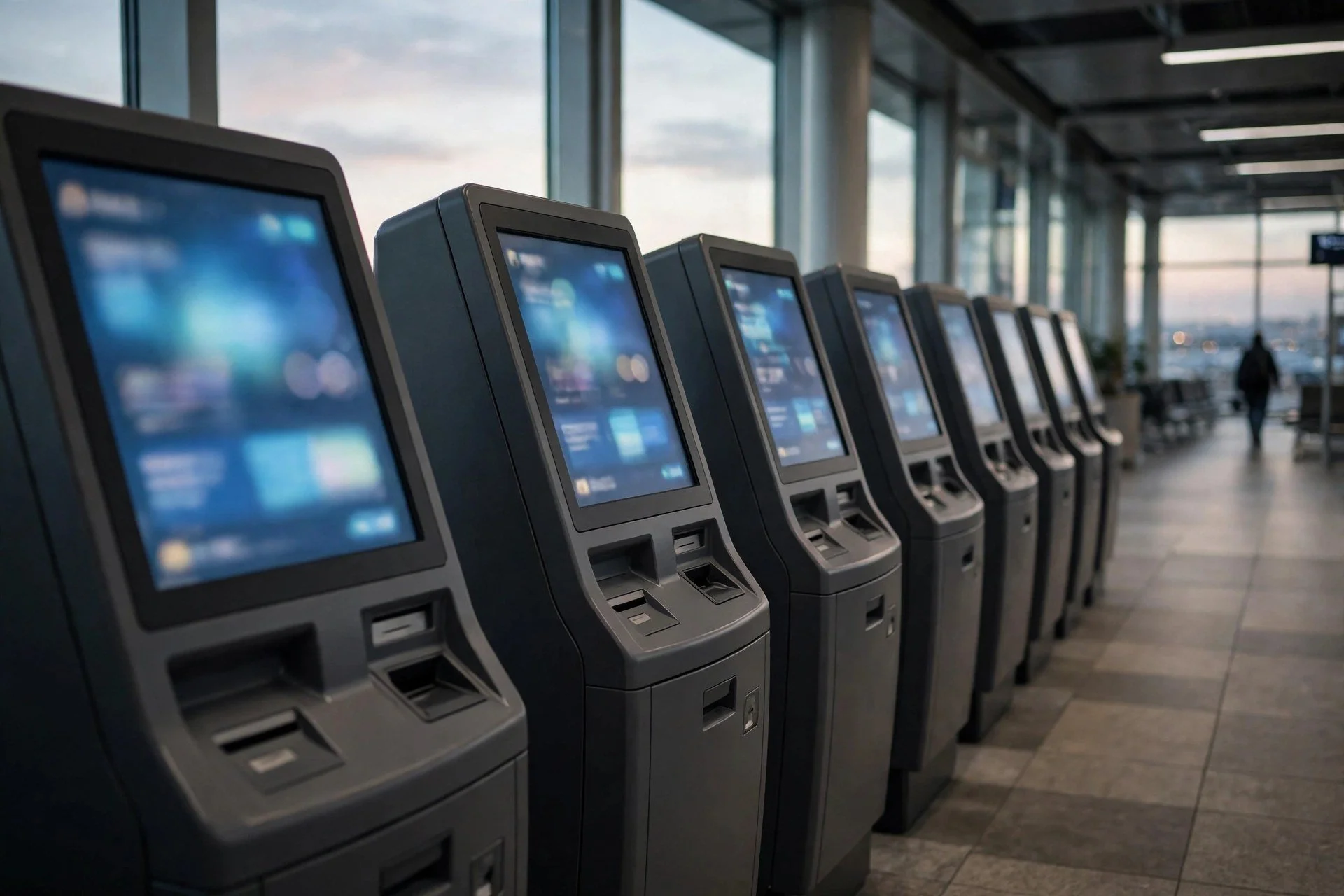
The kiosks, waiting for permission.
By Ellis Ward | November 15, 2026
Google can read United's fares. Your AI travel agent cannot, at least not legally, unless United says so in writing.
That is the core of a terms-of-use update United Airlines posted on November 11. Search Engine Journal reported the fine print on November 14. The distinction between search engine indexing and AI agent access sits at the center of the new rules.
Search Engines In, Agents Out
Standard web crawlers can still index United's public pages. Assistive technology and standard browsers are also exempt. The terms define a separate category, called an "Automated Agent," and that category requires prior written permission to access the site or app.
One detail catches many readers off guard. Built-in agent features inside browsers are not exempt, even though the browser itself is. If your browser ships with an AI assistant that can book flights, that feature needs permission. The browser's clearance does not extend to its agent capabilities.
What United Means by "Automated Agent"
United's terms define an Automated Agent broadly. It covers any software, service, or feature with full or partial autonomy. That includes anything that searches, books, buys, manages travel, or extracts data from United's site or app. The definition covers AI assistants, bots, scrapers, and browser extensions. Supervised tools are included too.
The Contract of Carriage goes further. It names social and messaging assistants, AI browsers, and stand-alone agents. Third-party services that reach United through travel agencies or intermediaries are also covered. Rule 6.J.6 prohibits agents from making, modifying, or servicing tickets, or from buying any product or service. Rule 5.H places agent-made bookings on a list of improper reservations United can cancel without notice.
Travel agencies and booking platforms are not exempt. They need written permission too.
Permission, Responsibility, and the FAQ
No Automated Agent may access United's site or app without prior written permission. United reserves the right to block access. If a user deploys an agent anyway, the terms treat that use as acceptance of the agreement by the user, by whoever runs the agent, and by the person the agent acts for.
United's Digital Trust Center FAQ is direct. Any agent, bot, browser extension, or browser feature is unauthorized if it searches, books, buys, manages, or collects data on the site or app without permission. The FAQ draws one clear line in the user's favor. Using an AI tool to research or plan a trip is acceptable, as long as the tool does not access United's site or app directly.
United confirmed it does not currently work with any third-party agents. Bookings made before November 11 stand. They will not be canceled.
A Separate Bar on Training Data
The updated terms add a restriction beyond access. No one may use United's fares, schedules, availability, pricing, or other data to train, fine-tune, ground, evaluate, or otherwise develop an AI model. Grounding, in this context, means an AI system pulling in outside content to build a response.
That definition leaves one gap unaddressed. Search engines now use indexed content to generate AI-powered answers. If a search engine has permission to index United's public pages, it is not clear whether using that content in a generated answer crosses the grounding bar. The terms are silent on the question.
Why United Says the Rules Are Necessary
United listed several concerns in materials reported by Search Engine Journal. Sharing login credentials with an agent exposes sensitive account information. Automated actions risk unintended purchases and unauthorized account changes. MileagePlus accounts could be misused.
The check-in example is specific. FAA and DOT rules require a person to personally acknowledge that their bags contain no prohibited items during check-in. An automated check-in cannot provide that acknowledgment. United flagged this as a potential regulatory problem.
CEO Scott Kirby put the commercial concern more plainly. At a Wall Street Journal event in Chicago, he said: "I don't want to create another middleman."
Not Controlled by robots.txt
The policy does not run through robots.txt, the standard file websites use to communicate crawling rules to bots. As of November 14, United's robots.txt does not name any AI crawlers, and, as Search Engine Journal notes, none of the policy depends on that file.
There is a practical reason. Personal agents do not broadcast a user agent string the way web crawlers do. A personal agent acting on a user's account has no user agent for robots.txt to address. The file would miss it entirely.
Open Questions and Industry Context
United has not said how it plans to detect unauthorized agents. The company said it will keep reviewing the policy and will update the FAQ if it begins working with any agents.
The move follows a broader pattern. Amazon blocked Meta's Muse AI shopping agent in September. eBay added "buy-for-me agents" and "LLM-driven bots" to its list of tools requiring written permission in a January update to its user agreement. RFTUV has been tracking this pattern across the travel and retail sectors.
For now, United's site and app are closed to agents by default. Access requires written permission. The company has not described what that permission process looks like.