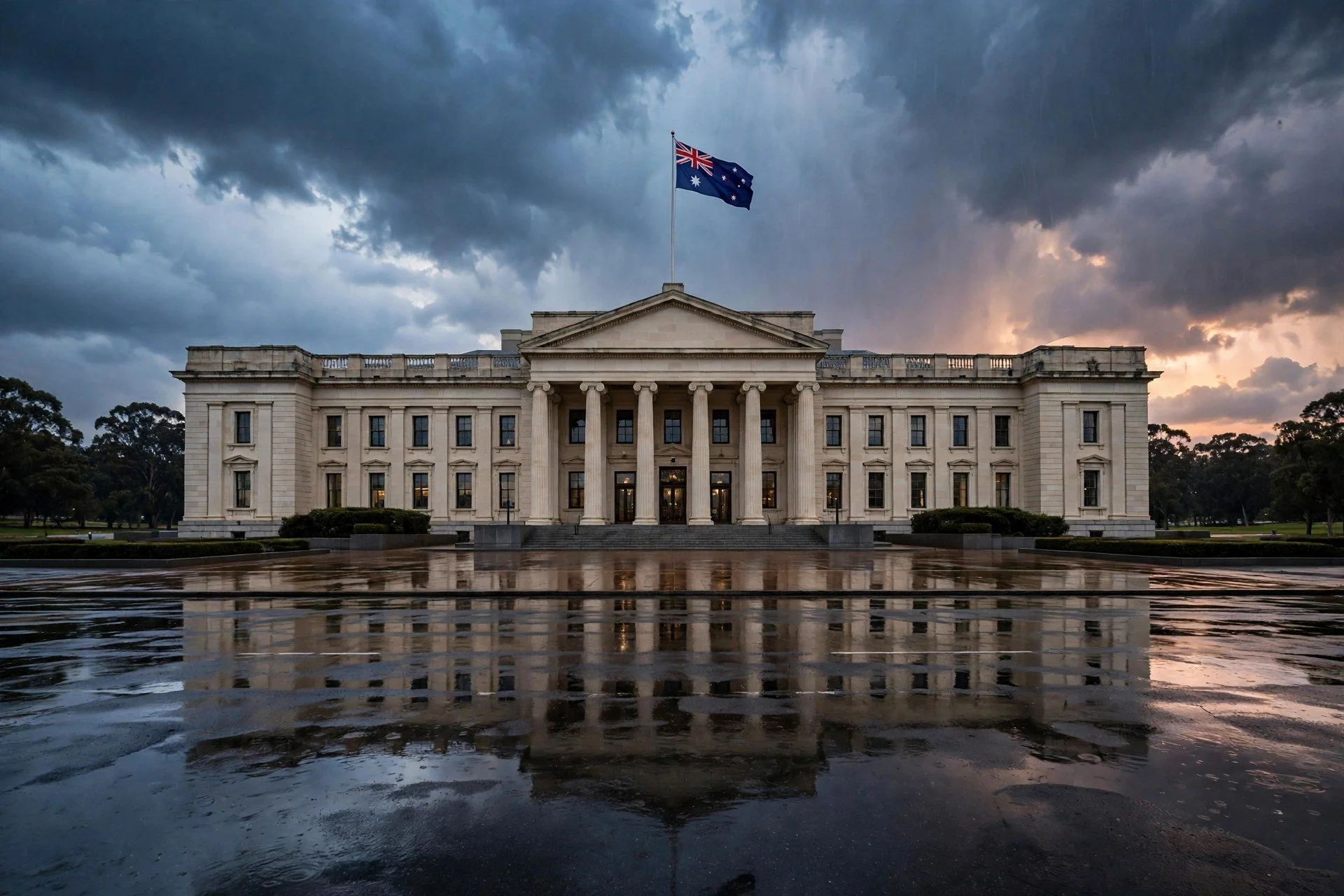
The parliament, under a storm sky.
By Ellis Ward | November 16, 2026
Two governments looked at the same AI moment this week and reached opposite conclusions. Australia announced it will legislate safety rules for frontier AI systems. A White House task force said companies hit by AI-fueled cyberattacks deserve liability relief. Same technology, same general period, sharply different instincts about where risk should sit.
That divergence matters beyond the two countries involved. It sketches the outlines of a coming regulatory split. This split will shape how AI companies build products, how governments assign blame, and how the public absorbs consequences neither side has fully mapped.
Australia Moves from Voluntary to Legislated
Australia's announcement came November 15. SecurityBrief Australia reported the country will legislate safety rules for frontier AI, the most capable class of models at the leading edge of development. That shifts the governing framework from voluntary commitments, which companies can observe or ignore without formal consequence, to legal obligations with enforcement attached.
The move follows a broader international pattern. Voluntary AI safety frameworks have proliferated since 2022. Major AI developers have signed pledges, submitted to third-party evaluations, and published safety cards. Pledges are only as durable as the institutional relationships that sustain them. Legislation creates a different kind of obligation. It survives a change of leadership at the company, a change of investors, or a decision by executives that compliance costs outweigh the reputational benefit of goodwill.
What Legislated Safety Rules Would Require in Practice
The verified reporting does not specify the exact requirements Australia's legislation would impose. That detail will emerge through the legislative drafting process. Legislating safety for frontier AI generally involves some combination of pre-deployment evaluation, incident reporting, documentation of training data and model capabilities, and limits on deployment in certain high-risk contexts. Those are the categories comparable frameworks in other jurisdictions have addressed.
The act of legislating rather than relying on voluntary compliance changes the enforcement calculus immediately. A company that fails a voluntary commitment faces reputational pressure. A company that fails a legal obligation faces regulators, fines, and potential injunctions against continued deployment. The difference is not theoretical. It determines whether safety rules survive periods of competitive pressure, when shortcuts are most tempting and the incentive to cut corners is highest.
Commentary in the Australian Financial Review on November 16 put a sharper frame on it: "AI has crossed the Mythos line. It should be controlled like the banks." That framing is attributed opinion, not government policy. It reflects the logic behind the legislative choice. Banking regulation did not emerge because banks volunteered to maintain capital reserves. It emerged because the costs of failure landed on people who had no vote in bank strategy. The AFR argument is that AI has reached a comparable point, where systemic risks exceed what voluntary frameworks can manage.
The banking analogy has real limits. Banks hold deposits and settle payments; their failures propagate through known channels, traceable in real time. AI systems fail in ways that are harder to anticipate and harder to attribute. A model that produces harmful outputs may do so inconsistently, in ways that surface weeks or months after deployment, through interaction patterns no single team predicted. The core logic of the analogy, that regulation should track the size of potential harm rather than the goodwill of the regulated party, applies in both cases.
What Australia is doing, in practical terms, is establishing that frontier AI developers and deployers are accountable to a standard set by law rather than by their own published commitments. That is a significant shift. It means safety decisions made in a boardroom in San Francisco or London are subject to enforcement by Australian regulators if those decisions result in systems that fail to meet the legislated standard.
The US Position: Liability Relief in Cyber Incidents
Two days before Australia's announcement, Cybersecurity Dive reported a different posture from Washington. A White House task force concluded that companies hit by AI-fueled cyberattacks deserve liability relief. The position is that when AI is used as a weapon against a company, that company should face reduced legal exposure for the resulting damage.
The argument has surface plausibility. AI-fueled attacks can outpace the defenses available to the targeted organization. If an adversary deploys a highly capable AI system to compromise a network in ways no current tool could detect or prevent, holding the victim to a pre-AI standard of care seems like a poor fit for the actual threat environment. That framing connects to longstanding arguments in cybersecurity policy that companies cannot reasonably be held to impossible standards.
What Liability Relief Would Mean in Practice
Liability relief does not eliminate accountability. It moves where accountability sits. Under the task force's position, a company that suffers an AI-fueled attack would face reduced exposure to lawsuits from customers, partners, or counterparties harmed by the breach. The liability shifts, at least partially, away from the attacked company.
The practical effect depends entirely on the design of the relief. Narrow relief, covering only novel attack vectors no reasonable security program could have anticipated, functions very differently from broad relief that reduces liability for any breach where AI played some role. The verified reporting does not specify which version the task force envisions. That gap matters. The difference between narrow and broad relief determines whether the policy functions as a reasonable adjustment to new threat conditions or as a blanket shield for security negligence repackaged in AI language.
There is also the question of who absorbs the liability that the attacked company no longer carries. Relief does not make harm disappear. It allocates harm differently. If consumers suffer losses in a data breach and the attacked company has reduced liability, those consumers carry more of the cost themselves, or the system depends on other mechanisms, insurance, government backstops, or remedies against the actual attacker, to cover the gap. The task force position does not address that redistributive question directly, at least not in the reporting available.
The position sits inside a broader US tendency to resist hard liability rules for technology companies on the grounds that strict liability would slow development and investment. That argument has shaped US tech policy for two decades. AI-specific liability questions are playing out against that backdrop, and the task force's instinct toward relief rather than obligation fits a recognizable pattern.
Where the Stanford Question Lands
In August 2026, Stanford HAI published a paper titled "Designing Loyalty: AI Agents and Conflicts of Interest." The paper explores whose interests an AI agent actually serves when its instructions conflict. That question connects to both regulatory stories in ways that have not been officially acknowledged by either government.
Australia's move to legislate safety for frontier AI implicitly asks: who is the AI loyal to? A model deployed by a financial institution may be optimized for revenue in ways that disadvantage the customer. A model deployed by a healthcare provider may prioritize throughput over individual care quality. Legislation that mandates safety rules puts a floor under what the model must do regardless of what the deployer instructs it to do. It answers the loyalty question by making certain obligations non-negotiable. The deployer cannot contract around the safety standard by instructing the model differently.
The liability relief question raises the same issue from a different direction. If a company uses an AI system in ways that expand its attack surface, and that company then benefits from relief when attackers exploit that surface, the question of whose interests the system served becomes harder to answer. A model that generates efficiency gains for the company while creating security costs that fall on third parties is performing a loyalty calculation. The Stanford paper does not address these policy stories directly; it was published months before either announcement. Its core question runs through both.
Stakes for Companies Operating Across Borders
A company deploying frontier AI products in both Australia and the United States now faces materially different regulatory environments. In Australia, it will face legislated safety obligations with enforcement consequences. In the United States, it may eventually benefit from liability relief if it suffers an AI-fueled attack, while facing a less prescriptive pre-deployment regime.
Those two frameworks do not simply add up. They create friction. A company built to comply with Australian safety obligations may find that the documentation, evaluation, and incident reporting those obligations require creates paper trails that complicate its US liability position. Cross-border compliance always produces this kind of friction, but it is amplified when the underlying regulatory philosophies point in different directions. Australia is asking what the company did before deployment. The US task force is asking what happened to the company afterward.
The more structural tension is between safety as a pre-condition and liability relief as a post-incident remedy. Australia's approach tries to prevent harm before a system reaches users. The US task force approach reduces consequences after harm has occurred. Both respond to real problems. Neither alone is sufficient. A legislated safety regime without enforcement capacity produces the same outcomes as a voluntary one. A liability relief regime without safety requirements creates incentives to underinvest in security, then claim relief when the foreseeable results arrive.
For public safety, the question is whether these frameworks interact in a way that actually reduces harm, or whether they create a gap. This gap is a world where companies in some jurisdictions face accountability for how their systems are built, while companies in others face reduced accountability for what happens when their systems fail. That gap, if it materializes, will not be felt evenly. It will be felt most by people who have the least ability to avoid AI systems they did not choose and cannot evaluate.
The Australian Financial Review commentary described AI crossing a threshold at which a technology becomes too consequential to govern through norms alone. Australia decided this week that frontier AI has crossed it. The US task force was addressing a narrower question, liability in cyber incidents, but its implicit answer to the broader question was different. The US is still treating AI-related harm as a problem to be managed through existing frameworks, adjusted at the margins, rather than a category requiring new structural obligations on developers before they ship.
For companies, regulators, and anyone who uses AI-powered products, neither answer is final. Australia's legislation will be drafted, negotiated, and amended. The task force's recommendations will be adopted, modified, or set aside. The regulatory picture in 2027 will look different from today's. What will not change is the underlying condition both governments are responding to: AI systems powerful enough to cause serious harm, deployed widely enough that harm is no longer a theoretical risk.
Both governments are trying to locate the threshold at which that becomes a governance problem rather than a product problem. They disagree about where it is, and they disagree about what happens after you cross it.
Sources
- Australia to legislate safety rules for frontier AI (SecurityBrief Australia, November 15, 2026)
- White House task force: companies deserve liability relief for AI-fueled cyberattacks (Cybersecurity Dive, November 13, 2026)
- Stanford HAI: Designing Loyalty: AI Agents and Conflicts of Interest (August 25, 2026)
- AFR commentary: AI has crossed the Mythos line (Australian Financial Review, November 16, 2026)