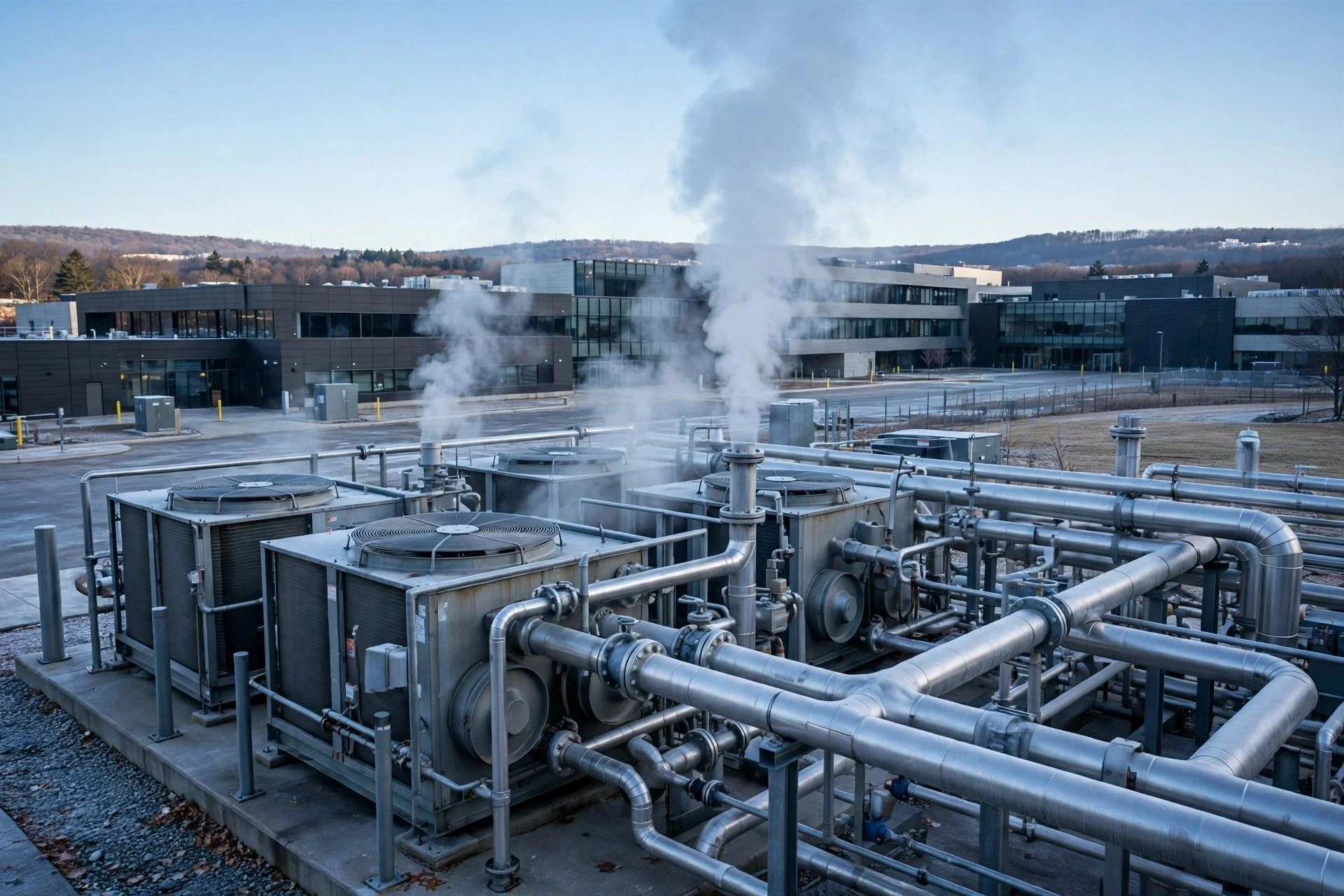
The chillers, outside Building 003.
By Mara Quinn | November 16, 2026
The announcement on November 5 carried the kind of names that make press releases easy to write: IBM, Oak Ridge National Laboratory, AMD. A co-located quantum error-correction platform, operational in Poughkeepsie. The technology sounded abstract and distant. The town planning file tells a different story.
Before IBM's quantum system runs at the capacity its partners are aiming for by late 2028, the Town of Poughkeepsie needs to approve a chiller pad.
That is not a diminishment of what IBM, ORNL, and AMD are building. It is a description of how big infrastructure actually gets built. The science moves forward in laboratories and research papers. The machinery moves forward through planning boards and SEQRA reviews and decisions about where to put permanent generators on a 180-acre campus off South Road.
RFTUV covered the platform itself on November 15. This piece looks at the other half of the story: the paperwork, the concrete, and the cooling systems that a fault-tolerant quantum future physically requires.
The Planning Record at Building 003
The IBM campus at 2455 South Road has been a fixture of the Town of Poughkeepsie for decades. The campus covers roughly 180 acres. The current planning action centers on a single structure within that campus: Building 003, identified in town planning materials as the site of the IBM Quantum System II, Phase II installation.
The project scope in those materials describes three additions to the site. The first is a new chiller pad. The second is an equipment enclosure. The third is permanent generators.
These items are not glamorous. They are not the kind of details that show up in a press release about quantum computing milestones. But they are what running a quantum computer at scale demands. Chillers manage heat. Enclosures protect sensitive equipment from the elements. Generators provide power when the grid cannot.
The planning documents reviewed by the desk do not specify the mechanical details of the chiller or generator systems, such as capacity ratings or fuel type. They describe the procedural path those additions must travel through town review, and that path has been moving since at least the summer of 2026.
A Negative Declaration and a Hearing on the Calendar
The State Environmental Quality Review Act, known as SEQRA, sets up a formal review process before local governments approve projects that might carry environmental consequences. Under SEQRA, a lead agency reviews a project's potential impacts and either issues a positive declaration, which triggers a full environmental impact statement, or a negative declaration, which finds no significant adverse environmental impact and allows the project to proceed to other approvals.
The Town of Poughkeepsie planning board issued a negative declaration for the Building 003 project on September 17, 2026. That determination cleared the environmental review threshold and moved the application toward a public hearing.
The planning board materials offered two possible dates for adjournment of that public hearing: October 15, 2026, and November 19, 2026. November 19 falls this Thursday. As of this writing, the desk has not confirmed whether the board acted at the October date, whether the hearing proceeded, or whether it was again adjourned to November 19. That is an open question.
If the November 19 hearing goes forward and the board acts on the application, it will do so just two weeks after the quantum platform announcement and four days after this newsroom's own coverage of that announcement. That convergence is almost certainly coincidental. Project timelines in municipal planning do not tend to track corporate press cycles. But the proximity is worth noting, because it illustrates how much of the behind-the-scenes work was already in progress before the public announcement arrived.
The negative declaration itself, dated September 17, represents a formal finding by town officials that the chiller pad, enclosure, and generators at Building 003 would not produce significant environmental harm. That finding is a prerequisite for the project to move forward. The public hearing is the next step. What happens at that hearing, and what conditions the board might attach to any approval, will shape the physical timeline for the installation.
The Platform: What IBM, ORNL, and AMD Actually Deployed
The quantum processor at the center of this infrastructure work is IBM's 120-qubit Nighthawk r2. It operates at IBM's Poughkeepsie facility. Connected to it is Oak Ridge National Laboratory's Umbra high-performance computing system, which runs AMD Instinct MI355X accelerators and fifth-generation EPYC processors. The combination performs real-time quantum error correction: the HPC system monitors the quantum processor's output as computations run and applies corrections to reduce error rates.
Error correction is the central unsolved challenge in practical quantum computing. Quantum bits, or qubits, are fragile. They lose coherence through environmental interference, and the errors they accumulate compound quickly. A quantum processor with many physical qubits does not automatically produce reliable results. Reliable results require the construction of logical qubits from multiple physical qubits, with continuous error monitoring and correction built into the computation.
The IBM-ORNL-AMD deployment puts that correction work on real hardware, in a production environment, in Poughkeepsie. The 120-qubit figure is a physical qubit count. Logical qubits, the error-corrected units capable of dependable computation, each require a larger number of physical qubits to build and sustain. As the logical qubit count grows, so does the demand on the physical qubit count, the heat load, the power draw, and the operational stability requirements of the facility housing the system.
That is the direct line from the quantum computing milestone to the chiller pad application.
More physical qubits generate more heat. More correction cycles running on the HPC side mean more continuous computation, more power consumption, more thermal output. A facility running at that level needs stable cooling and reliable backup power. When the grid falters, the correction cycles cannot pause. The quantum processor cannot wait for a utility fault to clear before coherence degrades. The generators in the town's planning file are the answer to that problem.
The 2028 Targets and the Road to Starling
IBM, ORNL, and AMD have set two specific goals for the Poughkeepsie platform by late 2028: 100 logical qubits and 100,000 operations. These are targets, not guarantees. The announcement named them as the benchmarks the partnership is working toward.
Reaching 100 logical qubits from a 120-qubit physical processor requires a compression ratio that reflects how many physical qubits must be dedicated to error correction for each reliable logical qubit. The exact ratio depends on error rates and the correction scheme in use. The materials available to the desk do not specify the ratio IBM and ORNL are targeting. They indicate that the platform is designed to inform IBM's Starling system, described as a fault-tolerant quantum computer planned for 2029.
Fault tolerance is the state in which a quantum computer can run long, complex computations without accumulating errors that invalidate the result. It is the threshold that separates experimental quantum hardware from practically useful quantum hardware. Reaching it requires years of iteration on physical qubit quality, error correction algorithms, and the infrastructure that keeps everything stable. The Poughkeepsie installation is designed to generate the data and operational experience needed to reach Starling's threshold.
The chiller pad and the generators are not support items at the edge of that project. They are part of the system. A fault-tolerant quantum computer that overheats loses coherence. One that loses power loses the correction cycle. The infrastructure the Town of Poughkeepsie is now reviewing is not incidental to the 2029 goal. It is what makes the 2029 goal physically possible.
A Long Presence on South Road
The IBM campus at 2455 South Road has been part of the Town of Poughkeepsie's economic and physical landscape for many years. The 180-acre site is not a colocation facility where a tenant leases rack space. It is a research and manufacturing campus that IBM developed over decades. The quantum work now underway at Building 003 is a continuation of that presence, not a new arrival.
The town planning file does not elaborate on the broader campus history, and that history goes beyond the scope of what the desk reviewed for this piece. The file does show that the current project is treated as a site modification: an addition to an existing, established facility, reviewed under the same SEQRA framework that governs other local development. The scale is different from a residential addition or a retail expansion. The process - filing an application, triggering environmental review, scheduling a public hearing - is the same.
Building 003 is one structure on a large campus. The chiller pad will occupy space outside it. The enclosure will protect equipment near it. The generators will back it up. The footprint of the additions is modest relative to the campus. Their significance lies in what they sustain.
County Oversight: What the Record Shows
Dutchess County maintains an Artificial Intelligence and Technology Oversight Committee. The most recent set of minutes the desk could locate for that committee are from June 4, 2026. Those minutes cover several topics: county AI policy, requirements for human review of automated decisions, questions related to public records and FOIL obligations, and a pilot program in the Dutchess County Family Services office called "Ava."
The desk found no November meeting record for the committee and no specific action connected to the IBM quantum platform or the Building 003 planning application. That absence does not establish that the committee has not discussed these topics. It means no record appeared in the desk's review.
The June minutes suggest a county government that was already thinking carefully, by mid-2026, about how automated systems interact with public accountability and records law. The committee's focus in those minutes was on narrower AI tools, not quantum computing systems. But the underlying question, how public institutions track and oversee advanced computing infrastructure operating in their jurisdiction, connects both conversations.
If the committee takes up quantum infrastructure questions in coming months, particularly as the Poughkeepsie platform moves toward its 2028 targets, that would be a thread worth following.
What This Story Does Not Yet Know
Several things about the Building 003 project remain unresolved as of this writing.
The status of the public hearing is the most immediate gap. If the November 19 hearing proceeds as offered in the planning board materials and the board votes on the application, the town will have formally acted on the infrastructure the quantum platform depends on. If the board adjourns again, the timeline extends. The desk will update this piece when the hearing outcome is confirmed.
The technical path from the current platform to the 2028 targets carries its own uncertainty. IBM, ORNL, and AMD announced those targets as goals. What reaching 100 logical qubits and 100,000 operations will require in terms of additional facility modifications, beyond the chiller pad and generators now under review, is not addressed in the materials available to the desk.
The Starling system, planned for 2029, is further still. Its physical footprint, its location, and what the Poughkeepsie platform will need to look like before Starling can be built on its findings are all questions without public answers yet.
The work is active, the planning process is real, and a town planning board in Dutchess County is reviewing the concrete, mechanical, and electrical prerequisites for one of the more serious quantum computing efforts now operating in the United States. The press releases describe the science. The town file describes the ground beneath it.