Load, meet grid.
By Mara Quinn | November 21, 2026
The Gap That Keeps the Door Open
Governor Hochul's executive order put a one-year pause on new data centers in New York. The pause applied to facilities drawing 50 megawatts or more. Centers drawing 20 to 49 megawatts were not covered. That range is not a narrow technical exception. A 20-megawatt facility is a substantial industrial load. Twenty-one Dutchess County legislators say the gap is real, and they want Albany to close it.
The Dutchess County Legislature adopted Resolution No. 2026163 urging state action to protect communities from large-scale data center development. Legislator Kristofer Munn prepared the resolution on September 29, 2026. The 21 sponsors are Drago, Valdes Smith, Atkins, Munn, Polasek, Alexander, Arnoff, Brendli, Caswell, Giles, House, Kaul, Kearney, Lawler, McHoul, Redl, Rhodes, Rolison, Shah, Tresca, and Winsby. The resolution carries no fiscal impact. Its purpose is to urge state action before another large data center project arrives in the county and local officials find themselves with no state-level protections to rely on.
What Resolution 2026163 Asks For
The resolution has three requests.
First, it urges Hochul to sign the Responsible Data Center Development Act, known in the Senate as S.10642 and in the Assembly as A.11560. Second, it encourages every town, city, and village in Dutchess County to adopt a temporary moratorium covering data centers of 20 megawatts or more. That local moratorium would serve as a bridge while state protections are established. Third, the resolution asks the Dutchess County Department of Planning and Development to draft model moratorium language that municipalities can adopt directly.
Copies of the resolution go to Governor Hochul, State Senators Michelle Hinchey and Rob Rolison, Assembly Members Sarahana Shrestha, Jonathan G. Jacobson, Anil Beephan Jr., and Didi Barrett, plus the Dutchess County Mayors and Supervisors Association and the county Department of Planning.
The resolution itself is non-binding. It carries no permits, fines, or enforcement mechanisms. It places a formal, collective position in front of every official who can act on it.
East Fishkill Already Acted
One Dutchess County municipality did not wait for Albany or for the county. The Town of East Fishkill voted unanimously on June 25-26, 2026, to impose a three-year moratorium on data centers drawing 20 megawatts or more. The ban runs through July 2029.
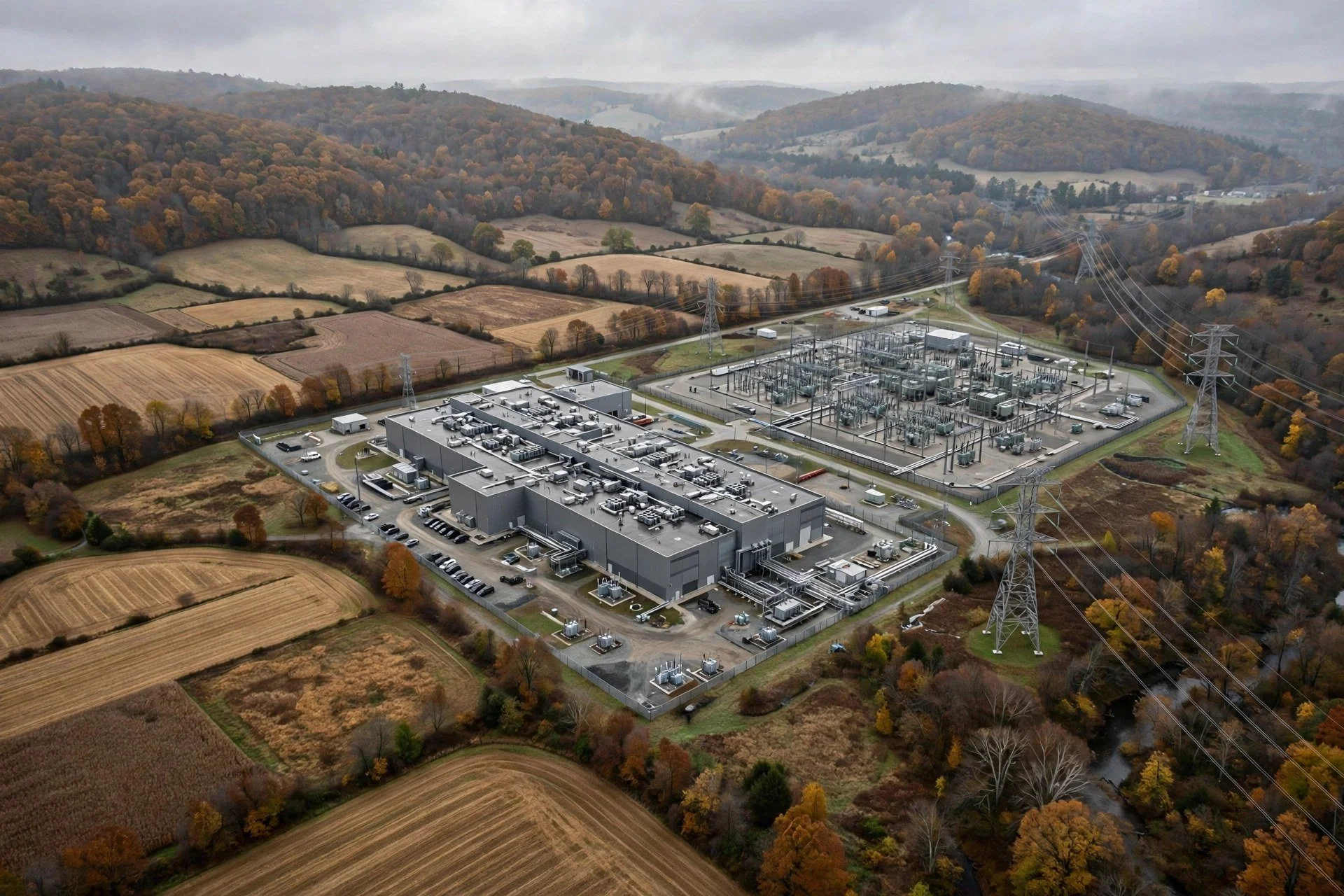
The timing was not coincidental. A developer known as Donovan Drive Holdings LLC, listed in interconnection queue entry 1738, seeks to connect 1,000 megawatts of load at a site in East Fishkill. The plan calls for 500 megawatts by 2028 and another 500 megawatts by 2030. The connection point is the Wood Street 345-kilovolt substation.
A second project, associated with an iPark 84 tenant expansion, involves roughly 150 megawatts in a grid study. As of the moratorium vote, that project had no town site plan or special permit on file.
Together, those two proposals would represent load demand that rivals the output of a mid-sized power plant. East Fishkill's moratorium effectively puts both on hold at the local level while the broader debate plays out in Albany. The county resolution extends that logic: asking every municipality in Dutchess to do what East Fishkill did, and asking the state to do what local governments cannot do alone.
The Barrett Bill and What It Would Require
The Responsible Data Center Development Act is sponsored by Assemblymember Didi Barrett in the Assembly. The state Legislature passed it on June 4. The bill extends moratorium coverage to data centers of 20 megawatts or more, closing the gap Hochul's executive order left open.
The bill does more than pause permits. It sets standards that developers must meet before receiving approvals. Those standards cover energy use, water consumption, utility costs, environmental impacts, public participation, labor practices, and benefits to host communities.
The public participation requirement is specific. Under the bill, developers must hold at least one in-person public hearing in the host community. That hearing must take place at least three months before a permit issues. Advance notice of 30 days is required.
The energy and utility provisions address a concern that has emerged wherever large data centers have clustered. When a single facility draws tens of megawatts around the clock, it can strain local distribution systems and push up costs for other customers on the same grid. The bill requires utilities and municipal water providers to create a distinct service classification for large data centers. New rate structures under that classification must be fully in place by June 1, 2030.
The permitting body under the bill is the Department of Environmental Conservation. The DEC would administer the one-year moratorium on new permits for covered facilities.
Hochul's Position: Watching, Not Acting
The Legislature passed the bill. A gubernatorial signature has not followed.
On May 28, before the Legislature voted, Hochul cast doubt on a statewide approach. She told reporters: "This is a local decision for municipalities. It's land use, which is the purview of local governments. It's not a statewide approach necessarily, but it's something I'm looking at intensely."
After the bill passed, her spokesperson Kristin Devoe told Politico that "the governor will review the bill."
That is not a commitment to sign. The governor's earlier framing placed responsibility on local governments, which is partly why the Dutchess County resolution explicitly asks municipalities to act in parallel. The resolution acknowledges that local governments may need to protect themselves before state action arrives.
The dilemma is that local action alone creates a patchwork. A town with a moratorium protects itself. A neighboring town without one becomes the path of least resistance for the next developer. Statewide standards level that field. The resolution asks for both: local interim protection and permanent state rules.
The Grid Is Already Under Strain
The state policy debate runs alongside a separate process at the federal level. On November 16, 2026, the New York Independent System Operator filed its Large Load Integration Procedures with the Federal Energy Regulatory Commission. The filing responded to a FERC show-cause order issued June 18.
NYISO's proposal lays out how the grid operator would study and approve large new loads. Under the plan, large loads would be studied in successive groups, with each group checked against resource-adequacy standards. A project that would harm grid adequacy could still proceed, but only if it secured firm withdrawal rights through long-term arrangements with qualifying resources. Those resources do not need to be physically co-located with the load.
NYISO proposed two main service tiers. Under Firm Withdrawal Service, a large load would have protected access to grid energy. Under Non-Firm Withdrawal Service, the load would be curtailed when local prices reach 200 dollars per megawatt-hour. A third option, Zero Withdrawal Service, covers loads that take no energy from the grid at all.
The study cycle under the new procedures would run roughly 18 to 24 months. NYISO asked FERC to make the procedural rules effective February 1, 2027, with market rule changes following on June 1, 2028.
The NYISO filing does not address permitting, land use, or community benefits. It addresses grid reliability and cost allocation. But it reflects the same underlying pressure that the Dutchess County resolution addresses: the grid was not designed for a sudden concentration of multi-hundred-megawatt loads, and existing rules do not clearly prevent existing customers from absorbing those costs.
IBM vs. the Data Center: A County Contrast
The Dutchess County resolution does not oppose all large technology projects. The distinction the county draws is visible in a project announced separately this year.
Attorneys at Whiteman Osterman and Hanna secured land-use approvals and Dutchess County Industrial Development Agency incentives for IBM's quantum computer manufacturing and research facility in the Town of Poughkeepsie. The project carries a price tag of 2.5 billion dollars. The incentive package includes a 30-year payment in lieu of taxes and five-year sales-tax exemptions. The firm described it as the largest technology project in the Hudson Valley, with hundreds of jobs attached.
That project went through SEQRA review and local land-use approvals. It carries a large workforce. It manufactures something.
A large data center is a different kind of project. It draws continuous power around the clock. It typically employs a small permanent staff. It contributes to the local tax base, but its primary impact on a local grid can be sustained, heavy load rather than a construction-period demand that then levels off.
The resolution does not say data centers are prohibited. It says they should be evaluated under standards that account for their actual costs to the grid, to water systems, to neighboring ratepayers, and to the community that hosts them.
The Model Moratorium and What Comes Next
The request for model moratorium language from the county Department of Planning and Development is practical. Most towns and villages in Dutchess County do not have dedicated attorneys drafting land-use code amendments. A model document lowers the barrier to adoption. It also makes the patchwork problem slightly more manageable: if every municipality in the county starts from the same template, the protections are more consistent across the region.
The resolution asks municipalities to impose temporary moratoriums covering data centers of 20 megawatts or more. The word "temporary" matters. The goal is not a permanent county-wide ban. The goal is a pause long enough for the state to establish permanent standards. If Hochul signs the Barrett bill, those standards would include public hearings, rate structures, environmental review, and labor requirements. Local moratoriums would no longer need to carry the full protective load on their own.
If Hochul does not sign, the county and its municipalities are left with whatever local authority they can assert. That authority is real but limited. A town moratorium, like East Fishkill's, can delay a project. It cannot impose ratepayer protections or require public hearings statewide. It cannot standardize environmental review across dozens of jurisdictions.
That is why the resolution sends copies to the governor, to both state senators representing Dutchess County, and to four Assembly members. The county legislature is using a formal resolution to press all of them on the same day.
NYISO's interconnection queue already shows what may be coming. The East Fishkill projects alone represent a proposed load of 1,000 megawatts at a single substation. That is not a hypothetical future scenario. It is an active grid study, filed and pending. The moratorium vote in East Fishkill and the county resolution in Poughkeepsie are responses to something already in motion.
Albany has the bill. It has the queue numbers. It has a county legislature on record. The state now needs to move before the next application lands.
Sources
- Dutchess County Legislature Resolution No. 2026163 (PDF)
- New York state legislature passes data center moratorium, awaits governor Hochul's approval - Data Center Dynamics
- New York Legislature Passes Data Center Moratorium; Bill Awaits Governor's Approval - Legal 500
- Five Grid Operators Respond to FERC With Distinct Plans for Large-Load Integration - POWER
- Shaping Speed to Power: What the FERC Show Cause Responses Mean for Data Centers - Relae
- East Fishkill passes 3-year data center freeze - WAMC
- WOH attorneys secure the approvals for the largest tech project in the Hudson Valley - Whiteman Osterman & Hanna