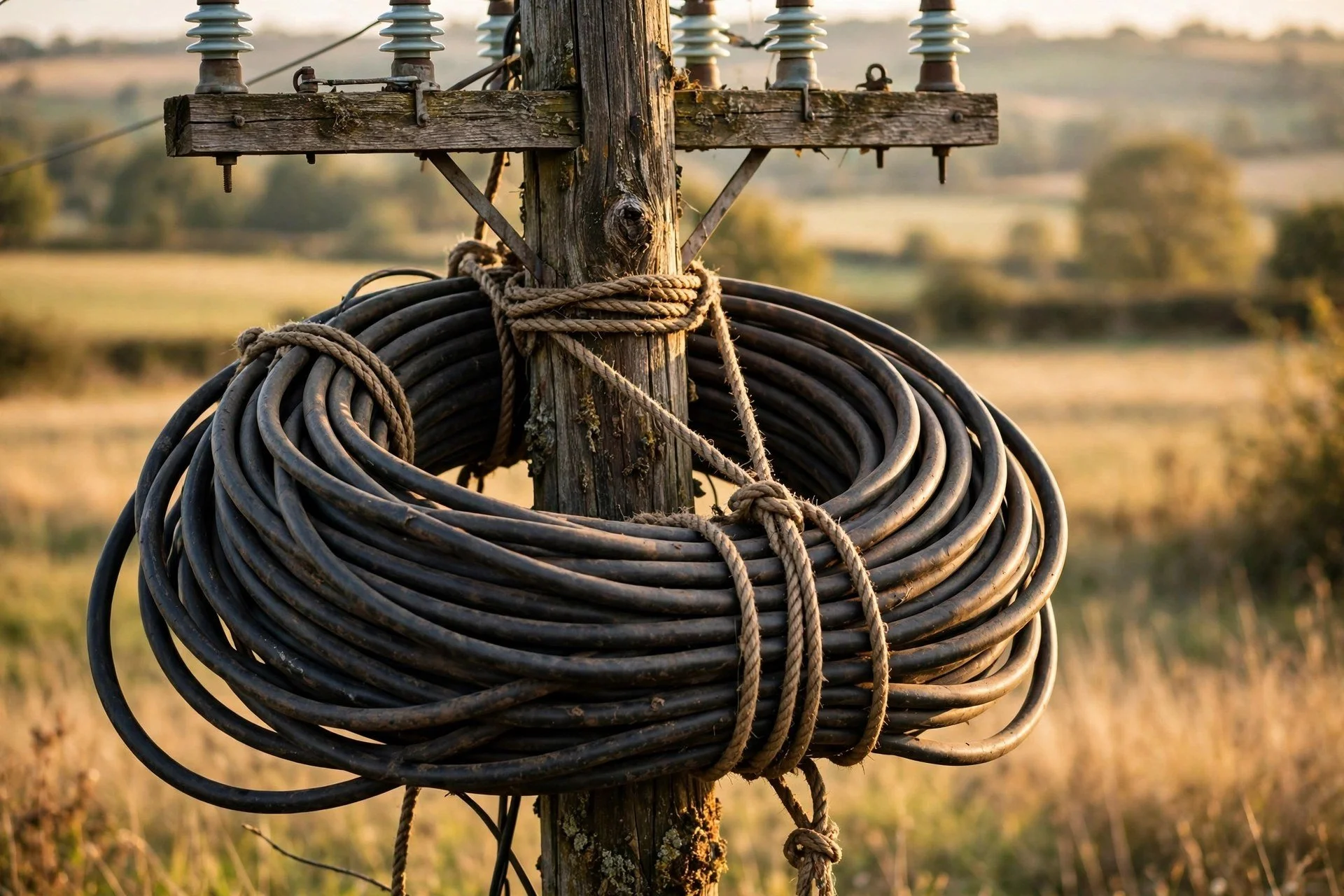
The copper still on the poles.
By June Mercer | November 21, 2026
Somewhere in the Hudson Valley right now, a landline is the only phone that works. Not because someone chose copper over convenience, but because cell service fades in the hills and the power is out. Verizon wants to end that service entirely - and the window to stop it is closing fast.
On November 20, Congressman Pat Ryan publicly urged the Federal Communications Commission to reject a Verizon proposal that would phase out copper landline service across New York State, including communities throughout the Hudson Valley. Unless the FCC steps in, the application - which Verizon filed on September 9 - will be automatically approved on December 20. The public has until December 4 to file objections.
Ryan's district covers Beacon and rural stretches of Ulster County, territory where cell towers are thin and storms roll in hard. His November 20 press release includes the full text of a letter he sent to FCC Chairman Brendan Carr in September. In it, he calls on the commission to reject Verizon's proposal outright, requiring the company to demonstrate "a genuinely reliable, verified alternative" at each customer's specific location before anyone loses a copper connection.
The Phone That Keeps Working When Everything Else Goes Dark
The case against Verizon's plan starts with a physical fact: copper landlines draw power directly from the telephone company's central office. They do not need electricity in a home or neighborhood to function. A storm can knock out power for hours or days across the Hudson Valley's mountainous terrain - and a copper landline will keep ringing through all of it.
Cellphones drain batteries. Routers go dark. Voice-over-internet service, which requires a functioning modem and home power, goes silent. A copper phone does none of those things.
Ryan made that point directly in his September letter to FCC Chairman Brendan Carr. Cellphone service in the Hudson Valley is "notoriously spotty," he wrote, accusing Verizon of trying to "cut costs" by abandoning a service that many of his constituents cannot replace. "In many parts of the Hudson Valley, landlines are often the only reliable way for folks to stay connected - but now Verizon is trying to rip that critical service away without a thought of how it will impact us," he said in the press release. "No one in the Hudson Valley should have to worry about losing their ability to dial 911 during an emergency or call a loved one when the power goes out just because Verizon wants to cut costs."
The concern is sharpest for older residents. According to the most recent annual survey by the National Center for Health Statistics, conducted in 2024, 78 percent of U.S. adults rely solely on cellphones, while just 1.4 percent have only a landline. Adults 65 and older are a different story entirely: they are far less likely to rely solely on cellphones and far more likely to depend on landlines, according to federal data reported by The Highlands Current.
New York's own numbers make the case more plainly. According to state-level data from 2023, 81 percent of New York adults use cellphones all or most of the time - roughly in line with the national figure - but 3.4 percent are landline-only and another 4.6 percent use landlines most of the time. Landline use in New York runs higher than the national average, and the gap is widest among seniors.
For many of those users, the landline is not just a phone. It is the cable that keeps a medical alert device connected. It is the number a home health aide calls. It is the line that works at 3 a.m. when the power is out and a cell signal will not reach the nearest tower. "That's unacceptable - especially for seniors who rely on landlines for their safety and medical needs, and for rural families that can't count on reliable cell service," Ryan said.
Verizon's Argument: Aging Infrastructure, Rising Costs, and a Theft Problem
Verizon frames the issue differently. In its application to the FCC, the company said it wants to end Plain Old Telephone Service - known in the industry as POTS - in nine states and Washington, D.C., in areas where cellphone, wireless, or voice-over-internet service is already available. According to Verizon, about 750,000 of 28 million homes and businesses in that footprint, roughly 2.7 percent, still use copper landlines.
The company argues the technology has aged past the point of practical maintenance. Replacement parts for copper infrastructure are increasingly scarce. The cost of copper wire has risen sharply, and that rising value turns the cables themselves into a target. The theft problem is not theoretical: in June, copper thieves disabled phone service for residents of Philipstown, a town in Putnam County, in a demonstration of exactly the vulnerability Verizon says it can no longer absorb.
"Every dollar Verizon spends maintaining aging, little-used copper infrastructure diverts critical investment away from future-ready networks that customers across the country demand," the company said in a statement quoted by The Highlands Current. "This is a win for states and consumers alike."
Verizon contends that the services it would substitute - mobile and voice-over-internet - meet federal 911 requirements. It argues that cellphones can continue to operate during power outages or be charged through cars, laptops, and portable battery banks. The company says it began last month to contact customers who lack "an adequate replacement option" to let them know they can keep copper service. It also committed to a "careful disconnection process" with "extensive communication" before anyone loses a copper connection.
Whether those assurances hold up in a region of ridgelines, dead zones, and frequent power outages is exactly the question now before the FCC.
200 Comments, Town Boards, and a County That Said No
The opposition has been building since Verizon made its application public. The FCC has received more than 200 comments since the announcement, many from older residents who live in remote areas where cell coverage is unreliable, power outages are common, or who do not own cellphones at all, according to The Highlands Current. Town boards across the region have filed objections. So has the Greene County Legislature - or at least its Public Safety Committee, which moved a resolution to the full Legislature.
At an October 13 meeting, the Greene County Public Safety Committee voted 9 to 0 to advance a resolution opposing Verizon's plan to cut off copper landline service until every resident has a reliable alternative. The committee directed the county clerk to send copies of the resolution to state and federal officials, the FCC, and Verizon itself.
The committee's concern was not abstract. Greene County's Sheriff's Office runs a program that calls seniors every day to check on them. That program depends on landlines. If copper service disappears, the county faces the prospect of losing contact with the most isolated members of its population - precisely the people the program was built to reach. For residents in rural and mountainous parts of the county, as the resolution notes, a copper line may be the only dependable phone they have.
Ryan's public announcement on November 20 adds a congressional voice to what has been building as a regional chorus. His demand: no customer moved off copper service until a genuinely reliable, verified alternative is confirmed at that specific location, with strong consumer protections throughout. "I'm urging the FCC to tell Verizon to pump the breaks and present an actual, viable alternative instead of just ripping the rug out from under us," he said.
The FCC estimated last year that 395 million people in the United States use cellphones, 63 million use internet-based voice services, and 15 million still use landlines. That 15 million is a small share of the country - but in the Hudson Valley, where cell towers are few and power outages are a seasonal fact of life, those 15 million include the people most likely to need a phone when nothing else is working.
How to File an Objection Before December 4
Under FCC rules, Verizon's application to discontinue service will be automatically approved on December 20 unless the agency takes action to block it. The FCC announced on November 19 that it is accepting public objections through December 4.
Filing is open to any member of the public. Comments must include specific information about how the proposed discontinuance would affect the person filing, including "any inability to acquire reasonable substitute service," according to the public notice. The commission is not looking for general opinions about landlines - it wants to hear from people whose circumstances would be directly changed.
To file: go to fcc.gov/ecfs/filings/standard and search for Proceeding 26-252. Under "Type of Filing," select "Comment." Objections must be uploaded as a Word document, PDF, or text file.
The underlying mechanics of copper service matter here. Because power for a copper line comes from the telephone company's central office rather than the home, the phone keeps working when household electricity goes out. That is not true of a cellphone with a dead battery, a modem that has lost power, or a voice-over-internet handset with no electricity to run it. Verizon's application covers areas where it says adequate alternatives exist. The question the FCC must weigh is whether "available" and "adequate" mean the same thing in the hollows and hilltops of the Hudson Valley - where coverage maps show a signal that may not exist in a basement or on a ridge during a nor'easter.
The Greene County Public Safety Committee was operating in October with an understanding that Verizon intended a shut-off date of November 30, 2026, according to the meeting summary. The FCC's current timeline, as reported by The Highlands Current on November 20, sets the automatic approval date at December 20. The comment deadline of December 4 is what residents have to work with now.
The Window Is Narrow
December 4 is the last day to file an objection. December 20 is when the application becomes final unless the FCC acts.
For the thousands of Hudson Valley residents who pick up a copper telephone when the lights go out - or when a medical device needs a connection, or when a sheriff's deputy calls to make sure an elderly neighbor got through the night - December 4 is the deadline that matters most.
The FCC's Electronic Comment Filing System is at fcc.gov/ecfs/filings/standard. Proceeding number: 26-252.