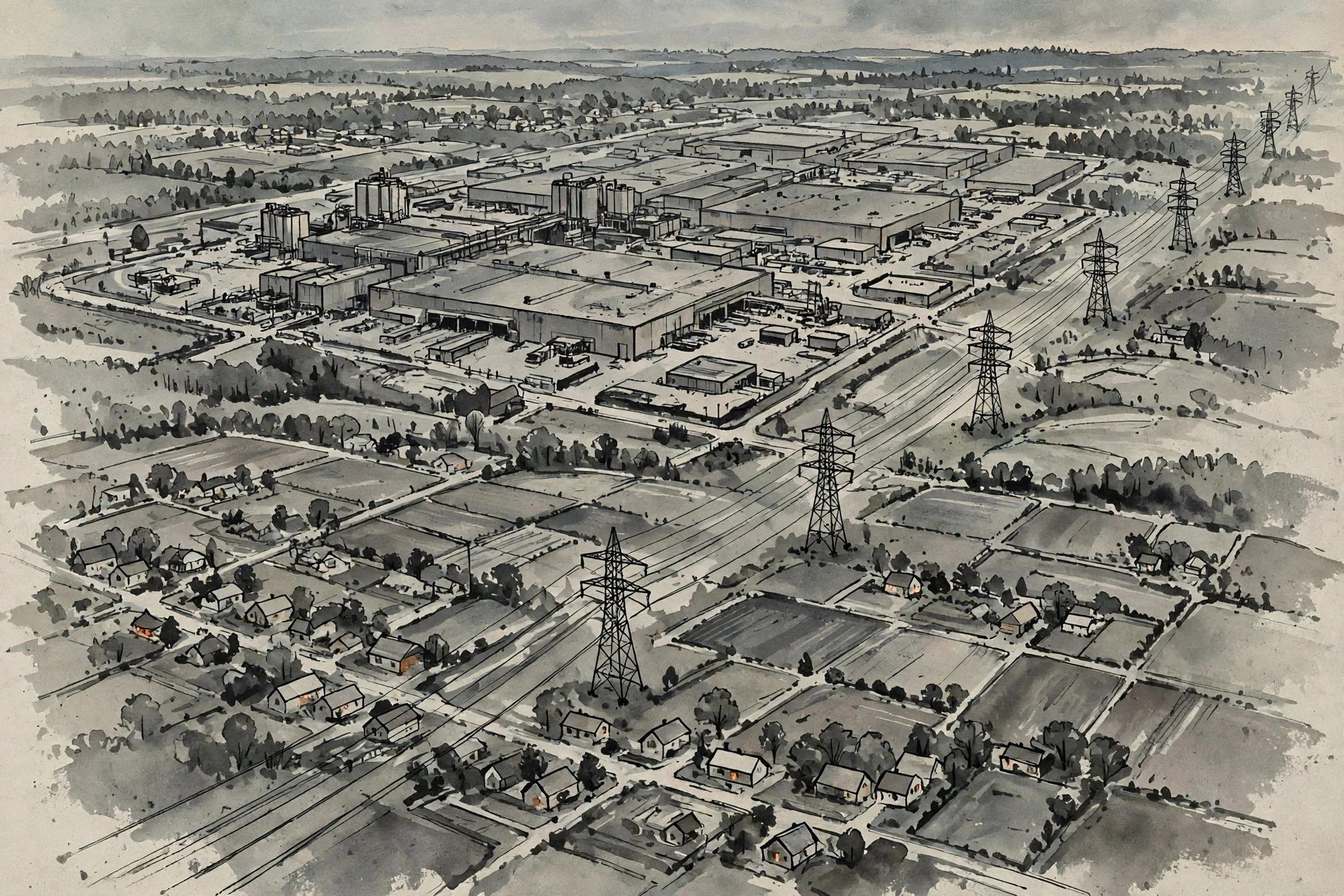
The site, the lines, the queue.
By June Mercer | November 27, 2026
This updates RFTUV's East Fishkill data center coverage of November 24 and 26: East Fishkill task force first meeting and Treetop lawsuit and moratorium.
Queue Check: Still Active as of November 26
As of November 26, 2026, the East Fishkill 1 GW data center project holds an active status in the New York ISO interconnection queue. Neither the town's three-year moratorium nor the pending lawsuit has removed it. That confirmation comes from Watt Street's New York Interconnection Queue tracker, updated November 26.
The scale of the statewide queue matters for context. The 235 pending requests total 34.6 GW. By type: batteries account for 125 requests and 19.1 GW; solar for 66 requests and 9.7 GW; wind for 19 requests and 3.1 GW; natural gas for 6 requests and 1.9 GW. For large loads specifically (data centers, factories, and electrification), 76 requests cover 17.7 GW. East Fishkill's 1.0 GW ties for second among large loads, behind St. Lawrence Infrastructure 2 at 1.9 GW, and level with NY-Route 9W Load Center in Greene County. Micron Fab 3 sits at 606 MW. In Dutchess County, 7 pending requests across all types total 1.1 GW, alongside 2.2 GW already in service. Watt Street's standing caveat applies: "A queued project is a request, not a commitment."
Moratorium and Lawsuit: What the Town Controls
The East Fishkill town board passed Local Law No. 3 of 2026 on June 25. All five members voted yes. The law bars any new data center from being permitted or considered for three years. Exceptions are narrow: ancillary uses under 20 MW and projects eligible for an Economic Development Special Permit. The law runs to July 1, 2029. The pending lawsuit, covered in RFTUV's November 26 piece, adds a separate legal challenge. No new development in that case was confirmed this week.
Neither action reaches an interconnection queue listing. That is NYISO's domain, not the town's.
New FERC Filing Sets February 1 as the Threshold
NYISO filed two dockets with the Federal Energy Regulatory Commission on November 16, 2026. According to NYISO's filing, as analyzed by Load Factor News on November 19, the dockets establish a new large-load interconnection framework. The docket texts were not read directly for this article. The dockets are ER27-517, covering the study process and new services, and ER27-529, covering cost recovery with six transmission owners including Central Hudson.
Under the framework, a large load is 50 MW or more at a single site, or within 2 miles and 2 electrical buses in the same Capacity Region. NYISO includes co-located load in that definition.
Approved requests can receive three different outcomes. First, Firm Withdrawal Service if the load causes no harm to resource adequacy or transmission security. Second, Non-Firm Withdrawal Service for the share that does cause harm, capped: that share must bid no higher than $200/MWh at the node, which is NYISO's curtailment lever. Third, zero withdrawal for co-located loads not authorized to draw grid energy at all.
The resource-adequacy test covers years 1 through 10. A project that degrades adequacy by 25 MW or less gets full firm service. Above that threshold, the firm share is cut. A project can recover firm service by pairing with a new capacity resource under a 15-year arrangement.
The cost structure is set by the filing. The application fee is $10,000. Study deposits run $100,000 to $200,000 depending on project size. The readiness deposit is $4,000 per MW of peak load. Under ER27-529, each large load pays 100% of network upgrade and attachment facility costs within 15 years. From year 16, the utility credits deferred excess back so other customers do not absorb the cost.
The rationale is in the numbers. NYISO's July informational report said preliminary results could show a statewide resource-adequacy violation as early as 2033, growing through 2036 to a deficiency exceeding 1,800 MW when forecast large-load growth is counted. More than 12 GW in large-load requests sat in the queue as of March 2026, most filed in 2025. Only about 500 MW of large load entered service in New York over the past decade, mostly crypto mining, according to NYISO market monitor Potomac Economics.
What Determines East Fishkill's Position After February 1
NYISO has asked FERC for a February 1, 2027 effective date. When those rules take effect, the current load queue is withdrawn, except for projects that have completed their interconnection studies or qualify for two transition groups. A transition cycle starts June 1, 2027. The first regular cycle starts July 1, 2027. Each cycle takes about 1.5 to 2 years.
Whether East Fishkill's queue entry survives February 1 turns on two facts the public listing does not disclose: whether the project has finished its studies and whether it qualifies for a transition group. The active queue status confirms the project is still in the queue. It says nothing about what happens on February 1.
Task Force: First Meeting on Record
The official record comes from Town Board minutes dated June 25, 2026. Local Law No. 3 passed that day. At the same meeting, Board Member Marianne Flores proposed the Data Center Task Force, calling for "all the key stakeholders; residents, town officials, the engineering, utilities, environmental."
A town flyer announced the first meeting for November 19, 2026, at 6:00 PM at the East Fishkill Community Center.
Everything that follows is from a single source. According to a resident member's recap, a November 23 Facebook post by Francine Caracappa, the November 19 meeting was introductory. Flores chairs. The 11 members not counting the chair include the Town Planner, Town Engineer, zoning consultant Nelson Pope, a Fire District representative, a Dutchess County Economic Development representative, Central Hudson, the Conservation Advisory Council, and four residents, two of whom were absent at the first meeting. An iPark representative resigned following a conflict-of-interest concern about iPark's expansion plans. The town attorney summarized the moratorium. Future meetings move to 5:00 PM at Town Hall to allow recording, with materials posted online. The next meeting is tentatively January 7, 2027.
Residents raised the audible hum from the site, according to the same recap. The poster called for nighttime sound measurements and a sound contour map; that reflects the poster's advocacy, not a task force decision. The recap also noted a briefing on the state's Responsible Data Center Development Act (S10642/A11560) and a claimed Governor's Executive Order statewide pause. Neither has been independently verified. They were briefed at the meeting, according to the recap.
What Comes Next
Two comment windows close in December. ER27-529 comments are due December 7, 2026. ER27-517 comments close at 5 PM ET on December 14, 2026. The task force meets again tentatively on January 7, 2027. NYISO has asked for February 1, 2027 as the date its current load queue is withdrawn. East Fishkill's position in that process is not public.
Sources
- New York Interconnection Queue - Watt Street (data as of Nov 26, 2026)
- New York's Data Center Rules Reach FERC - Load Factor News, Nov 19, 2026
- Town Board Minutes, June 25, 2026 - Town of East Fishkill
- Resident recap of the Taskforce first meeting - Francine Caracappa, Facebook, Nov 23, 2026 (single source)
- East Fishkill Local Law No. 3 of 2026 record - DataCenterData