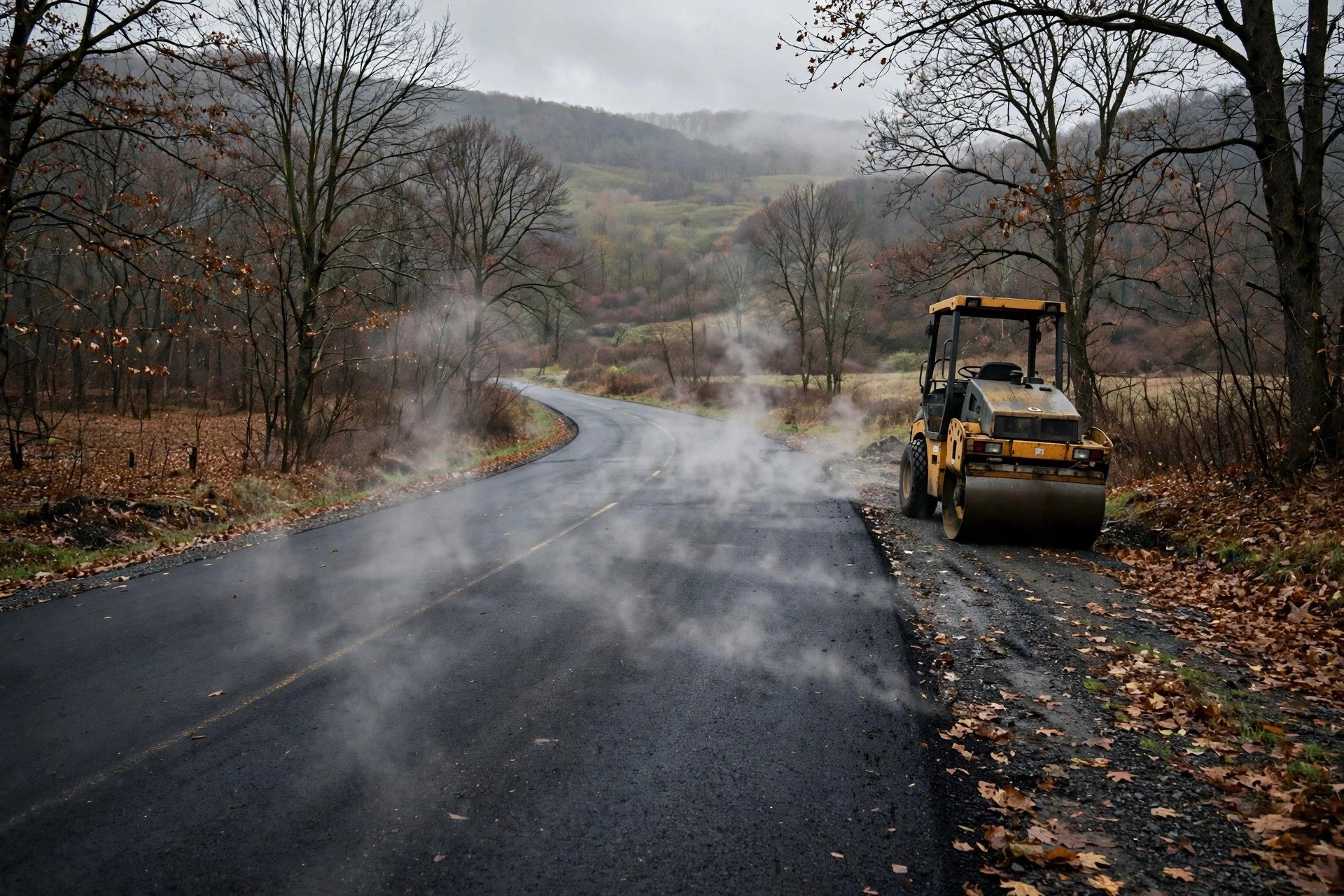
Fresh asphalt, still steaming.
By June Mercer | November 12, 2026
Orange County Gets $9.6 Million. What That Buys.
Governor Hochul announced on November 11 that New York State will spend $100 million repaving hundreds of miles of roadway under the Harsh Winter Paving program. For the Mid-Hudson region, that translates to $13.95 million spread across 49 lane miles. Orange County gets the largest piece of that, $9.6 million spread across three specific routes, with work set to begin next spring.
The scope of the statewide program is substantial: 68 locations, 642 lane miles, and what the state describes as the most ambitious annual resurfacing effort in its history. The Mid-Hudson's 49 lane miles represent a meaningful portion of that total. For drivers who have spent years navigating cracked and rutted pavement on regional routes, the numbers sound good. What they actually buy is worth examining closely.
Orange County's Three Projects: Routes, Towns, and Dollars
Orange County receives the largest share of Mid-Hudson funding in this round. Three projects account for the full $9.6 million, and two of them run through Hamptonburgh, which puts that town at the center of the county's paving investment.
The first project covers Route 207 through Goshen, Hamptonburgh, and the Village of Goshen. The state has set aside $3.6 million for that corridor. Route 207 carries a steady mix of commuter and commercial traffic through that stretch of the county. Resurfacing it means stripping away deteriorated asphalt and laying down fresh material, which addresses surface cracking, rutting, and roughness that build up year after year of freeze-thaw cycling.
The second project, the largest single allocation in Orange County, goes to Route 416. That corridor runs through Hamptonburgh, Montgomery, and the Village of Montgomery, and the state has committed $4.8 million to it. Route 416 handles consistent daily movement between those communities. At $4.8 million, it comes in $1.2 million higher than the Route 207 work, reflecting the scale of that corridor's resurfacing need, though the specific lane-mile breakdown by project has not been released in the available source materials.
The third project is confirmed as part of the $9.6 million Orange County total but is not separately named or described in the sources reviewed for this article. Routes 207 and 416 together account for $8.4 million, which means the remaining $1.2 million belongs to the third project. No route number, municipal location, or project name for that third allocation appears in the governor's release as reviewed. That information will require confirmation from NYSDOT or the governor's office before it can be reported.
Taken together, the three Orange County projects represent surface improvement coming to roads in Goshen, Hamptonburgh, and Montgomery. These are resurfacing jobs, not full reconstruction projects. That distinction matters a lot to drivers setting expectations.
What Resurfacing Fixes, and What It Doesn't
Resurfacing fixes what's on top. It addresses cracked pavement, uneven surfaces, and rough road texture that rattles vehicles and wears through tires faster than it should. A fresh layer of asphalt also tends to improve drainage, because deteriorated pavement develops depressions that pool water and speed up freeze-thaw damage. After resurfacing, roads ride smoother and hold up better through subsequent winters.
Resurfacing does not fix structural failure beneath the surface. If a road's base layers, the soil and aggregate that sit under the asphalt, have broken down, a new top coat will not solve that. The road will look better, but structural problems tend to push back through over time. Drivers on Routes 207 and 416 should expect a noticeable improvement in ride quality. Potholes that reappear quickly after the work is done, though, could point to deeper issues that surface treatment alone cannot cure.
Resurfacing also does not widen roads, adjust lane configurations, or change sight lines. None of that is part of this program.
Drivers also need to understand the timing question. Projects begin next spring. No specific construction start dates have been announced, and traffic restriction plans have not been released. Drivers on Routes 207 and 416 should plan for some disruption during spring and summer construction windows, but the exact dates, duration, and lane restriction patterns are not yet public. The state has not released projected completion dates for any of the Mid-Hudson projects under this round of funding.
The Harsh Winter Paving program exists for a specific reason. Winter is the most destructive season for road surfaces. Freeze-thaw cycles crack asphalt from below as water seeps into small voids, freezes, expands, and forces the material apart. Each winter that rolls over an already-stressed surface adds compounding damage. Getting fresh pavement down before the next winter hits, or as early as possible in the following spring, limits how much of that damage can accumulate. The program's name reflects the logic.
Why Orange County's Per-Mile Cost Runs Higher
A rough calculation illustrates the regional picture. The Mid-Hudson region's $13.95 million across 49 lane miles works out to approximately $284,000 per lane mile as a simple average. That figure is not a project-specific cost rate; individual project costs vary based on road conditions, materials haul distances, and site complexity. But it does sit above the statewide average implied by the $100 million program covering 642 lane miles, which works out to roughly $156,000 per lane mile. The regional projects in this round may involve more deteriorated or complex sections, though the state has not released a breakdown explaining the difference.
Beyond Orange County: Putnam and the Dutchess Question
The Mid-Hudson region's $13.95 million covers more than Orange County alone. Putnam County has at least one named project in this round: Route 301 in Kent and Putnam Valley, running from the Kent line to Old Forge Road. The dollar amount for that project was truncated in the governor's release and does not appear intact in the sources reviewed for this article. The Route 301 Putnam County allocation cannot be confirmed or estimated, and no figure will be reported here until it is verified.
Dutchess County does not appear in the Mid-Hudson project list from the sources reviewed. No project is named or funded there under this specific Harsh Winter Paving round. That absence does not mean Dutchess County roads are excluded from all state investment this year. It means no allocation appears in the materials covering this particular $100 million announcement. This is worth saying plainly rather than leaving readers to wonder whether something was missed.
The Statewide Numbers Behind the Record Claim
The $100 million Harsh Winter Paving program sits inside a significantly larger infrastructure push. Governor Hochul's announcement connects it to what the state calls the most ambitious annual resurfacing program in New York's history, and the figures behind that claim are substantial.
NYSDOT invested over $600 million in more than 180 other paving projects totaling almost 2,150 lane miles scheduled this year. Combined with the Harsh Winter Paving program's 642 lane miles, the total reaches over 4,000 lane miles for the year. That level of investment reflects the FY26 budget's $800 million commitment to paving, which the state says built on last fall's record investment.
To get a sense of scale: 4,000 lane miles is a large number. New York maintains tens of thousands of lane miles of state highway, and deterioration happens across all of them every winter. A program at this volume cannot fix every road that needs attention, but the state's characterization of it as historically ambitious appears grounded in its own investment figures. The 68 locations under the $100 million Harsh Winter Paving program span 642 lane miles statewide. The Mid-Hudson's 49 lane miles represent roughly 7.6 percent of that statewide lane-mile total, while the region's $13.95 million represents roughly 14 percent of the total dollar investment. The regional share of spending runs proportionally higher than the lane-mile share, suggesting more intensive work per mile in this area, though again the state has not provided a detailed breakdown.
What Drivers on These Routes Should Actually Expect
If you drive Route 207 through Goshen or Route 416 through Montgomery, here is the straightforward picture. By next spring, construction crews will begin resurfacing work. Traffic will be disrupted. Exact dates and restriction plans are not yet available. The finished product will be a smoother road surface, better riding conditions, and improved pavement life through coming winters.
You will not get a rebuilt road. You will not get structural repairs if the base beneath the asphalt has failed in sections. And you will not get a construction schedule yet. Those details have not been released.
The Putnam County project on Route 301 from the Kent line to Old Forge Road is confirmed as part of this program, but its dollar amount is not available from the sources reviewed. Drivers in that corridor should watch for a follow-up release from NYSDOT or the governor's office with the specific figure.
For Orange County, the picture is clearer. Three resurfacing projects, $9.6 million committed, work beginning in spring. Routes 207 and 416 will get fresh pavement. The third project's location remains unconfirmed in the available release. The broader context is a statewide program running at a scale the state says it has not attempted before.