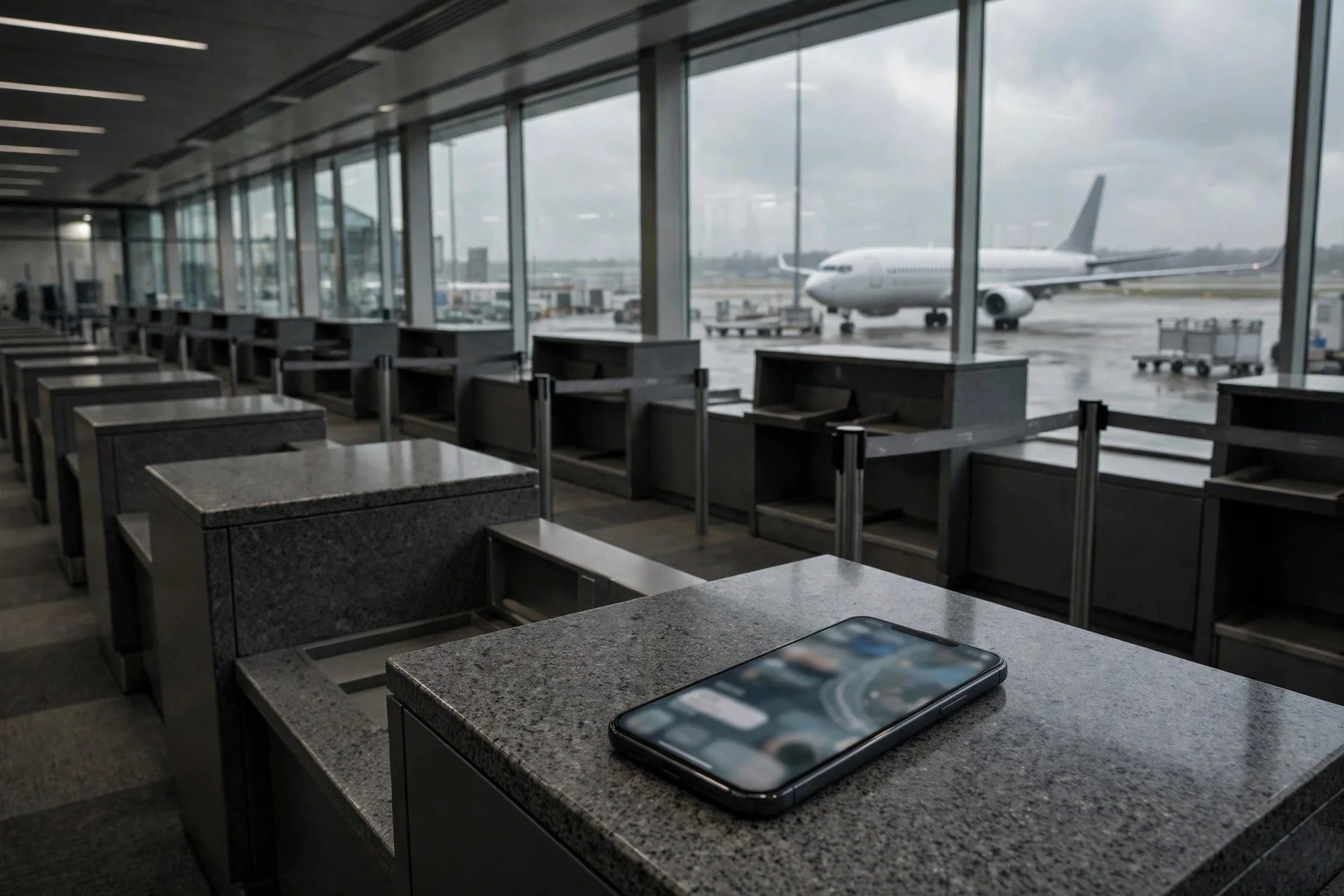
The counter is open. The agent is not.
By Ellis Ward | November 12, 2026
Your AI assistant can still scroll through United's flight options and report back prices. What it cannot do, as of Wednesday, is buy the ticket, change your reservation, or check you in. United Airlines wrote that prohibition directly into its Contract of Carriage on November 11, becoming the first US airline to formally ban third-party AI agents from handling bookings. And buried in the new rules is a clause that lets United cancel your reservation without telling you.
The policy says this, the airline says it did it for these reasons, and you should do this if you have been using AI tools to manage travel.
What United's Contract of Carriage Now Says
The changes touch three separate rules. Rule 1 adds a formal definition of "AI agents" to the contract. Rule 6.J.6 adds the use of AI agents to make, modify, or service a ticket, or to purchase any service or product, to the list of practices United prohibits. Rule 5.H gives United the right to cancel reservations made or managed by AI agents without notice.
That last provision is worth reading twice. Without notice. If a third-party AI agent completed a booking on your behalf after November 11, United can cancel it without warning you first. The airline confirmed that bookings made before November 11 are not affected, and it encouraged travelers to verify that any recent reservations were booked and ticketed correctly.
The ban reaches across every channel United operates or touches: its own website, its mobile app, travel agencies, and third-party booking platforms and aggregators. The rule does not stop an AI tool from displaying flight options, comparing prices, or showing available routes. It stops the tool from completing any transaction, any itinerary change, or any account action on a traveler's behalf.
Simple Flying, which first detailed the Contract of Carriage changes on November 12, noted that the story was initially reported by the Wall Street Journal.
Three Reasons United Gave
United offered three distinct rationales. They differ in character, and separating them helps.
Credential sharing and data exposure
The first concern is security. USA Today reported that United's statement cited the risk that AI agents can expose sensitive customer information. The structural problem is straightforward: a personal AI agent that acts on your behalf typically needs your login credentials, payment details, and account information to do anything useful. That means your MileagePlus password and credit card data pass through a system United did not build, did not vet, and cannot audit.
United's Digital Trust Center states the position plainly: the airline does not work with any third-party AI agents. No integration exists. No authorized pathway has been established. When a traveler grants an AI tool access to their United account, that access runs entirely outside any framework United controls or has approved.
Unintended purchases and account changes
The second concern is accuracy. AI agents, the airline noted, can trigger unintended purchases, unintended account changes, or unintended use of MileagePlus miles. A flight booking involves layered decisions: fare class, seat selection, baggage fees, change policies, and whether to redeem miles or charge a card. An automated agent working from a natural-language prompt can make choices the customer did not explicitly authorize. A misread instruction might burn miles the traveler was holding for a bigger trip, or lock in a nonrefundable fare the traveler assumed was flexible.
United did not specify what error rate it observed or what incidents, if any, prompted this language. That detail is not in any of the sources reviewed for this article.
Federal rules at check-in
The third rationale is the most specific, and it points to a genuine regulatory constraint. Under 49 CFR 175.25, airlines must inform passengers about prohibited dangerous goods at both purchase and check-in. At check-in specifically, passengers are required to acknowledge that their baggage does not contain banned substances, including explosives. Federal regulations require that acknowledgment to come from a human.
An AI agent completing check-in on a passenger's behalf cannot legally satisfy that requirement on its own. Simple Flying reported that this check-in concern is rooted primarily in federal hazardous materials rules.
USA Today noted that neither the FAA nor the DOT responded to requests for comment before publication.
Who Is Actually Affected Right Now
For most travelers today, the practical impact is close to zero. United's Digital Trust Center says the airline does not currently work with any third-party AI agents. No consumer AI tool has an authorized integration with United's booking systems. The ban, in that sense, formalizes a reality that already existed.
What is new is the consequence. United has now put in writing that it can cancel reservations made through unauthorized AI agents without notifying the passenger. Travelers who have been experimenting with agentic tools, such as AI assistants designed to research and autonomously complete travel bookings, should take that seriously.
The parties with the most direct exposure are companies building AI-powered travel products. Tools designed to autonomously search, compare, and book flights across multiple carriers now face an explicit prohibition on one of the largest US airlines. United's willingness to encode the ban in a legally binding contract, rather than leaving it as a vague terms-of-service warning, signals that this is a considered position, not a temporary caution.
United told USA Today it will continue to evaluate how it works with AI tools. The airline also stated that it wants standardized, secure technology integrations in place first, ones that include privacy protections, authorization frameworks, and clear accountability structures. What those integrations would look like in practice, and when they might arrive, the airline has not specified.
What Analysts Are Watching
United's stated reasons center on safety and regulatory compliance. Industry analysts have noted a second dimension that runs alongside those concerns.
Henry Harteveldt, a travel industry analyst, addressed the policy in coverage by CBS News. Analysts watching the sector have pointed to a distribution question layered beneath the security argument: airlines have worked for years to steer bookings toward their own direct channels, where they capture more margin and retain more customer data. A third-party AI agent that shops across all carriers and books the cheapest result available can undercut that model in ways that metasearch tools never fully could, because an AI agent can complete the transaction without the traveler ever visiting the airline's own site.
United has not framed the policy in those terms. The company's public rationale focuses on data exposure, unintended actions, and federal compliance. The distribution concern is analyst observation, not United's stated position. The distinction is worth noting.
JetBlue's president offered a contrasting view from the other side of the debate. Per Reuters reporting carried November 12, the JetBlue president said airlines should follow customers' lead on AI booking agents. That is a meaningfully different posture: accommodate whatever tools travelers choose to use, rather than restrict them in advance.
The gap between United's formal first-mover prohibition and JetBlue's more permissive framing suggests the industry has not settled on a consensus approach. United is the first US airline to put a ban in writing. Whether others follow or take a different path will likely depend on how quickly secure AI booking integrations develop and whether federal regulators weigh in on the human-acknowledgment question at check-in.
What Travelers Should Do Now
If you use AI tools to research or manage travel, three steps are worth taking.
First, check any United reservation from the past week or so. If an AI assistant may have completed or modified a booking on your behalf through United's site, its app, or any third-party booking platform, verify that the reservation is ticketed and still active. United has reserved the right to cancel such bookings without notification.
Second, understand the line United has drawn for future travel. An AI tool can pull up prices, display available routes, and compare options. It cannot click "purchase," modify your itinerary, apply upgrades, or complete check-in. Those actions need to come from you directly, through United's own channels.
Third, if you are building workflow automations that touch travel purchasing, the Contract of Carriage now contains explicit prohibitions. Rule 6.J.6 covers making, modifying, or servicing a ticket, as well as purchasing any service or product through United or its booking partners.
What Remains Unsettled
Several things are genuinely unclear and worth watching.
The regulation behind United's check-in rationale, 49 CFR 175.25, requires human acknowledgment of dangerous goods restrictions. What counts as sufficient human involvement when an AI tool assists in prefilling a check-in form is not something United has spelled out, and neither the FAA nor the DOT responded to press inquiries before publication. If regulators eventually clarify that a traveler reviewing and confirming an AI-assisted check-in satisfies the rule, one of United's three stated rationales weakens.
The scope of "AI agent" under Rule 1 of the Contract of Carriage also invites scrutiny. Browser extensions that pre-populate booking forms, voice assistants that initiate purchases, and travel apps with autofill features all sit somewhere on a spectrum from "tool" to "agent." United has not publicly released the full text of its AI agent definition. The Apex Wire reported that Rule 1 adds the definition, but the precise language United uses will determine where the edges of the ban fall in practice.
Finally, United has said it wants to work with AI tools under secure, standardized integrations, with privacy, authorization, and accountability protections in place. That framing is an opening, not a permanent door-closing. The question is whether the AI travel sector and United can agree on what that standard actually requires, and how long arriving there takes.
For now, the rule is simple: on United, your AI assistant can browse. It cannot buy.