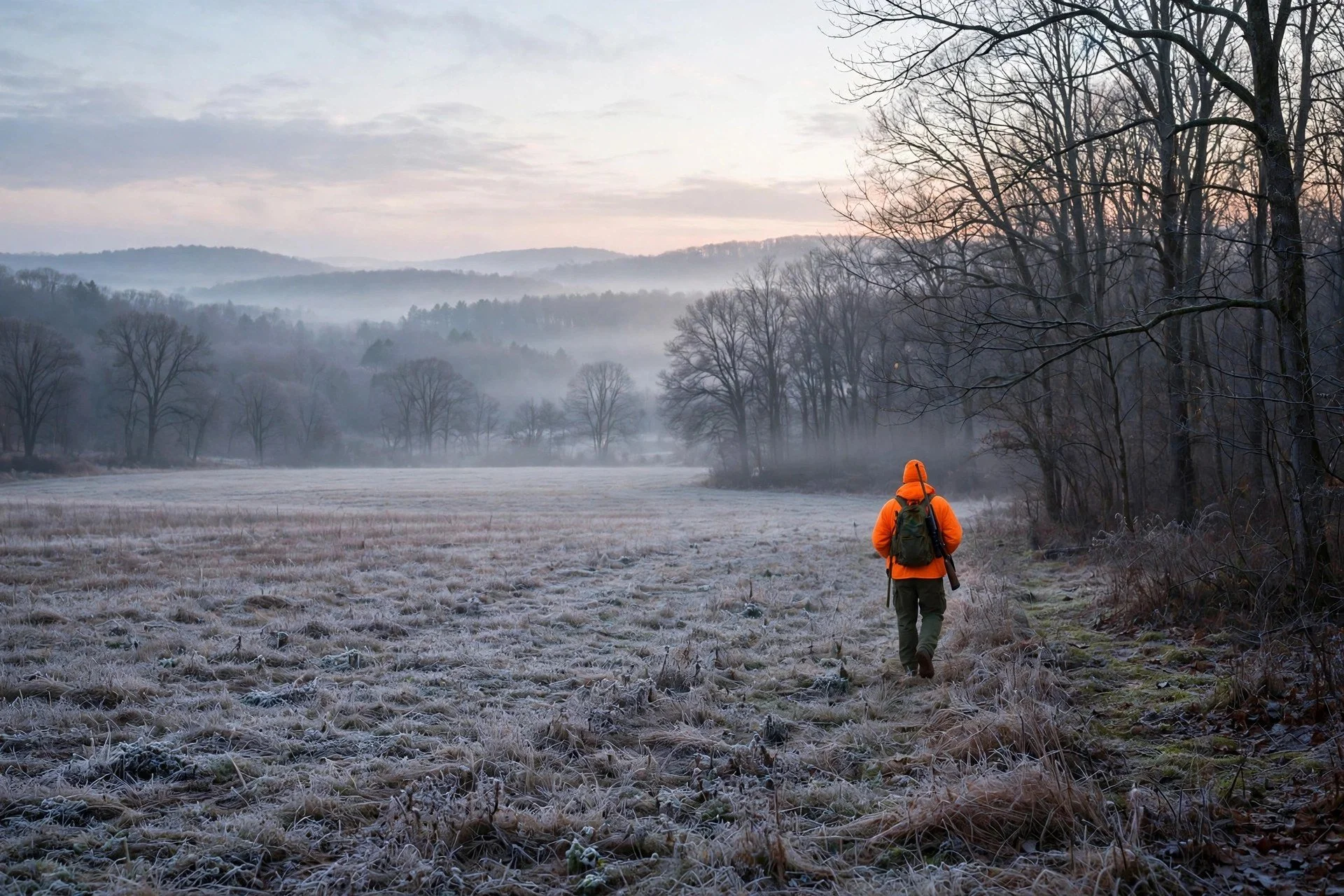
Opening morning, first light.
By Ellis Ward | November 20, 2026
Saturday is your first shot. The Southern Zone firearms deer season opens November 21, 2026, and runs through December 13. That covers Hudson Valley, Dutchess County, and the rest of the zone. Bowhunting closed Friday. The rifles come out tomorrow.
If you have not confirmed your gear, your tags, and your unit rules, do it today. This guide walks through the six things you need to get right before you step into the field.
Step 1: Put on Fluorescent Orange or Pink
New York State requires every hunter and every companion in the field to wear fluorescent orange or pink when hunting big game with firearms. DEC sets that rule, and it covers anyone walking with you, not just the person holding the gun.
Some hunters assume the orange rule applies only to the shooter. It applies to everyone in the hunting party. If your spouse, your kid, or a friend is walking the woods with you, they wear it too.
A vest, jacket, or hat in the required color works. The point is visibility. Dense cover and low morning light make it hard to see other people, and the orange or pink tells other hunters you are there before they hear you.
Do not go into the field without it. There are no exceptions and no alternatives.
Step 2: Get Your Hours Right
Legal hunting hours run from 30 minutes before sunrise to 30 minutes after sunset. That window moves every day as the sun shifts through late November and into December.
Do not guess the exact times. The DEC publishes a sunrise-sunset table in the annual Hunting and Trapping Regulations Guide. Pull that table before each day you hunt and note the specific start and end times for your location. The window narrows fast as December approaches, and shooting after legal hours is a serious violation.
Plan to be in your stand before the legal start, and pack up before the window closes.
Step 3: Know What You Cannot Do
New York law bans specific methods outright. Using any of these is illegal regardless of your tags or your intentions. According to DEC, the following are prohibited:
- Fully automatic firearms
- Artificial light or laser aids used to hunt deer
- Silencers
- Rimfire firearms
- Shotguns under 20 gauge, or shotguns loaded with anything other than a single projectile
- Harvesting a deer in water
That last item catches hunters off guard. If a deer walks into a stream or pond, you cannot shoot it there. Wait for it to return to dry ground, or let it go.
Review this list against your planned setup before you go. If anything you brought appears on it, leave it behind.
Step 4: Check Antler Rules for Your WMU
Antler point restrictions apply in several Southern Zone Wildlife Management Units. In those units, a legal buck must carry at least one antler with three or more points, each measuring at least one inch in length.
The WMUs where that restriction applies are: 3A, 3C, 3H, 3J, 3K, 4G, 4O, 4P, 4R, 4S, and 4W.
Hunters aged 12 to 16 are exempt from the restriction. If you are 17 or older and hunting in one of those units, you need to count the points before you shoot. A fork-horn or spike buck does not qualify under the three-point minimum.
If you are unsure which WMU covers your property or planned hunting area, check DEC's current regulations guide. The antler rule is enforced, and not knowing your WMU is not a defense.
Step 5: Tags, DMPs, and 2026 Rule Changes
Tag rules shifted for 2026. DEC made several updates that affect what you can carry and how additional tags work. Treat the summary below as a starting point, then verify every detail in DEC's current guide for your specific unit.
One antlered tag comes with your license. That part has not changed.
Harvest an antlerless deer with a valid tag and you earn a second antlered tag. Fill your doe tag legally, and DEC opens up a second antlered tag for you. That gives hunters a reason to pursue antlerless deer early in the season.
Bow and muzzleloader privileges now include one antlerless tag each. If you hold either privilege, one antlerless tag comes with it. That is new for 2026, according to DEC.
Deer Management Permits are now unlimited in 23 WMUs. You can apply for DMPs during the season in those units, not just before it opens. DMPs are also now transferable, but only as paper tags. Digital transfers do not count. If you plan to pass a DMP to another hunter, you need the physical paper tag in hand.
DEC is the authority on all of this. Confirm your unit's DMP availability, your antlerless options, and the earning rule for the second antlered tag in the full regulations guide before you hunt.
Step 6: Tagging, Transport, and CWD Rules
The verified facts available for this article do not cover the specific step-by-step procedures for tagging your deer, transporting the carcass, or complying with Chronic Wasting Disease rules. This section points you to the right source rather than fill those gaps with guesswork.
DEC's current Hunting and Trapping Regulations Guide covers all of it: how to tag your deer immediately after harvest, what information goes on the tag, legal transport requirements, and any CWD check station rules that apply to your area.
CWD procedures can change season to season. Do not rely on last year's guide or on advice from other hunters. Pull the current document and read the relevant sections before the season starts.
Confirm Your WMU Before You Go
Every rule in this guide connects to your specific Wildlife Management Unit. Antler restrictions, DMP availability, and CWD requirements all vary by unit. Hudson Valley and Dutchess County hunters fall within specific WMUs that may differ from neighboring zones.
Look up your WMU in DEC's current regulations guide before you head out Saturday. Mid Hudson News reported on November 19 that the season opens this weekend. The preparation window is short.
The firearms season runs November 21 through December 13. Late bowhunting follows December 14 through 22. Muzzleloader season runs December 26, 2026 through January 1, 2027. This week is your first window.
Today is the day to get your paperwork and gear in order. Saturday, you hunt.