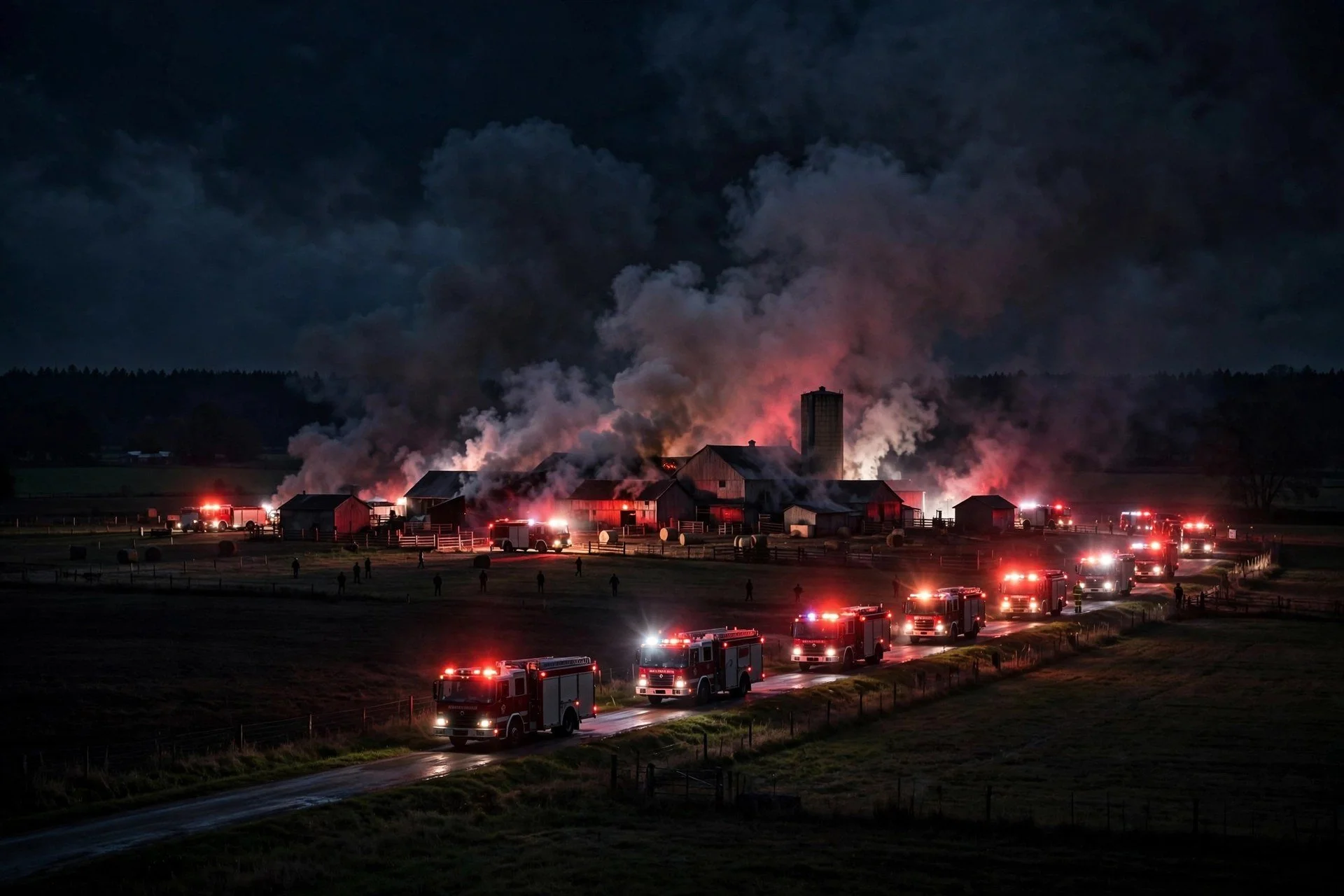
Two hundred responders by sunrise.
By June Mercer | November 20, 2026
The 911 call came at 1:10 in the morning. First responders arrived at 346 Airport Road in Mongaup Valley to find the main building at Hudson Valley Foie Gras already fully engulfed. Chief Charlie Kalinowski of the Smallwood-Mongaup Valley Fire Department said the fire had spread too fast to allow crews inside. By the time Thursday's sun rose on November 19, two bird buildings were destroyed, an unknown number of birds were dead, and roughly 200 first responders from five counties had spent the night fighting a fire they could not stop. By 10 in the morning, a large grey smoke plume had drifted southeast and reached Monticello.
The farm at Airport Road was not an ordinary agricultural operation. Hudson Valley Foie Gras and a single neighboring producer, La Belle Farm, also based in Sullivan County, together produce nearly all commercial foie gras sold in the United States. The fire on Thursday morning destroyed most of the domestic production capacity for a product with a narrow market, a contested legal status in some cities, and a food culture that extends far beyond the Catskills.
The Response: 200 First Responders, Five Counties
Airport Road closed in the early hours of Thursday morning. Emergency vehicles arrived from Sullivan, Orange, Ulster, Delaware, and Pike counties, a geographic spread that required coordination across multiple jurisdictions. Between 20 and 25 fire trucks arrived. Roughly 200 first responders worked the scene. Trucks from the Grahamsville, Kaneunga Lake and Hortonville fire departments were among those seen rushing down Route 17B on Thursday morning, and the fire spread through metal-clad, wood-framed structures, according to Radio Catskill.
The Smallwood-Mongaup Valley Fire Department led the response. Chief Kalinowski described conditions on arrival: the main building was fully engulfed. The fire had moved too fast. Crews could not enter.
The initial structure was lost before any interior suppression effort was possible. The 200 first responders who answered the call worked to protect what remained, manage exposure to neighboring structures, and contain a fire that had already consumed the building where it started.
Routes 17B and 55 carried heavy emergency traffic through the morning. Airport Road remained closed for hours. For anyone driving through Sullivan County before sunrise on November 19, the density of emergency vehicles converging on surrounding roads was an early signal that something large had gone wrong overnight.
No employees were killed or injured. That outcome, confirmed by Thursday, is the clearest piece of good news from a night that destroyed the core of the operation.
The cause of the fire has not been confirmed. Investigators are working from a hypothesis of electrical malfunction. No official determination had been issued as of publication.
A Farm That Supplied Most of America
Hudson Valley Foie Gras, registered under HVFG LLC, operates at 346 Airport Road in Mongaup Valley. The farm produces duck, goose, and chicken products. Its foie gras operation produces the fattened livers of specially fed ducks or geese. Foie gras production involves a feeding process that enlarges the liver, a practice that has drawn sustained opposition from animal welfare groups and legal restrictions in multiple jurisdictions.
The domestic market for foie gras is small by the standards of American agriculture, but it is supplied almost entirely from Sullivan County. Hudson Valley Foie Gras and La Belle Farm, the only other large-scale commercial producer, together account for nearly all foie gras sold in the United States. No other domestic producers of comparable scale exist in the confirmed record.
That concentration matters when one of the two farms burns. The supply that Hudson Valley Foie Gras provided to restaurants, specialty retailers, and distributors ran through the production chain at 346 Airport Road. As of Thursday morning, two of the bird buildings at the core of that chain were gone.
The farm has also been engaged in an active legal dispute over foie gras sales in New York City. According to Gothamist, which reported on the fire November 19, Hudson Valley Foie Gras has a lawsuit pending over New York City's ban on foie gras. That legal fight, which the company was waging before the fire, now runs alongside a physical rebuilding question that has no confirmed answer.
The Company's Vice President Spoke
Marcus Henley, vice president of Hudson Valley Foie Gras, confirmed Thursday that two bird buildings were destroyed. He did not confirm the number of birds killed. That figure remains unknown.
Henley addressed the workforce directly. He said the company plans to transfer some employees to White Lake Foods, which recently opened a factory in Liberty, New York. That facility operates out of a former PepsiCo plant. Liberty is in Sullivan County, the same county as the Mongaup Valley farm.
The transfer applies to some employees. The total number of workers the farm employed before the fire has not been confirmed in the available record. The number moving to the Liberty location has not been specified. The gap between "some" and the farm's full workforce is a fact gap this report cannot close.
Henley made no public statement about rebuilding plans, production timelines, or the future of the Airport Road site. Whether the company intends to restart foie gras production at the existing location, seek a new facility, or reduce its operational scale is not known. No statement on those questions has been reported.
Smoke Over Monticello
For much of Sullivan County, the fire made itself known before any formal notification arrived. A large grey smoke plume rose from the Airport Road site and moved southeast. By 10 in the morning, it had reached Monticello.
Airport Road remained closed through the morning. The combination of the closed road, the emergency vehicle traffic on Routes 17B and 55, and the visible smoke column gave the event a physical presence across a wide area of the county long before midday.
The smoke that reached Monticello by 10 a.m. was the visible residue of a fire that Chief Kalinowski had described as fully engulfed when his crews arrived shortly after 1:10 in the morning. The plume was large and grey, visible across the southern Catskills well before any formal announcements were made.
For a region where large-scale agricultural operations are rare, the smoke over Monticello carried weight beyond its physical presence. Sullivan County has watched its economic base shift across decades. Hudson Valley Foie Gras represented one of the county's more visible agricultural operations and one of the very few remaining in the region with a national profile tied to a specific rural address in the Catskills.
What Remains Unknown
The fire left a cluster of significant facts unresolved. Accurate reporting requires naming them directly.
The cause is unconfirmed. The electrical malfunction hypothesis is a working theory, not an official determination. The investigation is presumably ongoing, but no finding has been issued as of this report.
The number of birds killed is not known. Marcus Henley confirmed two bird buildings were destroyed. What was inside those buildings at the time of the fire has not been quantified publicly.
The scope of structural damage beyond the two confirmed bird buildings has not been fully established. Chief Kalinowski described the main building as fully engulfed on arrival. The condition of other structures on the property is not part of the confirmed record.
The workforce impact is only partially known. Some employees will transfer to White Lake Foods in Liberty. How many people the farm employed before the fire, and what happens to workers not moving to the Liberty factory, has not been confirmed.
The farm's future is an open question. No public statement about rebuilding or winding down the operation has been made. The pending lawsuit over New York City's foie gras ban adds a legal dimension to decisions that have no confirmed direction.
A Market Built on Two Farms
Hudson Valley Foie Gras did not operate alone. Its production ran alongside La Belle Farm's output to supply nearly the entire domestic market for a product that is legal to produce federally but restricted in certain municipalities. That concentrated supply structure means a single catastrophic event at one of the two farms carries market consequences well beyond Sullivan County.
The fire removed a substantial portion of domestic foie gras production capacity in one night. Whether the resulting gap is absorbed through imports, through any expansion at La Belle Farm, or through reduced availability at the retail and restaurant level is not something this report can determine. Those dynamics will play out in the weeks after Thursday.
The farm at 346 Airport Road, one of two commercial foie gras producers that together supply virtually the entire United States market, lost its main building and its two bird buildings in a single early morning fire. Two hundred first responders from five counties worked the scene and could not stop it.
The workers who reported to Airport Road are now being directed, at least in part, to a Liberty factory that until recently made something else entirely. The birds are gone. The smoke reached Monticello before 10 in the morning and kept going south.