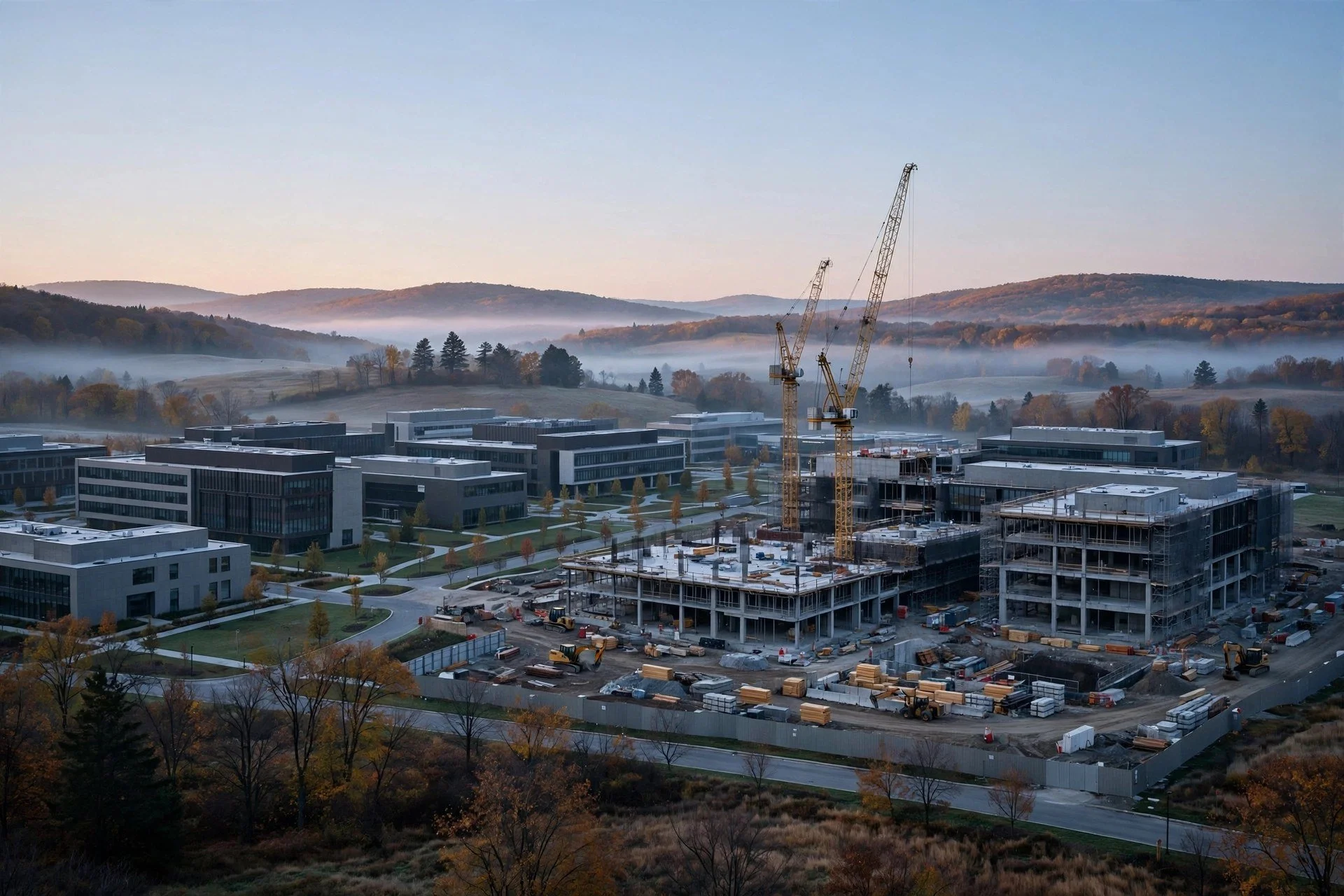
Cranes over the valley.
By Mara Quinn | November 20, 2026
Poughkeepsie's tax rolls are about to get a substantial recalibration. The Dutchess County Industrial Development Agency committed $104 million in tax incentives to IBM in October 2026, an approval updated in the IDA's filings as recently as November 11. That public commitment unlocks a private investment of $2.51 billion - IBM's planned capital outlay at its South Road campus from 2026 through 2035. For every dollar Dutchess County puts in, IBM has committed roughly $24.
The project is not waiting on approval to begin. Contractors are already on the ground for preliminary work. A co-located quantum-classical computing system began operating at the facility on November 5. An IBM official has indicated that formal groundbreaking could come soon. What remains unfinished is a permitting process that keeps full construction on hold even as preliminary activity starts around it.
The Incentive Package
The Dutchess County IDA structured the $104 million to support what IBM describes as a multi-decade commitment to its address at 2455 South Road in the Town of Poughkeepsie. The site covers approximately 308.67 acres - a footprint IBM has held for generations.
Construction costs alone are estimated at approximately $900 million, according to an IDA analysis cited by the Center for Industrial Competitiveness. That figure sits inside the broader $2.51 billion total investment, which covers not just construction but equipment, infrastructure, and the other capital outlays that go into building a world-class quantum computing campus over nine years. The $104 million in public incentives amounts to roughly four cents of every dollar IBM has committed.
The IDA's review weighed that capital commitment against the employment picture IBM brought to the table. The company currently employs approximately 2,300 people at the Poughkeepsie location. The project is designed to retain that entire workforce. On top of retention, IBM's filings project approximately 200 new full-time-equivalent positions over the life of the investment. For a county where high-skill employment in advanced technology does not come along often, that combination - hold 2,300, add 200 - carried weight in the agency's deliberations.
Two Filings, Two Buildings, Two Numbers
Understanding the project's physical scope requires separating two distinct filings, each describing a different structure and carrying a different square-foot figure. These are not competing estimates for the same building.
The first is the IDA filing. It describes a quantum computing facility of approximately 300,000 square feet. Supporting that facility is a cryogenic and generator building of about 12,000 square feet - the infrastructure needed to maintain the extreme cold that quantum processors require to function. The same filing covers site work, utilities, power, water, and cooling systems, as well as the renovation of Building 416, an existing campus structure of approximately 44,000 square feet. This is the filing directly connected to the $104 million incentive approval.
The second filing comes from a separate submission covered by Data Center Dynamics and Think Dutchess via Local Tech Radar. It describes a building called Starling, with a footprint of approximately 511,000 square feet - nearly 70 percent larger than the quantum facility in the IDA documents. The Starling filing also includes the demolition of two existing campus buildings totaling roughly 161,000 square feet. Those structures come down to clear room for what goes up.
The 300,000-square-foot figure in the IDA filing and the 511,000-square-foot figure in the Starling filing refer to two different buildings, documented in two different proceedings. Presenting either as the project's singular size would misrepresent its configuration.
Taken together across both filings, the broader campus plan is ambitious. The Data Center Dynamics and Think Dutchess reporting puts the eventual campus size at 3.9 million square feet across 45 buildings. IBM's presence at 2455 South Road is already large. The plan would make it considerably larger.
Contractors on the Ground
Three contractors appear in filings and reporting reviewed by the Center for Industrial Competitiveness.
Structure Tone, headquartered in New York City, holds the general contractor role. The firm manages the construction sequence, subcontractor coordination, and site safety across a job that will eventually employ more than a thousand workers at peak.
Shawn's Lawns Inc., based in Stamford, Connecticut, is performing site work, foundations, and groundwork - the early-stage activity that shapes the earth and sets the conditions for structural construction to follow. That work is already underway.
Select Demo, a New Hampshire firm, is performing asbestos abatement and is set to begin demolition. On a campus with buildings dating back decades, asbestos abatement typically must clear before demolition can proceed under state and federal environmental requirements. Select Demo's scope will eventually include the teardown of the two buildings - roughly 161,000 square feet total - covered in the Starling filing.
The mix of a New York City general contractor, a Connecticut site firm, and a New Hampshire specialty demolition company reflects the regional draw that large industrial builds routinely generate. The Hudson Valley Building and Construction Trades Council is watching closely not where the contractors come from but whether the workforce behind them carries union cards.
Todd Diorio, president of the Hudson Valley Building and Construction Trades Council, confirmed that the quantum project is an all-union job. No project labor agreement has been executed yet, Diorio said, but at peak construction he expects more than 1,000 workers on site at a time. By any measure, a peak workforce of 1,000-plus makes this one of the larger active construction jobs the Hudson Valley will see during the build window. Union halls across the region are expecting sustained referrals.
Jobs: Keeping 2,300, Adding 200
IBM's current headcount at the Poughkeepsie location stands at approximately 2,300 people. The project's retention commitment covers all of them. The IDA weighed that anchor employment as a central part of its incentive calculation - 2,300 specialized positions in quantum hardware, software, and related disciplines represent a significant piece of the county's economic base.
New hiring sits at approximately 200 full-time-equivalent positions. That figure does not dominate the headline, but the nature of the jobs matters. Positions IBM creates at this facility tend to be in fields - quantum physics, cryogenic engineering, classical control systems, semiconductor fabrication support - that carry compensation well above the county median. The 200 new FTEs are not interchangeable with 200 jobs at a standard commercial facility.
Together, the retention pledge and the new hiring make the IBM campus the kind of anchor employer that IDA boards in mid-size counties spend years trying to attract. Dutchess County already has it. The incentive package is designed to keep it in place through 2035 and to grow it, even modestly, in the process.
The Science Already Running on Site
Construction timelines and outstanding permits do not fully describe the state of the site. While contractors work the ground, IBM is already operating at the frontier of quantum computing inside the existing facility.
On November 5, IBM, Oak Ridge National Laboratory, and AMD announced the deployment of a co-located quantum error-correction platform in Poughkeepsie. The system pairs an IBM Quantum Nighthawk r2 processor - a 120-qubit device - with an Oak Ridge National Laboratory system called Umbra, built on AMD Instinct MI355X accelerators. The two systems work together on real-time error-correction co-design.
Quantum error correction is one of the central technical problems standing between current quantum hardware and practical large-scale computation. Quantum processors make errors - frequently - because quantum states are fragile. Correcting those errors requires classical computing power working alongside the quantum chip in near real time. The speed of that classical response matters: too slow, and the correction arrives after the quantum state has already degraded.
Co-locating the ORNL Umbra system with the IBM Nighthawk r2 in the same building removes the latency barrier that remote high-performance computing connections impose. This is not a simulation running in parallel with a quantum machine. It is an integrated platform in which the classical supercomputer participates in the quantum processor's error-correction cycle, in real time, in the same facility. As of November 5, that platform is running in Poughkeepsie.
The Starling building - the 511,000-square-foot structure described in the separate filing - connects directly to this scientific program. The Quantum Computing Report identifies the Starling system as the target that follows the current deployment, with groundwork aimed at 2029. That date places Starling at roughly the midpoint of IBM's 2026-to-2035 investment window.
Permits, Grid, and the Path to Groundbreaking
The IDA incentive is locked in, updated as recently as November 11. The contractors are on site. The quantum-classical platform is running. But the full construction program has not received all of its permits, and that gap is real.
IBM still needs grid verification from Central Hudson, the utility that serves the South Road campus. A project drawing the power loads that quantum computing infrastructure and cryogenic systems require needs confirmation that the regional grid can absorb the demand. If upgrades are required on Central Hudson's end, that introduces a variable IBM cannot fully control.
Traffic, noise, and visual impact studies are also outstanding. These are standard requirements in New York's environmental review process for major industrial development, and they feed into the larger permit package before construction at full scale can begin. The project also requires permit amendments from the state Department of Environmental Conservation.
A follow-up presentation before the relevant authorities is planned, though a specific date is not in the publicly available record as of this report. That presentation will likely be the forum where the utility question, the environmental studies, and the DEC amendments are addressed in sequence.
An IBM official's statement that groundbreaking could come soon reflects the company's read on that process. It is not a commitment to a date. How quickly Central Hudson verifies grid capacity and how the outstanding studies resolve will shape the actual schedule.
The nine-year investment window, from 2026 to 2035, was set wide enough to absorb this kind of regulatory sequencing. The 2029 target for Starling groundwork gives IBM a midpoint milestone to build toward. What happens at the permit level, at the utility, and on the construction site over the next two to three years will determine whether the campus arrives at its projected 3.9 million square feet on schedule.
For Poughkeepsie, the numbers carry local weight beyond the abstractions of quantum computing. The IBM campus at 2455 South Road has anchored the town's economy for decades. What is proposed now expands that anchor substantially, funded by the largest private technology investment in the region's recent record.