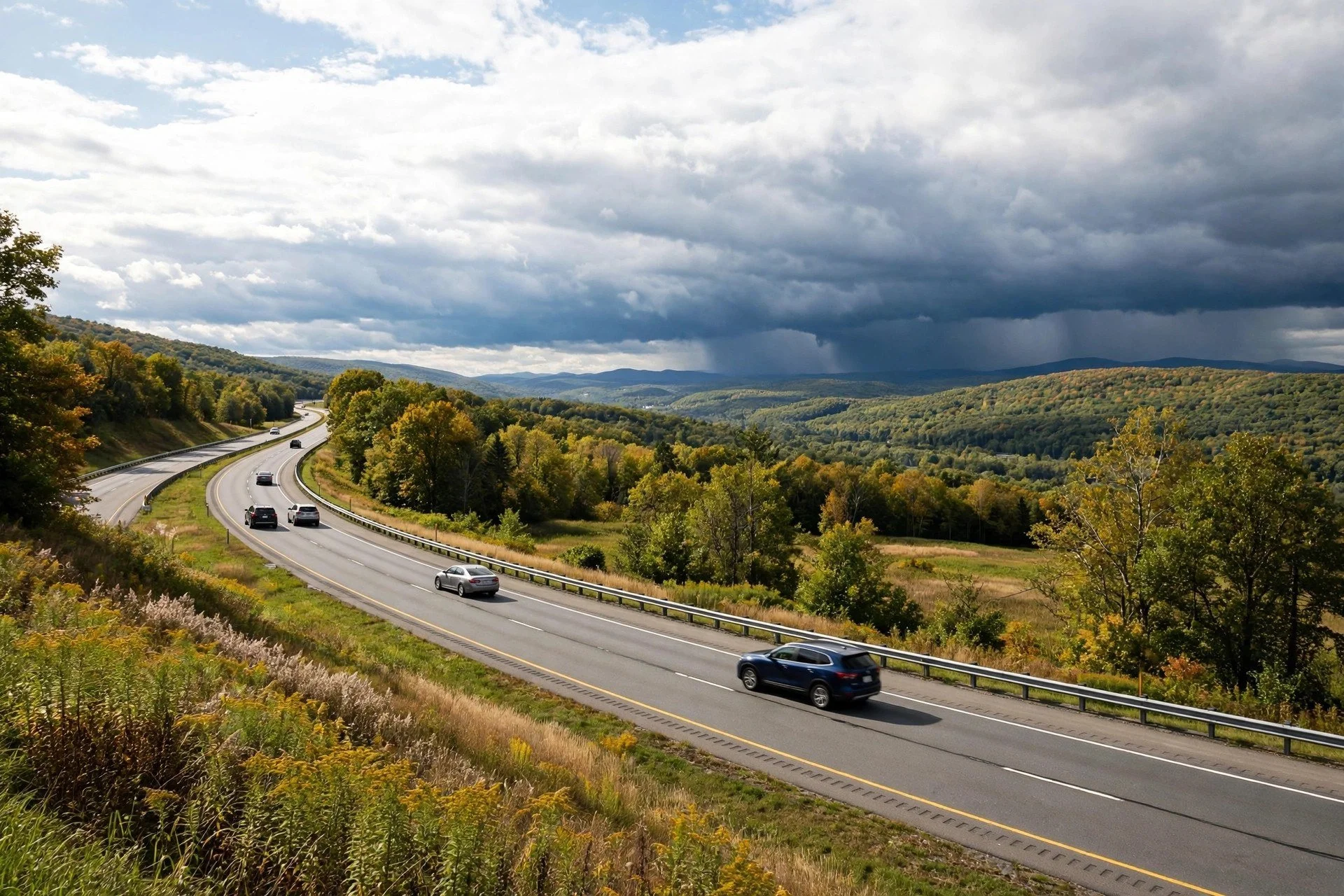
Ahead of the storm.
By Ellis Ward | November 23, 2026
The window to reach your Thanksgiving destination without fighting a coastal storm is narrow. It runs Monday through Wednesday morning. After that, rain, gusty winds, and possible coastal flooding reshape every option from the Hudson Valley to the New York City metro area. Six steps follow. Each one is built to keep you out of the storm's worst.
Step 1: Leave Monday or Early Tuesday, Before Traffic Builds
Monday is as clean as the forecast gets for Hudson Valley travelers this week. Clinton Corners sits at 61 degrees Fahrenheit with partly sunny skies. Poughkeepsie and Beacon both reach 66 degrees, mostly sunny, with no active alerts in Dutchess County. The National Weather Service's New York forecast office, in its 3:41 a.m. discussion on November 23, confirmed dry weather through Wednesday. If you can get on the road Monday, do it.
Tuesday remains dry, but traffic complicates the window. AAA, citing INRIX data, projects 81.5 million Americans will travel between November 24 and 30. Of those, 72.9 million go by car. That volume does not distribute evenly across the week. Tuesday's worst congestion falls between 2 p.m. and 8 p.m. Leave before 1 p.m. Tuesday and you stay ahead of the peak.
Step 2: If Wednesday Is Your Only Option, Go Before Noon
Wednesday is still dry per the National Weather Service, but the travel window narrows and the storm is already moving.
The system develops near the Gulf Coast on Tuesday. It tracks through the Southeast on Wednesday. By Wednesday night it reaches the Northeast, and easterly winds ramp up well before dawn Thursday. At higher elevations and inland areas, the Democrat and Chronicle reported on November 22 that rain could mix with snow or sleet at onset before changing to all rain. AAA's data puts Wednesday's traffic peak between noon and 7 p.m. Leave before noon and you clear both the road congestion and the storm's leading edge.
Step 3: Do Not Drive Thanksgiving Afternoon or Evening
Of all the days in the travel period, Thanksgiving Day itself carries the least road traffic, according to AAA. The roads will be open. The weather is another matter.
The National Weather Service forecasts rain, strong gusty winds, and widespread coastal flooding possible across southeastern New York on Thanksgiving Day. East-northeast winds reach 20 to 30 miles per hour, with gusts between 35 and 45 mph through most of the region. Near the coast, gusts could reach 50 mph. Rainfall of 1 to 2 inches is expected over 12 to 18 hours, with the highest probability concentrated in the afternoon and into the nighttime hours.
If your trip demands a Thanksgiving Day drive, go early in the morning before the storm reaches full strength. The Democrat and Chronicle, drawing on forecast offices in New York, Albany, and Binghamton and the Weather Prediction Center, reports that heavy rain and strong winds spread up the Interstate 95 corridor through the day. Waiting until after dinner means driving into the worst of it.
Step 4: If You Are Flying Thursday, Check Your Flight Before You Leave the House
The same storm that makes road travel difficult on Thanksgiving makes air travel worse. The National Weather Service flags possible instrument flight rule conditions across New York metro and coastal airports, with gusts reaching 35 to 45 knots. Low clouds, heavy rain, and sustained wind create the conditions that trigger ground stops, cut runway capacity, and push departure queues deep into the evening.
The Democrat and Chronicle specifically flags New York City hub airports for possible Thanksgiving Day delays. These hubs handle an outsized share of connecting traffic. When one bank of flights delays, the disruption spreads to routes across the country.
Check your flight status before you leave the house. Add extra time for security and check-in, since the terminal fills quickly when flights stack up. If you have any schedule flexibility, arriving a day early or returning a day later sidesteps the Thursday window entirely.
Step 5: Prep Your Vehicle Before Any Long Drive
AAA recommends checking tires, batteries, and fluids before a long drive. In a dry autumn week, that is routine guidance. This week it carries more weight.
The storm brings 1 to 2 inches of rain falling over 12 to 18 hours, east-northeast winds gusting to 45 mph, and cold temperatures settling across the region. All of that puts extra demand on a vehicle. Wipers, brakes, and tires that handle dry autumn roads without issue can fall short in a storm of this intensity. A battery that is marginal in mild weather can fail in cold rain. If your vehicle is overdue for any service, handle it Monday or Tuesday, before you need it on the road.
Step 6: Plan Your Return Before Sunday Noon and Recheck the Forecast Each Day
Rain tapers early Friday, per the National Weather Service. That opens a return window Friday afternoon through Saturday for most travelers. If that timing fits your trip, it also avoids the peak return rush.
Sunday is when the roads fill again. AAA identifies Sunday return traffic as worst between noon and 8 p.m. Leave before 11 a.m. Sunday and you stay ahead of the surge. If Sunday afternoon is your only option, add time to your estimate and plan for congestion on major routes back into the Hudson Valley.
Before every departure this week, recheck the National Weather Service forecast. That instruction appears in every source cited here for a reason: this storm's details are still uncertain. The Democrat and Chronicle, summarizing forecast offices in New York, Albany, and Binghamton along with the Weather Prediction Center, reports that forecasters stress the storm's exact track and timing remain in flux. The Weather Prediction Center has flagged a marginal excessive rainfall risk. The storm could arrive faster than projected, or slower. A forecast you checked Sunday morning may not hold by Wednesday night.
Recheck Tuesday evening. Recheck again before you leave Wednesday. The conditions that determine whether your drive is routine or miserable will be clearer by then.
Sources
- Area Forecast Discussion, Nov 23 - National Weather Service New York
- Thanksgiving storm 2026 New York weather forecast - Democrat and Chronicle, Nov 23
- Thanksgiving storm New York rain snow forecast - Democrat and Chronicle, Nov 22
- 81.5 million Americans expected to travel for Thanksgiving - AAA Newsroom
- AAA Thanksgiving travel forecast - AAA Northeast