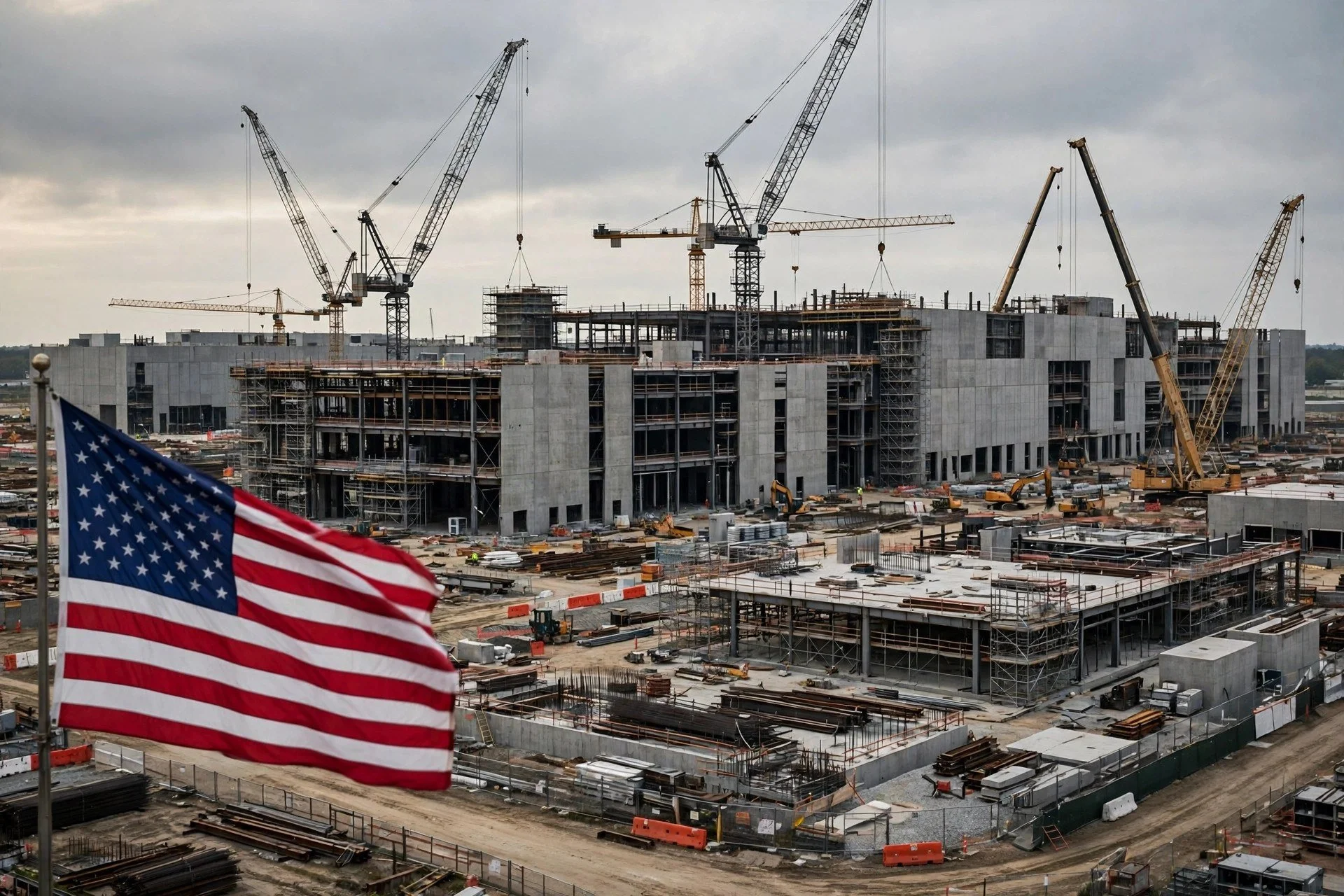
Steel, cranes, and a flag.
By Ellis Ward | November 23, 2026
President Trump said Friday he plans to tax American tech companies that build artificial intelligence data centers abroad. The announcement adds federal pressure on an industry already navigating local opposition and new grid rules.
Trump spoke at a White House press conference on November 20, shortly after returning from Asia. Vice President JD Vance and Secretary of State Marco Rubio were in attendance. The session ran nearly 90 minutes, according to the Wall Street Journal.
"We're not going to allow companies to build data centers in other countries," Trump told reporters, according to the Associated Press. "If they do that, they can. But we're going to put a tremendous tax on them."
The concern is China. "We're not allowing data centers to go into other countries because China will take all of them, and we're not allowing that to happen," Trump said in remarks reported by the Wall Street Journal. "And we're going to put tremendous penalties on companies that try and do it."
The United States leads China in AI development today, Trump said. He argued that building abroad would erode that edge. Foreign chip production had already been "very destructive," he said. If building abroad goes unchecked, "they all will build in China," he warned, according to the AP and USA Today.
No Rate, No Statute, No Mechanism
Trump offered no rate, no statute, and no executive order. No enforcement mechanism appeared in reports from the Associated Press or the Wall Street Journal. Trump acknowledged he had not yet told his staff about the plan. As the AP reported, it is not immediately clear how such a penalty would be enforced. The Wall Street Journal noted it is also unclear how the administration could penalize companies for building projects in other countries.
The penalty, for now, is a stated intention without a structure behind it.
Why Companies Build Abroad
Companies including Amazon, Google, Microsoft, and OpenAI seek cheaper land, labor, and electricity outside the United States, the Wall Street Journal reported. Getting around domestic permitting fights is another reason. The dollars involved are large. UBS projects $1.8 trillion in AI spending next year, mostly on data centers, the AP reported.
Trump also addressed host communities. "You ought to take advantage of data centers," he said, in remarks reported by USA Today. "Make them pay. Make them pay your communities, but don't shut them off." He continued: "Make the deal. They have plenty of money. Take it." The AP reported that deal elements could include tax breaks, reduced utility bills, money for teachers, and direct payments to communities.
Google and Meta officials told the AP they are increasing incentives and transparency. No specifics appeared in reports available at publication time.
Congress Acted the Day Before
The Senate approved legislation on November 19, one day before Trump's press conference, to speed permitting for power plants, transmission lines, and energy infrastructure. The bill also requires data centers to pay for their own energy upgrades. It now goes to the House, according to the AP and USA Today.
The legislation follows a political moment shaped by voter backlash. Data center concerns contributed to a Republican wipeout in midterm elections less than three weeks before Trump's announcement, the AP reported.
Voters Have Said No, Repeatedly
The polling is consistent. About three out of four voters opposed a new data center in their community, per an AP voter poll. A Gallup poll from August found that seven in ten Americans do not want one locally. An AP-NORC/EPIC summer survey found about six in ten Americans supported limiting new data centers. A majority in that survey said they were extremely or very concerned about electricity prices and water use.
USA Today reported referendums in at least 45 cities and towns. At least 44 of those votes moved to restrict data centers.
East Fishkill and the Grid Rules
RFTUV has followed data center development in the Hudson Valley, including a large project in Dutchess County. As of November 21, Watt Street queue data shows a 1.0 gigawatt data center request in East Fishkill still active in the New York Independent System Operator queue. That request is one of seven from Dutchess County, which together total 1.1 gigawatts.
The project operates inside a grid framework that has grown stricter. NYISO filed two new tariff proposals with the Federal Energy Regulatory Commission on November 16, docket numbers ER27-517 and ER27-529. RFTUV explained those filings on November 22. Under the proposals, large loads of 50 megawatts or more must choose between firm and non-firm service. Non-firm service carries a bid cap of $200 per megawatt-hour. Developers must also pay for grid upgrades within 15 years. The proposed effective date is February 1, 2027.
A 1.0 gigawatt project qualifies as a large load by a wide margin. The NYISO rules shift more cost and risk onto developers before construction begins.
Trump's promised federal penalty adds one more variable to that picture. Whether it reaches the East Fishkill project depends on enforcement details that do not yet exist. What does exist is a growing stack of costs and obligations, at the local level, in the Senate, and in FERC's docket.
Sources
- Trump says he plans to penalize US tech companies that build AI data centers in other countries - Associated Press via LA Post
- Trump tax on AI data centers - USA Today
- Trump White House press conference following trip to Asia - Wall Street Journal
- New York interconnection queue - Watt Street
- NYISO ER27-517 large-load integration - Load Factor News