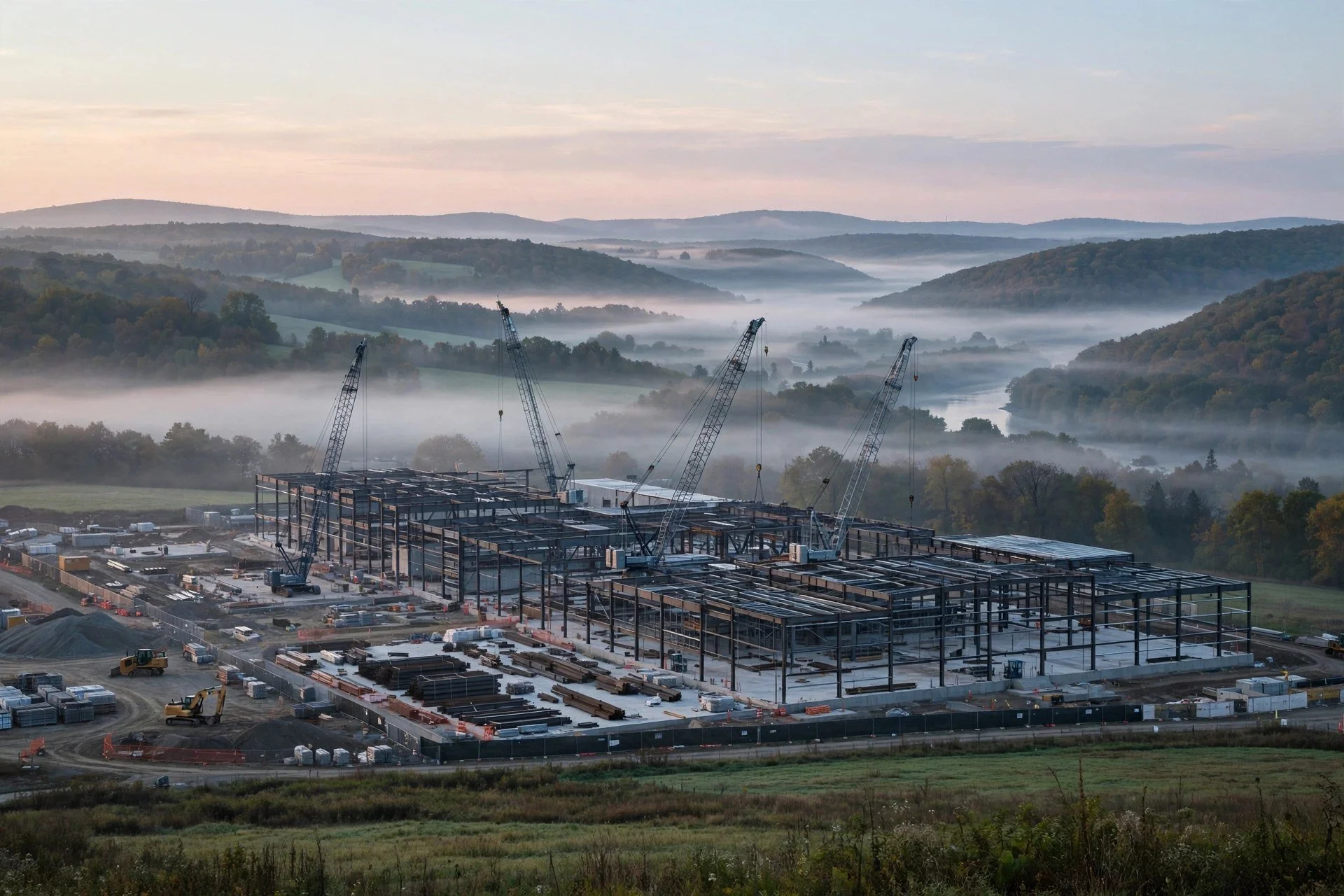
Steel up at South Road.
By Mara Quinn | November 22, 2026
A $2.5 Billion Bet on Poughkeepsie
IBM is spending $2.5 billion to build a quantum computing facility on more than 308 acres in Poughkeepsie. The project covers three new structures and one major renovation, totaling roughly 356,000 square feet of construction. It is the largest technology project in Hudson Valley history, according to Whiteman Osterman and Hanna, the Albany-based law firm that represented IBM through the full approval and incentive process.
The public incentive package came to $104 million. It includes a 30-year Payment in Lieu of Taxes agreement, five years of sales tax exemptions on construction purchases, and a mechanism designed to extend the tax benefit framework to future IBM investments at the site. Dan Hubbell and Katie Kemp, attorneys at Whiteman Osterman and Hanna, negotiated that package with local industrial development agencies. Their colleagues David Everett and Paul Van Cott handled the land use and regulatory approvals across multiple jurisdictions.
IBM's existing Poughkeepsie workforce drives the economic case as much as the new hires do. The company expects to retain approximately 2,300 current positions at the site and add roughly 200 new full-time-equivalent roles. This combination, holding the existing base while adding to it, sets this investment apart from technology projects that arrive without a local workforce already trained and in place.
What Gets Built
The construction program breaks into four distinct elements. IBM will build a quantum computing center of approximately 300,000 square feet, the core of the entire program. Next to it goes a cryogenics plant of roughly 12,000 square feet, purpose-built to supply the extreme low-temperature cooling that quantum hardware requires. Building 416 on the existing campus receives a 44,000-square-foot renovation. All of this spreads across four Poughkeepsie parcels: 2455 South Road, 477-708 Innovation Way, 29-31 Sand Dock Road, and 98 Cliff House Lane. The combined acreage totals 308.67.
Construction costs alone run to $900 million. That figure covers the quantum center, the cryogenics plant, the Building 416 renovation, and all site work across the full footprint. Groundbreaking is expected shortly, according to documents filed with development agencies as part of the project approval process.
Three contractors hold primary positions. Shawn's Lawns is performing site work, covering earthwork, grading, and site utilities across the entire 308-acre spread. Select Demo is handling asbestos abatement and demolition on existing structures that must come down before new foundations go in. Structure Tone is the general contractor for the building program itself, overseeing construction of the quantum center, the cryogenics plant, and the Building 416 renovation.
The Quantum Roadmap: Starling and Blue Jay
IBM has published a specific technology roadmap for what the Poughkeepsie facility will produce. The company describes the program, in materials released through its media center, as an effort to build the world's first fault-tolerant quantum computer.
The roadmap names two systems. Starling, targeted for 2029, is designed to operate at 100 million gates with 200 logical qubits. Blue Jay, targeted for 2033, is designed to operate at one billion gates with 2,000 logical qubits. Each system depends on the hardware and error-correction work completed before it.
The distinction between logical qubits and physical qubits carries practical weight. Physical qubits, the kind in quantum processors available today, lose coherence quickly and generate errors that make reliable large-scale calculation difficult. Logical qubits address that problem: each one is built from multiple physical qubits, with active error correction running continuously to protect the calculation in progress. The 200 logical qubits Starling targets by 2029 would exceed what any existing quantum system delivers. Blue Jay's 2,000 logical qubits would expand that by a factor of ten.
Poughkeepsie is where IBM plans to manufacture these systems, not simply research them. The quantum center's 300,000 square feet will house the fabrication, testing, and operational infrastructure the roadmap demands. The cryogenics plant next to it will supply cooling to fractions of a degree above absolute zero, the temperature range quantum hardware requires to function.
IBM has maintained a manufacturing presence on South Road for decades. The existing workforce, whose 2,300 positions the company commits to retain, includes engineers and technicians with experience in precision fabrication and low-temperature systems. That is the workforce base from which the quantum program will grow.
Construction Workers and the Trades
At peak, the project is expected to employ more than 1,000 construction workers on site. Todd Diorio, executive secretary-treasurer of the Hudson Valley Building and Construction Trades Council, confirmed the project is all-union. The job does not operate under a Project Labor Agreement, but every trade working on the project will come through union referral.
The trades involved in a build of this complexity run a long list. Carpenters will frame and finish the quantum center's interior. Electricians will wire the facility's power distribution and control systems. Pipefitters and plumbers will install the mechanical systems the cryogenics plant requires. Ironworkers will set the structural steel. Laborers will work the site through every phase of construction. Operating engineers will run heavy equipment across all 308 acres.
That combination of trades represents years of sustained work for Hudson Valley union members. Large private construction programs of this duration do not appear regularly in the region. The $900 million construction budget will distribute through the local economy in wages, materials purchases, and ancillary spending as the project moves through its phases.
The sequence of contractors follows standard large-project practice. Shawn's Lawns begins with site preparation. Earthwork and utility installation across 308 acres must precede everything else. Select Demo then clears the existing structures slated for removal, completing asbestos abatement before demolition crews move in. Structure Tone takes over the building program from there, managing the quantum center, cryogenics plant, and Building 416 work in sequence.
The size is not standard. At 300,000 square feet, the quantum center alone is comparable to a large commercial office complex. Adding the cryogenics plant and Building 416 renovation brings total new construction above 350,000 square feet, spread across a site that spans multiple city blocks in Poughkeepsie.
Approvals, Incentives, and How the Deal Came Together
David Everett and Paul Van Cott of Whiteman Osterman and Hanna guided the project through the land use and regulatory approval process. The approvals required environmental review under New York State law, zoning clearances, and site plan approval from the relevant local authorities, across multiple jurisdictions involved in the four-parcel footprint.
The incentive negotiations ran parallel to the approvals. Dan Hubbell and Katie Kemp, also of Whiteman Osterman and Hanna, worked with industrial development agencies to structure the $104 million package.
The 30-year PILOT replaces standard property tax assessments with negotiated annual payments that typically step up over the life of the agreement. For a project where construction alone costs $900 million, the PILOT reduces the carrying cost of the investment during the years before the facility generates substantial operational revenue. The five-year sales tax exemptions apply to construction materials and equipment purchases. On a $900 million build, that reduction in direct costs is meaningful. The future-investment mechanism extends the same tax benefit framework to additional capital spending IBM may bring to the site as the quantum program develops beyond its first phase.
Whiteman Osterman and Hanna noted, in its account of the approvals and negotiation process, that the IBM quantum project represents the largest technology investment in the Hudson Valley's history. That framing covers both the total capital commitment and the physical scale of the development program.
Why Poughkeepsie
IBM's choice of Poughkeepsie for quantum manufacturing is not incidental. The South Road site carries decades of manufacturing infrastructure, including the kind of controlled fabrication environments and utility capacity that precision quantum hardware demands. The existing workforce, trained in relevant disciplines over years, is not replicable quickly at a greenfield site. For a program that runs through 2029 and 2033 and beyond, workforce continuity is as important as building size.
Governor Kathy Hochul has included quantum computing in New York's economic development strategy. The state has pursued federal recognition as a quantum network hub. A facility that manufactures fault-tolerant quantum systems, rather than simply conducting research toward them, strengthens that position. The Poughkeepsie site becomes a production address for technology that most of the world is still developing in laboratories.
Context: Manufacturing and Research, Not Data Centers
Dutchess County has fielded significant interest from technology companies seeking large sites in recent years. Data centers have drawn particular attention, and conversations about their electricity and water demands have become part of the local policy discussion. The IBM quantum facility belongs to a different category.
This is a manufacturing and research operation. Its power consumption follows from precision fabrication equipment and cryogenic cooling systems, not from the mass server arrays that characterize hyperscale data centers. Its workforce draws from an existing pool of engineers and technicians with specific training in relevant disciplines. The 2,300 retained positions represent workers who already live and pay taxes in the region.
For local planning and economic development conversations, that profile matters. The project fits what regional development agencies have sought to attract and retain: skilled manufacturing employment, rooted in an existing industrial presence, with a capital commitment that extends across decades.
What This Means for the Valley
The 2,300 retained jobs carry more weight than a single figure suggests. These are skilled positions, built over years of training, in fabrication, engineering, and systems work at a facility that produces technology components. Keeping them in Poughkeepsie, as the foundation for the quantum program, is the economic anchor of the entire project.
The 200 new full-time-equivalent positions represent the initial growth layer. Those roles will likely concentrate in quantum systems engineering, cryogenics operations, fabrication support, and facility management, the functions that the quantum center's 300,000 square feet require to operate.
Construction employment is temporary by nature but substantial in scale. More than 1,000 workers at peak, organized through the Hudson Valley Building and Construction Trades Council, spending multiple years on a $900 million build, generate sustained economic activity in the region.
The IBM roadmap extends past 2033. Starling and Blue Jay are waypoints on a longer program. If IBM achieves fault-tolerant quantum computing at commercial scale, the Poughkeepsie facility becomes the manufacturing site for systems that have no commercial competitors yet. That is a durable industrial position in a technology sector still taking shape.
Approvals are cleared. Contracts are awarded. The site work is set to begin.
Sources
- WOH Attorneys Secure the Approvals for the Largest Tech Project in the Hudson Valley - Whiteman Osterman & Hanna
- IBM Secures $104 Million in Tax Incentives For $2.5B Quantum Project in Poughkeepsie - Construction Industry Council
- Building the world's first fault-tolerant quantum computer in Poughkeepsie, New York - IBM Media Center