The load, and what feeds it.
By June Mercer | November 22, 2026
New FERC/NYISO Rules Put East Fishkill's 1,000 MW Bid Through a New Grid Sort
On November 16, 2026, NYISO filed two new tariff rules with the Federal Energy Regulatory Commission. The filings - ER27-517 and ER27-529 - rewrite the entry process for large electrical loads across New York State. For Donovan Drive Holdings LLC, the timing is direct. The company filed Queue 1738 requesting 1,000 megawatts at East Fishkill, with 500 MW targeted for 2028 and another 500 MW by 2030. That request now enters a three-tier sorting system built around a single threshold: $200 per megawatt-hour at the node. Where a project lands in that system determines whether it gets reliable grid power or gets curtailed first when conditions tighten.
New York had more than 12 gigawatts in its interconnection queue as of March 2026, most filed in 2025, according to Load Factor News. Over the prior decade, roughly 500 MW of large load actually reached service in the state, mostly from crypto mining operations. The gap between what developers filed and what the grid delivered has not been this wide before.
How the Three-Tier System Works
The new framework creates three outcomes for large load applicants. The first tier is Firm Withdrawal, which carries the same grid priority as point-to-point transmission service. Projects in this tier can draw from the grid without facing curtailment ahead of other firm users. The second tier is Non-Firm Withdrawal, capped at $200 per megawatt-hour at the node for curtailment purposes. When grid conditions require cuts, non-firm loads get curtailed before firm users. The third tier is Zero Withdrawal, reserved for co-located loads that hold no authorization to draw power from the grid at all.
The assignment to each tier depends on resource adequacy modeling run across a 10-year study window, according to Load Factor News. NYISO models what a proposed load does to the grid's loss-of-load expectation - a measure of how often the system cannot serve all demand. Projects that degrade resource adequacy by 25 megawatts or less receive full firm service. Projects above that threshold get their firm share cut until the loss-of-load expectation returns to its pre-project level. The portion that cannot be made firm falls into the non-firm or zero-withdrawal tier.
There is a path back to firm status. A developer can pair its project with a new capacity resource - either co-located on site or located elsewhere in the same Capacity Region - under a 15-year commitment term. Until NYISO certifies that pairing, the project operates as non-firm. The requirement creates direct pressure on large-load developers to bring generation with them rather than asking the grid to absorb raw demand alone.
What It Costs to Enter
NYISO set clear fees for the new process. Applicants pay a $10,000 application fee. Study deposits range from $100,000 to $200,000 depending on project size. Developers also post a $4,000 per megawatt readiness deposit, according to Load Factor News. Projects landing in the non-firm or zero-withdrawal tiers face an additional charge: a System Reliability Benefit Fee drawn from the capacity market rather than from energy prices.
The companion filing, ER27-529, addresses how utilities recover the cost of connecting large loads. Under those rules, utilities recover 100 percent of network upgrade and attachment facility costs within 15 years. Starting in year 16, utilities credit any deferred excess back against their cost of service, so other ratepayers do not carry the remaining balance. Security requirements - either cash or a letter of credit - reset each year.
Large Load, as NYISO defines it in these filings, covers any customer drawing 50 megawatts or more at one site, or across two electrical buses within two miles in the same Capacity Region. NYISO's definition includes co-located load, departing from what FERC had suggested in earlier guidance, according to Load Factor News.
East Fishkill's 1,000 MW Enters the Sort
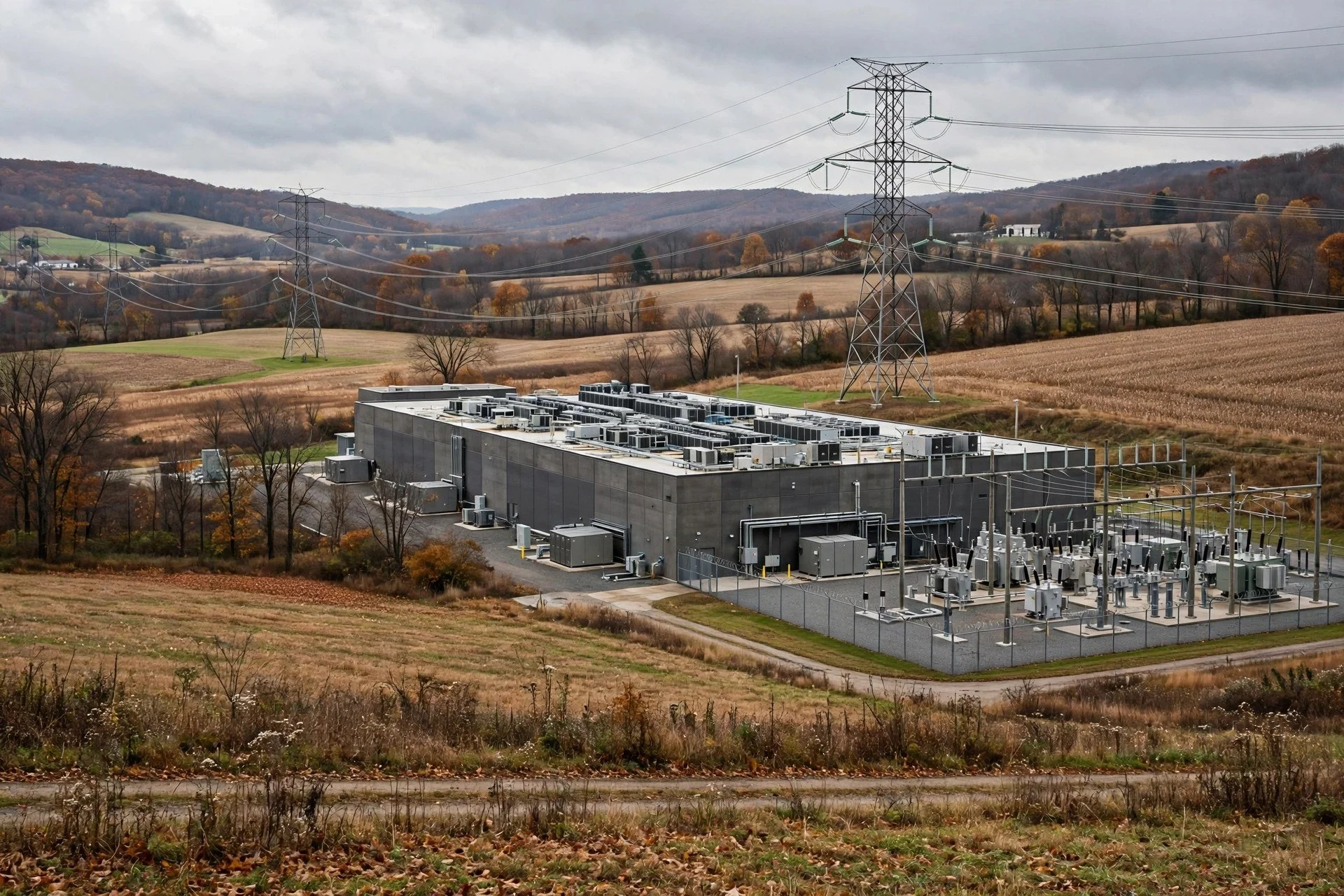
Queue 1738 is a direct test of these rules in Dutchess County's southern edge. Donovan Drive Holdings LLC asked for a 1,000 MW connection at East Fishkill in two phases: 500 MW targeted for 2028 and another 500 MW by 2030, according to RFTUV standing intake research. Under NYISO's Large Load definition, the project qualifies for the new process.
The town itself adds a local layer. East Fishkill adopted a three-year moratorium on data centers exceeding 20 megawatts, running through July 2029. That moratorium covers land use. The interconnection queue runs under a separate federal process. Both timelines now converge on the same window. The moratorium expires one month after NYISO's regular intake cycle begins in July 2027. Projects entering the first study cycle in June 2027 will not complete facility studies until at least the third quarter of 2028, according to transmission owners cited by Load Factor News. That places Queue 1738's first 500 MW target - aimed at 2028 - directly against the outer edge of what the new rules can process without delay.
A separate local project, an iPark 84 expansion of roughly 150 megawatts, is already in grid study, according to RFTUV standing intake research. That project falls under the same new rules and runs through the same study cycle as the larger Queue 1738 request.
The critical question for Donovan Drive Holdings under ER27-517 is where 1,000 MW at that node lands in the resource adequacy model. If the project degrades NYISO's loss-of-load expectation by more than 25 MW in any modeled year through 2036, the firm share gets cut proportionally. A 1,000 MW request at a single node raises that probability significantly. Without a paired capacity resource committed for 15 years, the portions that exceed the adequacy threshold would operate as non-firm - curtailed before firm users each time grid conditions tighten. And the grid is projected to tighten well within the decade.
The Grid Is Already Running Short
The adequacy pressure behind these rules is not abstract. NYISO's July 2026 report projected the first statewide resource adequacy violation in 2033, growing through 2036 to a deficiency of more than 1,800 megawatts when forecasted large load growth is counted, according to Load Factor News. That shortfall is roughly the output of a large nuclear unit.
The new rules exist because the grid cannot absorb 12 gigawatts of large load requests as firm demand. Something has to give, and the tier assignment determines what. Potomac Economics, NYISO's market monitor, found that most large loads had not indicated intent to build on-site generation or participate in demand response during peak hours, according to Load Factor News. That finding drove the market monitor's recommendation to study firm and non-firm loads separately before assigning grid access.
Flexible-load developers pushed back on the $200 per megawatt-hour cap in the non-firm tier. Their argument: when winter fuel costs spike, $200 is too low and too rigid to reflect actual market conditions. NYISO replied that indexing the cap to fuel prices is not feasible on the current implementation schedule. The market software cannot process curtailment caps in the $1,000 to $2,000 range without pushing the curtailment logic outside the market's clearing software entirely, according to Load Factor News. The $200 cap holds.
The study timeline is its own constraint. A Relae analysis found that NYISO's proposed 18-month to two-year study cycle is the longest of any grid operator currently developing large-load rules. FERC had contemplated 60 to 90 days for analogous processes elsewhere.
Albany's Parallel Track
New York State is running its own review alongside FERC's process. The Public Service Commission told FERC in July 2026 that it is the primary entity responsible for ensuring generation adequacy in New York, according to Load Factor News. The PSC pointed to its own proceeding, Case 26-E-0045, which it opened in February 2026.
The state created a separate pathway called the State Exempt Large Load Project designation. The Department of Public Service can designate certain projects to be tested collectively against a state adequacy criterion over years one through five, rather than evaluated one by one under NYISO's federal process. If the group fails that test, the DPS can revoke the designation within 60 days. The exemption gives developers an alternate route to firmer grid access under state standards, which may differ from NYISO's loss-of-load threshold math.
The two tracks - federal and state - run in parallel. For East Fishkill projects, that means potential interactions between NYISO's queue outcomes and DPS's adequacy review. Neither process pauses for the other.
Timeline and What Comes Next
Comment deadlines are close. Parties wanting to influence ER27-529 must file with FERC by December 7, 2026. Comments on ER27-517 close December 14, 2026. NYISO requested that both rules take effect February 1, 2027.
Under that timeline, the existing interconnection queue gets withdrawn except for two groups: projects that have already finished studies, and projects placed in one of two formal transition groups. The first new intake cycle opens June 1, 2027. The regular cycle starts July 1, 2027. Each cycle runs 1.5 to 2 years. Transmission owners do not expect the first facility studies under the new process to be complete until the third quarter of 2028.
The behind-the-meter net generation program faces its own closing. That program stops accepting new enrollment February 1, 2027, and ends entirely May 1, 2029. As of the November 22, 2026 scan, six resources remain active under it, according to Load Factor News.
For Queue 1738 and the iPark 84 expansion, the path runs through the June 2027 intake cycle. If those projects enter that cycle, facility studies would not finish until 2028 at the earliest. That aligns with Donovan Drive Holdings' 500 MW target year, but only if the interconnection process runs without extension. Any slip in the study period pushes the first phase into the same window as the second 500 MW tranche, compressing the timeline for both.
The Sort Has Started
The November 16 filings changed the question NYISO asks about every new large-load request. The old question was roughly: when did you file? The new question is: what does your project do to the grid's ability to serve all load?
New York has 12 gigawatts in queue and a track record of delivering about 500 MW of large load per decade. The three-tier system is NYISO's mechanism for narrowing that gap. Firm Withdrawal goes to projects the grid can carry without pushing adequacy below accepted thresholds. Non-Firm Withdrawal at the $200 cap goes to projects the grid can tolerate only when conditions allow. Zero Withdrawal goes to co-located loads with no grid access at all.
Donovan Drive Holdings' 1,000 MW request at East Fishkill sits at the high end of what has been filed anywhere in the state. Under the new rules, a request that size at a single node needs either a clean adequacy study result or a paired 15-year capacity commitment to hold firm service status. Without one of those, the project curtails first every time the grid gets tight. NYISO projects the grid gets meaningfully tight by 2033.
Queue 1738 will not be the last local request sorted under these rules. But given its size, its two-phase timing, and the moratorium window it sits inside, it is the first case in this area where the new framework's decisions will be visible to the community it concerns. The sort has started.