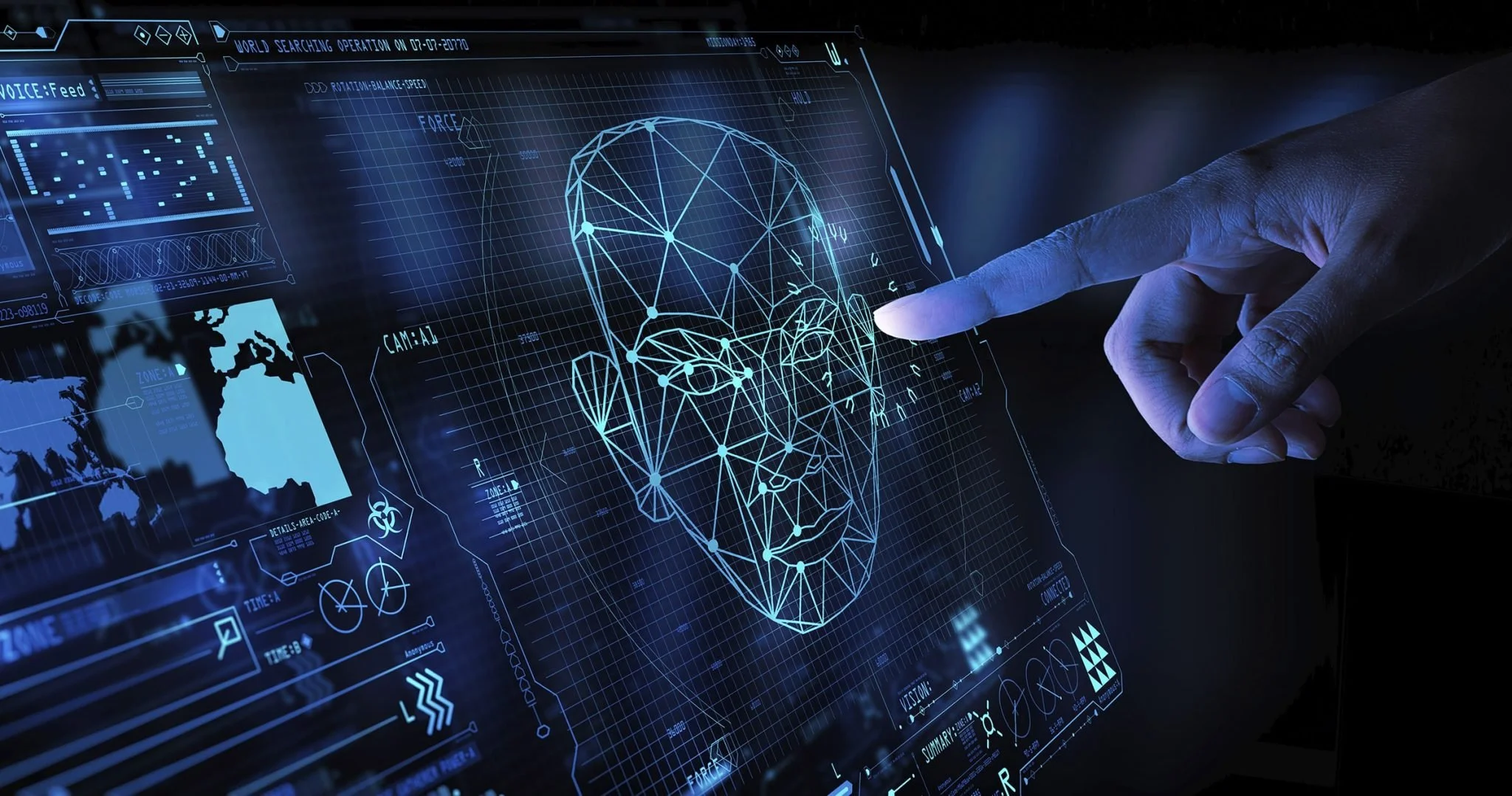
A facial-recognition interface on a screen. Stock photo for RFTUV.
By Callahan Blackwood | November 5, 2026
If you file for unemployment in New York and the state flags your claim for verification, you will not be dealing with New York. You will be dealing with ID.me, a private company. Before the New York State Department of Labor approves your claim or releases a single payment, that company will ask for your email address, your Social Security number, and a government-issued photo ID. Depending on the verification route, it may also ask for a photograph of your face.
The state does not stand between you and that company. The state put you there.
The Gate in New York
The New York State Department of Labor's published guidance states plainly: claimants who are notified to verify their identity must complete the ID.me process before a claim can be approved and payments released. The requirement also applies in certain cases when a claimant updates their banking information. The information ID.me requires to begin, per NYSDOL, includes an email address, a Social Security number, and a government-issued photo ID.
That is the entry point. What the company collects after that, and what it does with the data, extends considerably further.
What ID.me Actually Collects
ID.me's privacy policy describes the categories of data the service may collect during verification: name, date of birth, Social Security number or other government-issued identification numbers, copies of identity documents, contact and address information, photographs, and biometric data. The company's biometric-specific disclosures specify that facial geometry is among the information collected.
The U.S. Treasury's formal privacy compliance and legal impact assessment for ID.me, a federal document produced in November 2023, confirms that the system may also draw from authoritative sources, data licensors, commercial aggregators, and public databases when verifying a person's identity. It states that identity evidence is verified by biometric comparison and that the process involves the full Social Security number.
For a New York unemployment claimant who has been notified by NYSDOL to verify, handing over that constellation of data to a private company is not optional. The alternative is no claim approval and no payment.
ID.me maintains that government agencies do not receive direct or unfettered access to the underlying data, and that any government requests for additional user information require legal process. The company describes its security posture as including encryption, access controls, system monitoring, document authentication, biometric matching, AI-based fraud detection, and human review.
On data retention: the company states that some deletion requests for biometric data are honored. Biometric data connected to fraud investigations can be retained for up to three years after a user closes their ID.me wallet.
2022: What the CEO Corrected
The clearest public test of ID.me's representations came in early 2022, when the IRS announced it was transitioning away from third-party facial-recognition verification following significant public backlash. The specific objection: American taxpayers were being required to submit biometric data to a private company as a condition of accessing their own federal tax accounts.
After that announcement, Axios reported on January 27, 2022, that ID.me chief executive Blake Hall apologized for mischaracterizing the company's facial-recognition practices. Hall had previously emphasized one-to-one matching, the system comparing a submitted face against the face on a submitted document. The Axios report documented Hall's acknowledgment that the system also checked submitted faces against the company's database to look for duplicates and potential fraud. That is one-to-many matching: a single submitted face compared against an entire stored database of faces.
CyberScoop reported on the same correction in January 2022, covering the company's explanation and advocacy concerns about how the technology had been characterized to the public and to government partners.
The distinction matters. One-to-one matching confirms that a face corresponds to a document. One-to-many matching, running that face against a large database, is a different kind of search with different civil liberties implications, different error rate profiles at scale, and different risks if the underlying database is ever compromised. Following the backlash, the IRS announced in November 2022 that taxpayers could open accounts via ID.me without submitting biometric data, citing privacy concerns about providing such information to a private company.
ID.me's own presentation materials on digital identity draw a distinction between face matching for verification purposes and facial surveillance, arguing that searching a database to identify fraud duplicates does not constitute surveillance in the law enforcement sense. That distinction is technically real. It is also narrower than most people receiving an ID.me verification notice would assume.
The original framing required a public correction, made under pressure, after deployment across federal and state programs. This illustrates the central structural problem: when a private company gates access to public benefits, the public learns what that company actually does through controversy, not through disclosure.
When the System Fails, Who Waits
Biometric verification is only one failure mode. The other is slower, older, and harder to fix by policy announcement: the system gets congested, and people who cannot get through don't get paid.
A congressional report examining pandemic-era unemployment programs found that in April 2021, the average wait time for ID.me's trusted-referee video verification, the fallback pathway for people who cannot complete automated verification, exceeded four hours in 14 of the 21 states the company served at the time. ID.me told IRS officials that average wait times were approximately two hours. The congressional investigation found the actual figure was more than twice that in most of the states examined.
A February 2022 letter from House Oversight Committee Democrats to the IRS cited reports of would-be beneficiaries waiting not hours but days or weeks to complete the trusted-referee process before their claims could advance.
The Government Accountability Office has separately noted that biometric anti-fraud controls can preserve funds for legitimate claimants while simultaneously creating barriers for legitimate applicants. That phrasing is careful and accurate. It acknowledges the fraud-prevention purpose while naming the structural tradeoff: the same gate that blocks fraud also blocks some genuine claimants. When that gate belongs to a private company whose queue the state cannot directly manage, the state's instrument for fixing the problem is a contract, not a command.
The Accountability Gap
The governance question the New York situation poses is not whether ID.me is a competent or ethical actor. It is what public accountability looks like when a government agency outsources the identity determination, the decision about whether a citizen is real enough to receive public money, entirely to a private vendor.
When NYSDOL cannot process a claim because a claimant has not completed ID.me verification, the blockage sits inside a private system. The agency can point to the vendor. The vendor can point to the process. The claimant waiting for rent money has no direct recourse through ordinary democratic channels. No public records request reaches inside a private company's verification queue. No elected official can direct an ID.me operations center to expedite a case.
ID.me operates under contracts with state and federal agencies. Those contracts presumably include service-level terms, audit rights, and data-handling requirements. What those terms say is not publicly available in the verified record for this report. That opacity is not incidental to the arrangement. It is the arrangement.
The company states that it is subject to legal process for government data requests, meaning government agencies cannot query the ID.me database on demand. That is a meaningful protection, worth stating plainly. It is also the company's own account of its legal obligations, not an independent audit of how those obligations function when tested.
Concentration Risk: One Database, Many States
ID.me operates identity verification across multiple federal agencies and state-level unemployment programs. That scale creates a concentration risk distinct from any question about the company's current security practices.
The Treasury's privacy impact documentation confirms that ID.me may collect from multiple external data sources, commercial aggregators, authoritative databases, licensors, and stores identity evidence including biometric data and full Social Security numbers. The company's privacy policy acknowledges that photographs and biometric data are among the categories collected and retained.
No verified breach of ID.me's systems appears in the public record or in the research for this report. The concentration risk is not an allegation of past failure. It is a structural observation about future exposure. A database holding verified identity records, biometric data, and Social Security numbers for people who passed through ID.me's gate to access government services represents an unusually large and unusually sensitive target. The question is not whether ID.me has been breached. It is what the consequences would be if it were, and whether any single state or federal agency could fully answer that question on the basis of what it contractually knows about the system it depends on.
ID.me's Defense
ID.me's core argument is that its verification system prevents fraud that would otherwise divert public funds from legitimate claimants. That is a real function. Pandemic-era unemployment fraud was documented at significant scale across states, and verification systems designed to confirm that a claimant is who they say they are address a genuine and costly problem.
The company also distinguishes its biometric matching from surveillance, arguing that checking a submitted face against a fraud database is a targeted anti-fraud measure rather than mass identification. That distinction is technically coherent. And the company's statement that government agencies require legal process to access stored data addresses one of the more serious surveillance-related concerns about how private identity infrastructure can be turned against the people it verified.
Fraud prevention has real value. Verification has real costs. For a New York unemployment claimant who receives a notice from NYSDOL directing them to ID.me, neither of those facts cancels the other. They bear the costs, in time, in data exposure, and in the absence of any alternative path to their benefits once NYSDOL has routed them to the vendor.
Who Decides Whether You're Real
The problem the ID.me model poses is not primarily technical. It is structural.
When a government agency outsources the determination of whether a citizen qualifies as real enough to receive public money, that citizen's relationship to their own government changes. The state no longer decides. A private company does, using proprietary methods, subject to terms of service that can be revised, within systems the public cannot inspect, drawing from data sources the contracting agencies may not fully enumerate.
The 2022 IRS episode demonstrated what happens when that arrangement receives sustained scrutiny: the company's CEO corrected public descriptions of how the technology worked, the IRS changed its policy under pressure, and Congress sent letters. That process produced a result, biometric submission became optional for IRS account access. It worked imperfectly, months after deployment, and only because facial recognition in federal tax accounts generated sufficient political heat.
New York unemployment verification generates less political heat. The same structural conditions apply.
Sources
- NYS Department of Labor, Identity Verification Methods
- NYS DOL, The ID.me Process
- ID.me Privacy Policy
- ID.me Biometric Consent Page
- ID.me, Understanding and Managing Your Biometric Information
- ID.me Privacy and Protection
- U.S. Treasury PCLIA for ID.me, November 2023
- IRS Taxpayer Advocate, January 19, 2022 / updated February 7, 2022
- IRS Publication 5456, November 2022
- Axios, January 27, 2022: ID.me CEO Apologizes for Misstatements on Facial Recognition
- CyberScoop, January 2022: ID.me CEO Backtracks on Claims Company Doesn't Use Powerful Facial Recognition Tech
- House Oversight Committee Letter, February 11, 2022
- Congressional Report on Coronavirus Pandemic Lessons
- GAO Report on Biometric Technologies, 2024
- ID.me Company Presentation: Digital Identity and Face Matching