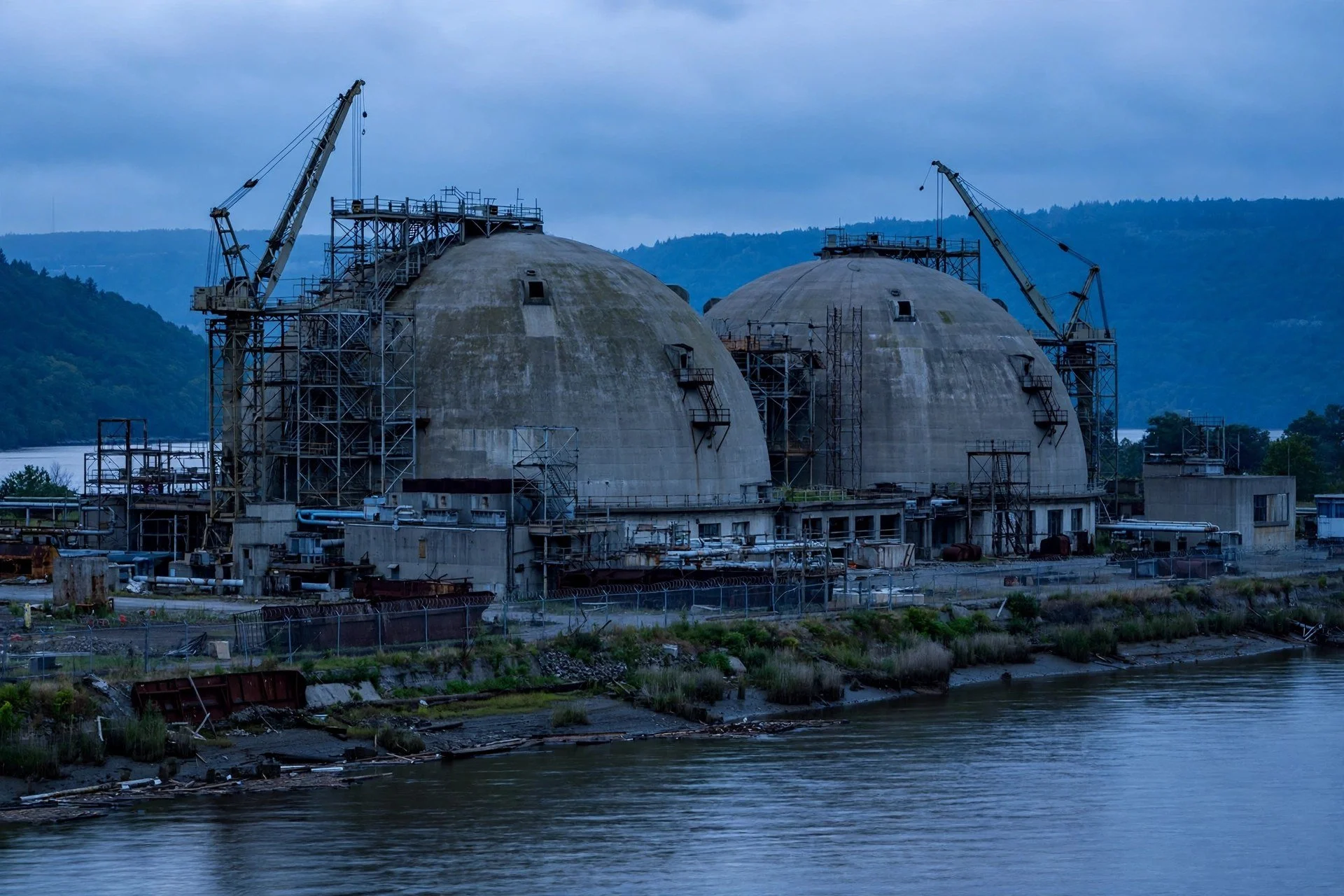
The domes at Buchanan, mid-teardown.
By June Mercer | November 13, 2026
Westchester County Executive Ken Jenkins sent a pointed warning to state regulators this month. He wants the state Public Service Commission to reject Holtec International's corporate restructuring plan for Indian Point. His demand is firm: no approval unless the company guarantees no additional cost to ratepayers.
Jenkins wrote to the PSC on November 6. Westchester County released the letter on November 10, and lohud reported on it Friday. The letter arrives with the PSC's public comment window set to close on November 18, leaving a narrow opening for opposition to weigh in.
"Let me be absolutely clear: the people of Westchester County will not be left holding the bill for the decommissioning of Indian Point," Jenkins wrote. "This is not an old movie theater or an abandoned supermarket. This is a former nuclear power facility surrounded by homes, schools and neighborhoods."
A Fund That Has Shrunk by Nearly $840 Million
The concern is not abstract. When Holtec took over the Indian Point Energy Center in Buchanan in 2021, it inherited a decommissioning trust fund holding roughly $2.4 billion. By the end of 2025, NRC filings from March show, the fund held approximately $1.56 billion. That is a decline of nearly $840 million in four years.
Decommissioning a nuclear plant is expensive and uncertain. Cost overruns are common in the industry. Jenkins argues the restructuring could make it easier for Holtec to shift financial responsibility away from the company, leaving ratepayers on the hook for any shortfall.
"[Financial responsibility] does not disappear simply because a corporation decides to reorganize," he wrote to the PSC.
His letter spelled out specific demands. Jenkins wants Holtec to guarantee the restructuring will not expose ratepayers to teardown cost overruns. He raised concerns the move could weaken corporate accountability, diminish financial protections already in place, and leave the public responsible for any gaps that emerge.
What the Restructuring Actually Does
Holtec's plan would shift Indian Point's ownership to a new subsidiary called the Decommissioning Asset Management Company, known as DEAMCO. That entity would hold Indian Point alongside three other Holtec teardown sites: Pilgrim in Massachusetts, Oyster Creek in New Jersey, and Big Rock Point in Michigan.
The company has described the restructuring primarily as a tax-saving measure. It comes ahead of a Holtec IPO that was postponed in September. Holtec has asked the PSC to either approve the plan or declare outright that state approval is not required.
The bundling of four decommissioning sites under one subsidiary is what critics say creates the financial risk. Jenkins and others worry that DEAMCO's obligations at other sites could affect resources available for Indian Point, or that the structure makes it harder to hold the right entity legally accountable if something goes wrong.
Holtec Says Ratepayers Are Safe
Holtec spokesman Patrick O'Brien defended the restructuring and rejected the ratepayer concerns directly. "There will not be any impacts to Westchester residents, taxpayers and rate payers," O'Brien said.
The company has not publicly detailed what financial protections or guarantees would accompany the restructured ownership. Whether those assurances satisfy the PSC's review is part of what the comment process is meant to surface.
Riverkeeper's Campaign and a Red Flag in the SEC Filing
Environmental group Riverkeeper has launched a letter-writing campaign calling for PSC scrutiny and a formal public hearing before any decision is made. The group's concerns go beyond the trust fund balance.
Larissa Liebmann, a Riverkeeper attorney, pointed to a Holtec SEC filing she says contains a specific problem. The filing, she argues, suggests the restructuring would shift responsibility to DEAMCO for costs tied to state laws that bar radioactive wastewater discharge into the Hudson River and Cape Cod Bay. Liebmann called it a "big red flag" for county ratepayers. Riverkeeper also cited a letter it sent to the Nuclear Regulatory Commission in July raising related concerns.
The group has asked the PSC to hold a public hearing before ruling on the restructuring. Whether regulators will grant that request has not been decided.
Comment Deadline and What Comes Next
The PSC is accepting public comments through November 18. Reply comments are due in early December. That tight calendar explains why Riverkeeper moved quickly to organize its letter campaign.
Jenkins' letter adds county government weight to the effort. Jenkins has publicly opposed any restart of Indian Point. Holtec has said it remains open to a restart if political will develops; O'Brien said such a restart would take about four years and cost between $8 billion and $10 billion. That question runs in the background, separate from the immediate fight over decommissioning structure and costs.
For now, the question before the PSC is narrower. Can Holtec reorganize its ownership without creating new financial exposure for the public? Jenkins says that case has not been made. Holtec says the concerns are unfounded. Regulators will have until the reply comment deadline in early December to gather more information before deciding.