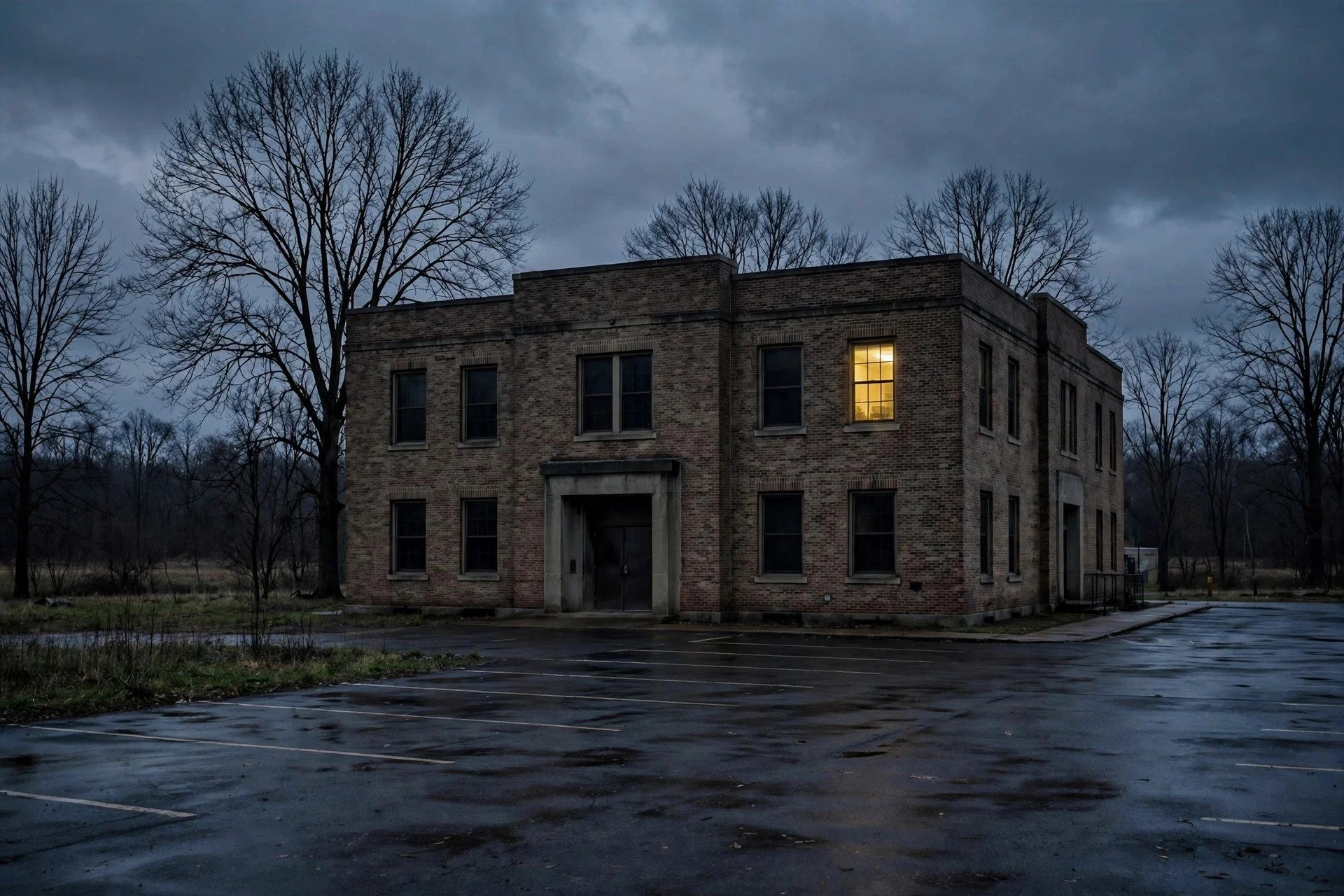
One window still lit at the district office.
By Callahan Blackwood | November 12, 2026
New York paid 114 educators more than $300,000 last year. In the same year, more than half the state's elementary students could not read at grade level. Those two facts do not explain each other. But they belong in the same sentence, and nobody in state government has put them there.
The Empire Center released its November 2026 SeeThroughNY payroll data this month, covering the fiscal year ended June 30, 2026. The figures are reported to the New York State Teachers' Retirement System. The Empire Center notes that pension contributions and health benefits are not included. Total compensation, by any honest count, runs higher for every educator on the list.
A Payroll Record Set Against a Reading Decline
One hundred fourteen educators outside New York City earned more than $300,000 in fiscal year 2026. That is up from 90 the prior year, a 27 percent increase in a single year. One hundred seventy-four educators across the state earned more than Governor Kathy Hochul's $250,000 annual salary, according to the Empire Center's analysis.
The median full-year superintendent pay statewide came to $215,922. That figure alone exceeds Hochul's salary. In every county outside New York City, the median full-time educator earned more than the median full-time worker living in that county. The gap ran about 33 percent in a typical county, the Empire Center reported.
New York Post coverage of the release noted that these are NYSTRS-reported pay figures, not total compensation. Add pension contributions, which run substantial in New York's defined-benefit system, and health benefits, and the gap between educator compensation and local worker earnings widens further.
Average educator pay by region shows where the salary weight concentrates. Long Island posted the highest regional average at $121,047. The Mid-Hudson region ranked second at $117,045. Both figures reflect averages. The top of each regional distribution climbs much higher.
The three highest-paid educators in the state all worked on Long Island: Roslyn UFSD Superintendent Allison Feldman at $436,976, Great Neck UFSD Superintendent Kenneth Bossert at $420,781, and Oyster Bay-East Norwich CSD Superintendent Francesco Ianni at $412,663, according to the Empire Center release.
Mid-Hudson's $389,000 Question
In the Mid-Hudson region, which includes Dutchess County, 752 educators earned more than $200,000 in fiscal 2026. Thirty-four educators in the region earned more than $300,000.
The region's top earner was Raymond Castellani, superintendent of Northeast Central School District in Dutchess County. Castellani earned $389,357 in fiscal 2026, according to the SeeThroughNY payroll database. That figure made him the highest-paid educator outside Long Island in the entire state, according to the Empire Center.
Northeast CSD sits in a part of the state where educator pay has concentrated near the top of regional rankings. Castellani's salary exceeds Hochul's by more than $139,000. It exceeds the statewide median superintendent salary by more than $173,000.
This report does not contain district-level test score data for Northeast CSD. No such data appears in the available source material. The payroll data establish where the money went. The statewide assessment data establish what it bought, at the aggregate level.
Where Six-Figure Pay Concentrates
Empire Center data show how completely salary weight maps to geography. Among full-time NYSTRS members at the 214 districts and BOCES that averaged more than $100,000, every one sits on Long Island (121 districts) or in the Mid-Hudson region (93 districts). No district outside those two regions crossed the six-figure average threshold.
Two-thirds of all six-figure educators statewide worked in the downstate suburbs. Long Island alone accounted for 34,779 of them. Westchester, Rockland and Orange counties combined for another 19,736.
The Big Five city districts show a different distribution. Yonkers averaged $143,937, the highest of the five. Buffalo averaged $95,664. Albany averaged $94,449. Rochester averaged $81,237. Syracuse averaged $80,141. Each of those figures sits below the Mid-Hudson regional average of $117,045.
The city district averages are lower partly because large urban systems employ more support staff and paraprofessionals whose pay pulls the average down. The salary ceiling, by contrast, runs higher downstate. The contract structures that produced Raymond Castellani's $389,357 are replicated across dozens of suburban districts in the same region.
ELA Scores Dropped Sharply Statewide
Preliminary results from the 2025-26 state assessments show 48 percent of grades 3 through 8 students tested proficient in English Language Arts statewide. That is down five points from the prior year, according to WAMC Northeast Public Media's reporting on the state data.
Five points in a year is a substantial drop. The year-over-year volatility underneath it makes it harder to read. Third graders provide the clearest illustration. Fifty-seven percent of third graders did not test proficient in ELA in 2025-26. That represented a decline of 11 points from the prior year. The prior year had itself risen 11 points. A full swing of 22 percentage points across two years, in the same grade, with no evident change in the population.
Emily Oster, who publishes the newsletter Parent Data, suspects a scoring file error may explain that volatility. She raised the concern publicly following the release of the preliminary results, as WAMC reported. The State Education Department has stood by both years of data. No correction has been announced. No investigation has been confirmed. The department says the numbers are valid, and the department sets the standards.
Fifth graders recorded the largest single-grade decline statewide. Fifty-seven percent did not test proficient in ELA, a drop of 14 points from the prior year, according to the New York Post's August 2026 reporting. Fourteen points in one year, in one grade, with no explanation attached.
What New York City's Results Show
New York City Public Schools released their own results in August 2026. Citywide ELA proficiency fell six points to 50.3 percent. Third grade ELA in the city fell 13.8 points, the district reported in its official announcement.
The city offered context. Officials said districts across the state saw declines regardless of resources or instructional approach. That is accurate as a description of the statewide pattern. It does not explain why the city's third grade fell 13.8 points.
The city also pointed to its own intervention. NYC Reads, a phonics-based literacy program launched in 2023, is the district's primary response to chronic under-performance in reading. The city says literacy screener data show gains from the program, particularly for Black and Latino students in grade 8. Screener data and state assessment data are different instruments. The city presented both but did not resolve the gap between them.
A Law That 130-Plus Districts Ignored
Albany saw this coming, or said it did. Governor Hochul signed the Back to Basics law in 2024. The law required districts statewide to abandon balanced literacy instruction and adopt evidence-based, phonics-grounded approaches by September 2025. That deadline arrived. That deadline passed.
New York Focus reported in May 2026 that more than 130 districts still reported using balanced literacy approaches, according to Hudson Valley Post's summary of that reporting. The Back to Basics law had a compliance requirement. Apparently, compliance was optional in practice.
Balanced literacy prioritizes whole-text meaning-making over systematic phonics instruction. Decades of reading research, consolidated under the label "Science of Reading," holds that children learn to decode text through explicit, structured phonics instruction. Children who do not receive that instruction, particularly those who do not come from print-saturated environments, fall behind. Many of them never catch up.
The state passed a law. Districts kept doing what they had always done. Children took the state ELA assessment and failed it at a higher rate than the year before.
One Researcher's Count
Rose Else-Mitchell directs the Science of Reading Center at SUNY New Paltz, which launched in 2022. She spoke to WAMC for its November 2026 coverage of the statewide results. Her estimate: 46 to 52 percent of children are not reading at grade level. She put it plainly. One in two children cannot read in a way that sets them up for success.
That range sits directly around the 48 percent state proficiency figure from the 2025-26 assessments. SUNY New Paltz's center was built specifically to address the problem Else-Mitchell described. It is now four years old. The percentage of children not reading proficiently has not moved in the direction New York needs.
What Teachers Say About Reading
The Standard NY, reporting on the same preliminary 2025-26 results, documented one explanation that the State Education Department has not centered: what students actually read in English classrooms. Teachers across the state describe a shift away from full-length novels toward short excerpts sized for state test preparation. Mandated reading programs reinforced that shift. Those programs do not require whole books.
The State Education Department responded that its standards call for both excerpts and full-length works. The department's position and classroom practice appear to differ. Teachers say the mandated programs drove the change.
The same data show that not every subject declined. Math proficiency rose to 57 percent statewide from 55 percent the prior year. Science rose to 47 percent from 44 percent. ELA fell to 48 percent from 53 percent - a figure that nonetheless remains above the 46 percent recorded in 2023-24. Math and science instruction did not undergo the same shift to excerpt-based preparation. The comparison does not prove causation. It does sharpen the question.
Final assessment data was due in early November, according to The Standard NY.
Record Spending, Unclear Returns
New York State spends approximately $37,000 per student annually statewide. That places New York among the highest-spending states in the country, by a significant margin. Governor Hochul dedicated a record $39.3 billion to education for the 2026-27 fiscal year.
That commitment is real money. It funds salaries, benefits, facilities, programs, and administration across hundreds of districts. It funds the superintendents on the SeeThroughNY list. It funds the teachers in the classrooms where the state assessments were administered.
What it has not funded, in any visible way, is a consistent rise in reading proficiency. Scores went up one year. They came back down the next. The year-over-year volatility is so pronounced that a credentialed economist raised a flag about whether the numbers are accurate. The state says they are. The state does not explain the swings.
The Empire Center's payroll data exist alongside that record spending, not in conflict with it. High pay and high spending are not the same as poor outcomes. But they are facts that share the same fiscal ledger. When 752 educators in the Mid-Hudson region alone earn more than $200,000, and when more than half the state's elementary students cannot read proficiently, the question of return on investment is legitimate. No official has answered it.
No One Has Owned This Gap
Accountability in New York's education system is diffuse by design. Superintendents manage districts. Teachers deliver instruction. The State Education Department certifies programs and administers assessments. The Governor signs the budget. School boards approve contracts. No single actor holds the whole outcome.
That structure produces results like the ones visible in fiscal 2026. Raymond Castellani earned $389,357 as Northeast CSD's superintendent. That salary reflects a contract his school board approved, in a labor market where Mid-Hudson educator pay averages $117,045 and 34 educators in the region earn more than $300,000. The salary is legal. It is market-consistent. It is public record.
What is also public record is that 48 percent of grade 3 through 8 students in New York State tested proficient in ELA last spring. That 130-plus districts kept using the instructional approach the state's own law prohibited. A prominent reading researcher says one in two children cannot read well enough to succeed. The State Education Department has not explained why third grade ELA swung 22 percentage points across two consecutive years.
The payroll data tell one part of the story. The assessment data tell another. New York has not yet decided to read them together.
Sources
- Empire Center: 114 New York Educators Receive $300K+ in Annual Pay
- New York Post: Over 100 NYS School Officials Raked in $300K Last Year
- New York Post: More Than Half of NY 3rd-5th Graders Fail Reading Proficiency Tests
- WAMC: In New York, Over 40% of Elementary Students Are Reading At or Below Grade Level
- NYC Public Schools: Citywide Results for State Assessment
- The Standard NY: NY Reading Scores Fell. Teachers Say Why.