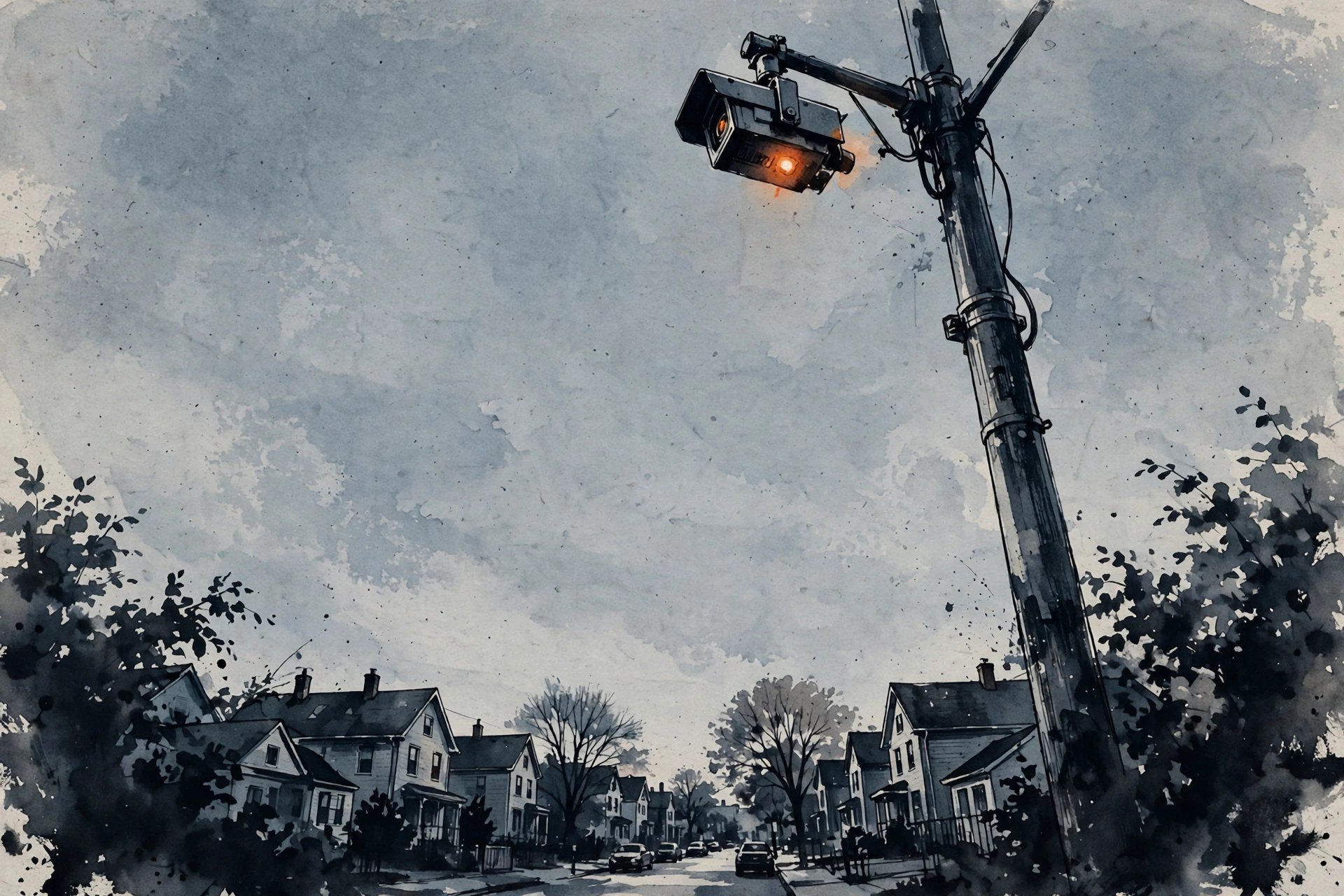
The cameras went dark on November 18.
By Callahan Blackwood | November 26, 2026
A girl walking home from Warring Elementary said a man beside a parked truck called her by name. He told her he would take her home. She didn't know him. She ran.
That was November 19. The day before, Poughkeepsie had shut down its network of automated license plate readers. Chief Richard Wilson confirmed to Mid Hudson News that the city's 13 Flock Safety cameras went dark on November 18. The city council had ordered the shutdown weeks earlier, citing documented concerns about mass surveillance, a national pattern of unchecked database access, and organized opposition from residents who decided they did not want every passing vehicle catalogued on their streets.
The collision between those two events now sits at the center of a genuine dispute. The council voted to end a contract it called a threat to civil liberties. The police union says that decision cost investigators time when a child may have been in danger. Both claims rest on documented facts. Neither cancels the other.
The Case Against Flock
The council vote didn't come from nowhere. By the time Poughkeepsie passed Resolution R-26-66 on October 20, more than 55 municipalities nationwide had cancelled or refused Flock contracts since June 2025. The movement had already arrived in Dutchess County before the city council acted. The district attorney's office and the county sheriff began cancelling their agreements in September. On October 13, the County Legislature voted unanimously to cover county-owned license plate readers with opaque material.
Flock Safety operates more than 80,000 cameras across 49 states and serves more than 5,000 law enforcement agencies. Those figures come from a letter submitted on May 20, 2026, by a coalition led by the American Civil Liberties Union. Every vehicle that passes a Flock camera gets photographed, regardless of whether the driver is under any suspicion. Most of that data sits in a centralized, searchable national database that law enforcement can access on demand, without a court order.
The company's standard terms allow customers to retain data for 30 days, with automatic deletion after that window closes. Flock captures only the rear of vehicles. It conducts no facial recognition, no predictive policing, no demographic profiling, and does not sell customer data. The Vehicle Signature feature lets officers search by make, color, body type, and details like roof racks, bumper stickers, or visible damage.
None of that changes the core access question. The national database is open to any participating agency, and those agencies do not need to show probable cause to run a query.
A Resident's Plate, Searched 63 Times
A concrete example of how that access gets used surfaced in North Manchester, Indiana. Resident Bob Sklar obtained records showing his license plate had been searched 63 times between December 2024 and the end of 2025. The local sheriff's office said those searches were conducted for officer safety during traffic stops. On November 4, the North Manchester town council voted to end its Flock agreement.
Sklar's case drew attention because the searches were numerous, traceable, and tied to a private citizen with no apparent criminal history. It showed something Flock's marketing does not lead with: a vehicle's plate can be queried dozens of times by officers with no documented triggering event beyond a routine stop. Multiply that by 80,000 cameras and 5,000 agencies, and the scope of routine, warrantless surveillance becomes difficult to frame as narrow or targeted.
Local Opposition and What the Poll Showed
In Poughkeepsie, the push to end the Flock contract drew organized backing from the Mid-Hudson Valley DSA chapter, For the Many, and Poughkeepsie Indivisible, along with individual residents who showed up to make their case publicly. A reader poll conducted by the Poughkeepsie Journal - a self-selected sample, not a scientific one - showed 81.4 percent of respondents against the cameras, 11.4 percent in favor, and 4.6 percent unsure. Resolution R-26-66 passed the council 8-1 on October 20.
Mayor Flowers' Veto
Mayor Yvonne D. Flowers did not dispute that the concerns about Flock had merit. She said so explicitly. Her veto message, posted to the city's website on October 29, acknowledged "legitimate concerns surrounding privacy, data retention, access controls, accountability" and "potential misuse of collected data." Her objection was procedural and practical, not a defense of the cameras on civil liberties grounds.
She wrote that the resolution lacked adequate consultation with her administration and the police department. She noted that the existing Flock contract expires in January 2027 and argued that waiting would allow for "an informed decision." Her October 21 statement put the case plainly: "My veto is not a rejection of oversight... eliminate capabilities that may support investigations," and added that "residents deserve both effective public safety and respect for privacy. We should not have to choose."
Flowers also raised the budget directly. Poughkeepsie's FY2027 spending plan includes roughly $2 million in anticipated revenue from speed and red-light camera programs. If the resolution's restrictions on new surveillance contracts applied broadly, that revenue could slip. It was a concrete financial argument alongside the procedural one.
The Override Vote, and a Conflict in the Record
The council passed Resolution R-26-72, overriding the mayor's veto. What the final vote count was depends on which source you consult, and both accounts cannot be correct.
Mid Hudson News, reporting on November 22, described the override vote as 7-1. Backfire News, reporting on November 25 and citing the city clerk's record, described it as 8-1 and named eight council members who voted yes. Both accounts agree on one thing: Council Vice Chair Nathan Shook cast the lone no vote.
This reporter is not in a position to settle the discrepancy. The official tally sits with the city clerk, and readers who need the precise vote count should consult that record directly.
Shook's position deserves a separate note. He did not defend Flock on the merits. He argued that the cleaner move was to let the January contract expiration arrive, then negotiate better terms or walk away without the legal complications of a forced termination. He warned of unintended consequences from the resolution as written. His no vote was an objection to timing and method, not a vote in favor of mass surveillance.
Council Chairman Da'Ron Wilson and Majority Leader Nedra Patterson-Thompson were among those who supported the override. The resolution directed the city to take all legal steps to terminate the Flock contract permanently, to immediately suspend camera use, and to notify Flock to cease operations and remove its hardware. If Flock did not pull its equipment within two weeks, the city could remove it and bill Flock for the cost. No new license plate reader contract could move forward until the city completed a public hearing and adopted formal guardrails.
November 18: The Cameras Go Dark
Chief Richard Wilson told Mid Hudson News that the cameras were disabled on November 18. The sources used for this article do not confirm whether Flock's physical hardware has since been removed from city infrastructure. The shutdown, as confirmed, was operational. The system stopped running.
That is the fact that matters for what came next.
November 19: What Happened at Warring Elementary
A girl walking home from Warring Elementary said a man standing beside a parked truck called her by name and said he would take her home. She didn't recognize him. She ran to a crossing guard near the intersection of Mansion and Smith streets, then returned to school. School staff reported the incident to police.
Officers arrived to find no one there. The man and truck were gone. Detectives collected video footage from private security cameras at nearby homes and businesses. That footage helped investigators identify the truck. As of the afternoon of November 23, no arrest or charge had been reported.
Identifying details about the child, the man, and the truck are withheld here consistent with standard reporting practice on an open investigation.
The Police Union's Complaint, and What It Actually Shows
PBA President Kevin Van Wagner told Mid Hudson News that losing Flock "substantially delayed" the investigation into the November 19 incident. Officers now rely heavily on private citizens and business owners to supply camera footage, he said. He called on the council to restore the cameras and stated that no instance of Flock misuse had occurred in Dutchess County.
Van Wagner's complaint is specifically about speed, not about whether the investigation ultimately succeeded. Detectives did identify the truck using private camera footage. The union is not claiming the case collapsed without Flock. It is claiming Flock would have made the work faster.
That distinction matters. If the Flock network had been running on November 19, investigators might have had a plate number within minutes rather than hours. Those same cameras would also have photographed every other vehicle on those streets that morning, retained the data for 30 days, and added those plates to a national database accessible by law enforcement agencies across the country, without a warrant. Whether that tradeoff is acceptable is exactly the question the city council was answering in October. The November 19 incident does not resolve that question. It restates it, with new weight.
Van Wagner's assertion that no Flock misuse occurred in Dutchess County cannot be verified from the sources available to this reporter. It may be accurate. It is also the kind of claim that depends entirely on how misuse is defined and who is doing the auditing. Flock does allow customers to review their own access logs. What no source has described publicly is a formal independent audit mechanism with any real enforcement behind it.
What Else Went Dark on November 18
The council's vote ended more than the license plate readers. According to the Flock Poughkeepsie City NY PD Transparency Portal, 13 cameras were operating across the city at the time. The Poughkeepsie Journal reported on October 21, 2026, that the city's Flock contract also covered gunshot-detection technology from the same provider. Ending the contract shut off both systems at once. Mayor Flowers noted the same in her veto message, pointing out that the council's action eliminated the gunshot-detection capability alongside the plate readers.
Poughkeepsie was not the first in the county to pull back from Flock. Dutchess County had already announced it would discontinue its use of the technology, including existing operational and contractual obligations. That decision came after a public forum in Pleasant Valley on September 23, 2026.
Mayor Flowers stated in her veto message that her objection was to the process and timing of the council's action, not to ending the Flock contract itself. The contract was scheduled to expire in January 2027. She did not dispute the destination. She disputed how the city got there.
What Comes Next
The resolution bars any new license plate reader contract until the city holds a public hearing and adopts guardrails for the technology. That process is not complete. Poughkeepsie has no replacement surveillance vendor in place.
Mayor Flowers' budget concern has not been resolved. The $2 million in anticipated FY2027 speed and red-light camera revenue remains a line item that depends on how broadly the resolution's restrictions are interpreted. The administration and council will need to work through that.
The question the council tried to answer in October is the same one sitting unresolved today: whether a system that photographs every vehicle on certain streets, feeds the data to a national database, and allows law enforcement queries without court approval is compatible with what Poughkeepsie residents expect from their city. The council said no. The police union says that answer carries a cost. Both things can be true at once, and they are. What the city builds in Flock's place, and under what rules, will determine which of those truths it decides to live with.
Sources
- Mayor Flowers' veto message - City of Poughkeepsie
- Poughkeepsie mayor plans veto after council votes to end Flock deal - Poughkeepsie Journal, Oct 21, 2026
- Poughkeepsie Flock cameras shut off; child-luring report and PBA response - Backfire News, Nov 25, 2026
- Common Concerns Answered - Flock Safety
- Coalition letter in support of the Perry-Garcia ALPR amendment - ACLU, May 20, 2026