By Mara Quinn | October 30, 2026
A Month of Eating New York
Every November, something unusual happens in the cafeterias of Red Hook Central School District. The lunch trays do not come from the usual national distribution chains, the produce sourced from wherever the price was right that week. For the entire month, every fruit, every vegetable, every protein on those trays traces back to a New York farm or producer. This is not a one-day event, not a single featured local entrée, but the consistent, daily reality of school lunch for the entire month.
This November marks the third time Red Hook has done it. The district calls the initiative New York November, and in announcing the 2026 edition, it described the commitment plainly, saying the district would “begin a month in which New York-sourced fruits, vegetables and proteins will be on their lunch tray every day,” sourced “from producers based in our state, with several directly in the Hudson Valley.”
Third-year programs have a different texture than first-year ones. The novelty has passed. What remains is infrastructure, routine, and a clear sense of what the thing actually is. Red Hook's New York November has become, at this point, an institutional posture: a district that has decided, deliberately and repeatedly, that knowing where its food comes from is worth the extra work of making it happen.
The Month's Menu, and How It Gets Built
The architecture of this year's November lunch program is not random. It has anchor events built into it, moments that are meant to stand out from the daily baseline of local sourcing and give the month a clear structure.
The kickoff is on Thursday, November 5, and it carries an unusual provenance: culinary students from the Culinary Institute of America in Hyde Park curated the day's menu. These are students, not professional consultants, and they earned this role the hard way. According to the district's announcement, as reported by 94.3 Lite FM on October 30, 2026, the CIA students spent October shadowing Red Hook's kitchen staff, watching how a school cafeteria actually operates before they were asked to design anything for it. Their assignment was specific: develop recipes that meet state nutrition requirements for school meals while showcasing their skills and the New York-based products the district uses.
That pairing of constraint with creativity is important. Anyone can design a beautiful meal from New York ingredients when cost and nutrition standards and production volume are not considerations. Designing one that works inside a real school kitchen, at real school-meal scale, is a considerably harder problem. The CIA students were not insulated from that difficulty. They saw the kitchen. They watched the staff. Then they designed the menu. The November 5 result is what that collaboration produced.
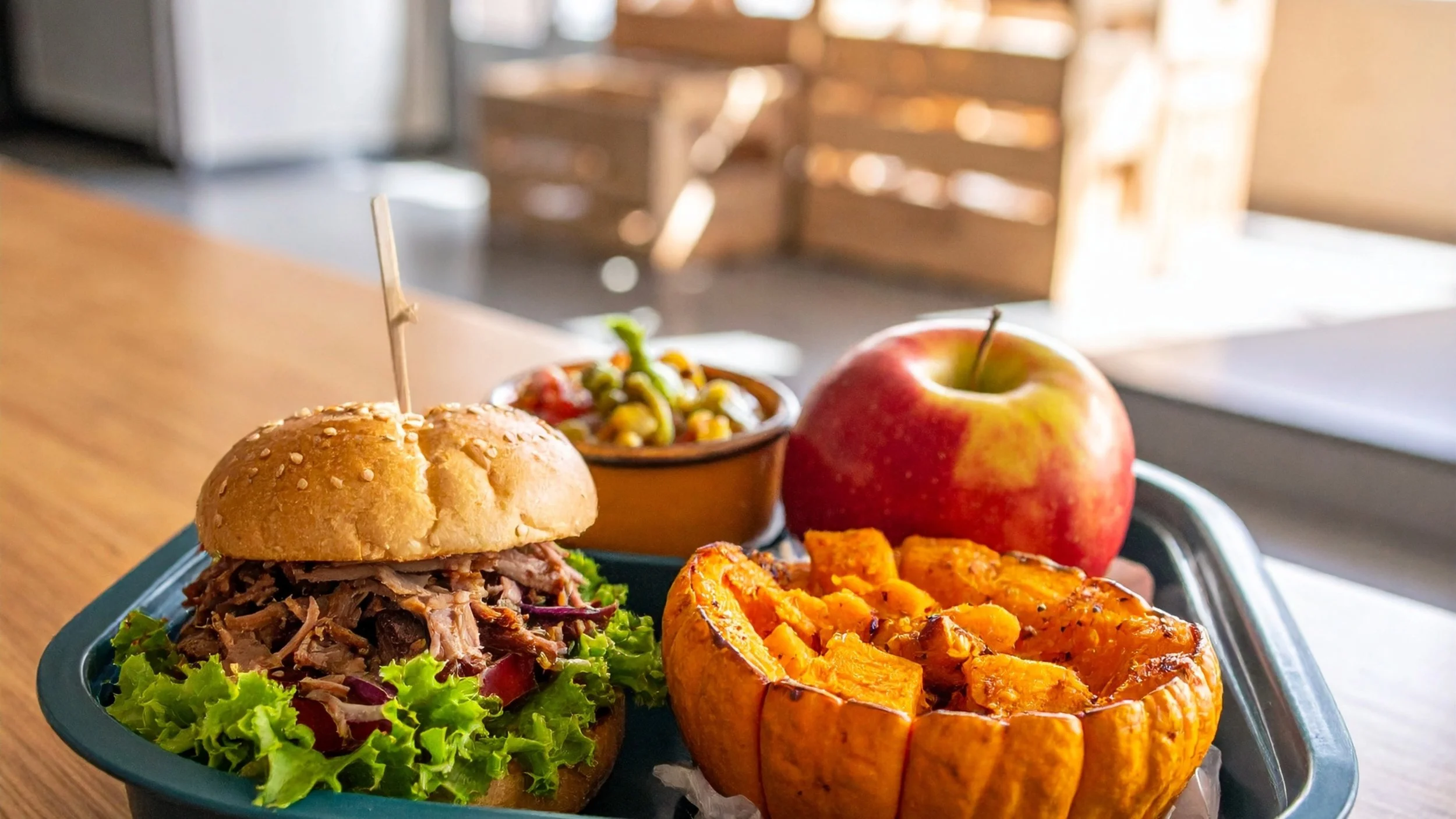
The month's second landmark falls on Thursday, November 19, and it is a first in the district's history: pulled pork sandwiches and baked beans, with the pork roasted by Red Hook's own kitchen staff. The district's announcement described it as the first time staff will "roast their own pork butts in the schools." That is not a casual operational detail. Roasting whole pork butts in a school kitchen involves equipment, timing, and staffing considerations that a standard lunch service does not. Doing it for the first time, during a month when every ingredient is already sourced to a higher standard than usual, is a statement about what the kitchen staff has built over three years of running this program. They are capable of more than they were in year one.
Every Friday throughout the month, the cafeterias will serve what the district has named New York Pizza Palooza. The concept is recent and practical: kitchen staff top pizza with ingredients left over from the week's previous meals that would otherwise go to waste. It is a small closed loop, a way to turn the month's ambitious sourcing into something that does not lose value at the end of each service. The ingredients were already paid for, already New York-sourced. The pizza gives them a second life.
The month closes on Tuesday, November 24, with a full Thanksgiving meal: turkey, garlic smashed potatoes, and cherry crisp. It is the one moment in the month when the menu aligns precisely with the holiday it precedes, and it gives the program a natural ending point, a feast built from what New York produces before the district breaks for the week.
The People Who Built This
The program has a clear origin. According to the district's own account of the second year of New York November, published in November 2025, the all-New-York November menu "was birthed by former Food Service Director Larry Anthony." Anthony is no longer running the district's food service; he later transitioned to a role with Cornell Cooperative Extension. But the program he created did not go away when he left. His successor, Sam Pride, took it on.
Pride is the person running New York November in 2026. The Lite FM report names him as the Food Service Director responsible for the district's planning and describes the district's claim that it regularly surpasses the state's 30 percent sourcing benchmark "by a significant margin," crediting Pride's work. In the district's 2025 account of the program, Pride was quoted directly: New York November represents "a commitment to our students, our farmers and our communities. When we serve food grown and produced here in our region, we're feeding kids meals that are fresher, simpler and done well." And separately: "Investing in New York products is how we nourish students while supporting the people who nourish us."
Those quotes are from 2025, not from this year's announcement, and they should be understood as reflecting where Pride's thinking was a year into his tenure running the program. But they describe a coherent philosophy that the 2026 commitment continues. The district is doing New York November because someone in charge of the cafeteria line believes it is the right thing to do.
The kitchen staff are not invisible in this story, either. Frank McCann heads the kitchen at Linden Avenue Middle School. Carole Anne Miles teaches Family and Consumer Sciences at Red Hook High School. In October 2025, both were part of the Red Hook contingent that attended the Upper Hudson Valley Farm to School Gathering at the Culinary Institute of America in Hyde Park, organized by Cornell Cooperative Extension in partnership with the state Education Department and the Department of Agriculture and Markets. At that gathering, Larry Anthony, by then on the Cornell side, led kitchen training for attending staff. Assistant Superintendent Dr. Erin Hayes represented the district at the administrative level. Hayes was quoted at the time on the goal of teaching students about nutrition and where their food comes from. Pride, at the same event, described his aim as raising the New York-sourced share "without breaking the budget. That's the trick."
That line is worth sitting with. The ideals behind local sourcing are not complicated. The economics are. Pride identified the actual constraint clearly and in public. The sourcing program he runs is a logistics and procurement problem that his kitchen solves differently than most schools do.
What the supply network behind the program looked like in 2025, the initiative’s second year, offers some texture. The district’s 2025 account named that year’s partners: Northwind Farms turkey, Hudson Valley Fresh milk, Hudson Valley Fisheries steelhead trout, and Milestone Mill breads and tortilla chips. When a regular fruit distributor fell short in late September of that year, Hudson Harvest stepped in, sourced through Hudson Valley Fresh. The district marked New York items on its menus with “NY” and Hudson Valley Fresh products with “HVF.” Those are last year’s named partners, not confirmed 2026 suppliers; the district’s 2026 announcement named no vendor list. But they represent the kind of regional network the program draws on, and the category of relationship that Pride’s procurement work is designed to maintain.
The State Structure That Makes This Possible
Red Hook does not accomplish New York November in a vacuum. There is a state program behind it, and understanding that program explains why a district that wants to do something like this can actually afford to.
The district's 2025 post described the framework this way: the New York State Farm-to-School Initiative "encourages schools to have at least 30% of its lunch menu consist of New York-sourced items," promoting "healthy, locally grown foods while increasing awareness of regional food systems," and meeting the benchmark "qualifies the districts for a sizable increase in state lunch reimbursement funding."
The specific mechanism, as the Governor's office has described it, is the 30 Percent NYS Initiative: when a district purchases at least 30 percent of its school-lunch ingredients from New York farms, the per-meal reimbursement it receives increases from 5.9 cents to 25 cents. That is a meaningful jump on a per-meal basis, and it multiplies across an entire school year. The Governor's office, in a release highlighting more than $66.5 million dedicated to locally sourced school food programs since 2021, attributes management of the 30 Percent Initiative to the Department of Agriculture and Markets. The district, in its own language quoted by Lite FM, credits the state Education Department's Farm-to-School program with the incentive structure. Both agencies are involved in the broader farm-to-school ecosystem; the distinction matters for policy precision but does not affect what Red Hook does at the kitchen level.
The state's cumulative investment in this space is substantial. Since 2021, the Governor's office reports, the 30 Percent Initiative and the associated Farm-to-School Grant Program and Regional School Food Infrastructure Grant Program have together directed $66.5 million toward local school food sourcing, reaching more than 1.1 million students. Schools participating in the 30 Percent Initiative have spent more than $40.4 million on New York food products for lunches, and the state has reimbursed over $11.1 million. For 2025-26, 82 school districts are participating and approved under the initiative, with more than 750,000 K-12 students impacted since 2021.
The infrastructure grants deserve mention too. The Farm-to-School Grant Program has awarded more than $3.9 million to over 30 organizations since 2021, supporting projects at more than 160 school districts. A ninth round opened with another $1.5 million available, with awards ranging from $50,000 to $150,000 and $450,000 set aside for first-time awardees. The Regional School Food Infrastructure Grant Program has committed $50 million over five years toward regional cooking facilities, at $5 million per region per round. These are not the reimbursement incentives that directly fund Red Hook’s daily sourcing; they are the structural investments that make local school food systems more durable and capable over time.
What Red Hook Has, That Most Districts Don't
Honesty requires a turn here. Red Hook's achievement in November is real, and the state has built a genuine financial incentive for other districts to follow. But most eligible districts are not following.
A 2025 State Comptroller audit found the 30 Percent Initiative substantially underused. In the 2024-25 school year, only 73 of nearly 762 eligible school food authorities outside New York City participated. That is roughly one in ten. An Assembly Agriculture Committee release from March 30, 2026, summarizing the audit, noted that lawmakers State Senator Michelle Hinchey and Assemblymember Donna Lupardo pushed to modernize the program in the 2026 budget, with proposals to expand eligibility from lunch only to all school meals, raise the per-meal reimbursement, add tiered incentives above the 30 percent threshold, and build in a three-year hold-harmless provision to reduce the risk of participation.
Reporting at the time, via the New York Senate's newsroom, put the utilization problem in stark numerical terms: approximately $10 million is allocated to the program annually, roughly $3 million is used, and more than $7 million goes unclaimed each year. The identified barrier is structural: the program currently counts only lunch purchases toward the 30 percent threshold. Schools that serve breakfast, snacks, and other meals cannot apply any of that buying power toward the benchmark.
Red Hook is not a typical case. It is a district that has built, over three years, the internal capacity and institutional will to do something the incentive was designed to encourage but that most eligible districts still do not attempt. Sam Pride's point about keeping the sourcing ambitious without breaking the budget is, in that context, not a modest operational observation. It is a description of something genuinely difficult that his district has figured out how to do while most have not.
The state built a floor, raised the reimbursement for crossing it, and put real money behind the program. Red Hook crosses the floor every day in November, by a significant margin, for the third straight year. The Comptroller's audit puts this question on the table: why do so few districts use the incentive?
That tension does not diminish what happens in Red Hook's cafeterias this month. The turkey on November 24, the pork roasted in the school's own ovens on November 19, the pizza built from the week's remaining New York ingredients on every Friday, the kickoff menu shaped by culinary students who spent October in the kitchen learning how lunch actually gets made: these are concrete, specific things happening in a school district that decided, three years running, to do something most districts still consider out of reach. That is worth knowing about. So is the gap.
Sources
- 94.3 Lite FM: Red Hook November Food Initiative (October 30, 2026)
- Governor Hochul: More Than $66 Million Dedicated to Locally Sourced School Food Programs Since 2021
- Red Hook CSD / ParentSquare: Second-year New York November account (November 2025)
- Red Hook CSD district site mirror of second-year account
- Red Hook CSD / ParentSquare: Upper Hudson Valley Farm to School Gathering account (October 2025)
- NY Assembly Agriculture Committee: Comptroller audit and 2026 budget push (March 30, 2026)
- NY Senate newsroom / Spectrum: Lawmakers call for expansion of school meal program (March 30, 2026)