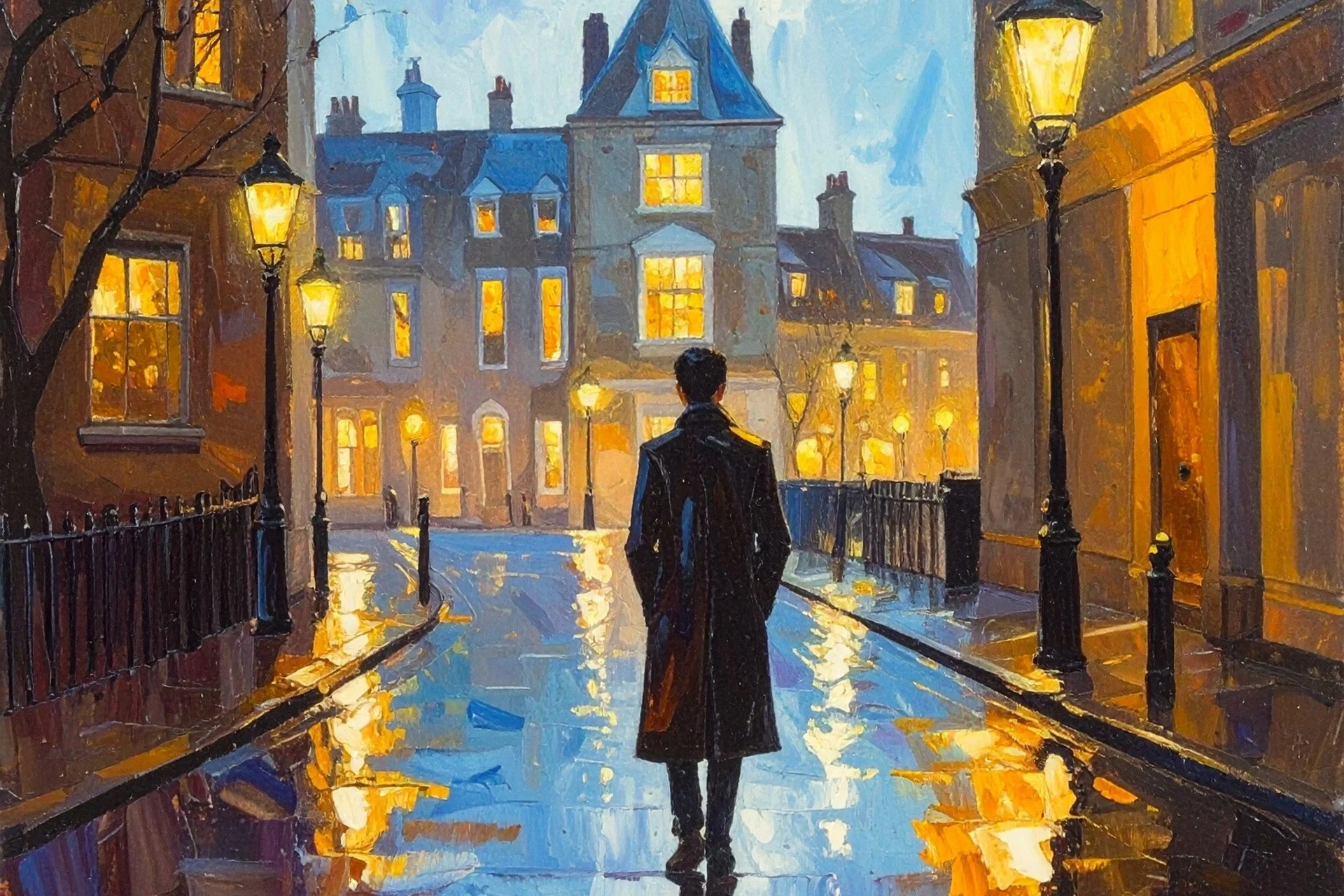
Harry Da Souza on a London street: the fixer the Harrigans cannot function without.
By Mara Quinn | November 28, 2026
The industry placed its bet before the audience got a vote. Paramount+ renewed MobLand for a third season on September 3, 2026, two weeks before Season 2 even premiered. When the Season 2 finale, "The Queen Is Dead," aired on November 20, cameras were already rolling on the episodes that follow it. Tom Hardy, Pierce Brosnan, and Helen Mirren are all confirmed for the new run. Per Brosnan's own account, it will be ten episodes. No premiere date has been set.
That sequence says something precise about how streaming television now works. The numbers that justified the original green-light were strong enough that the network did not wait to see how Season 2 performed. It had already seen enough.
A London Crime Drama Built on Three Bankable Stars
MobLand is a London-set crime drama created by Ronan Bennett. It premiered on Paramount+, a global streaming service, on March 30, 2025. Bennett and showrunner Jez Butterworth wrote all ten episodes of the first season together. Guy Ritchie, executive producer on the series, directed the first two episodes of each season. Promotional materials have sometimes credited Ritchie as creator or showrunner. He is neither.
The cast is the first reason any of this happened. Tom Hardy plays Harry Da Souza, a career fixer embedded with a north London crime family. Pierce Brosnan plays Conrad Harrigan, the family patriarch. Helen Mirren plays Maeve Harrigan, the matriarch. Paddy Considine plays Kevin Harrigan, the volatile son. Joanne Froggatt plays Jan Da Souza, Harry's wife. Anson Boon plays Eddie Harrigan. Janet McTeer plays Kat McAllister. Johnny Flynn plays Frankie Cooper. Ophelia Lovibond plays DCI Kavanagh, the detective circling the family's operations.
Three bankable stars, one of them a former James Bond, backed by a slate of proven British character actors. That combination was the industrial case for the green-light before a single viewer watched a minute.
From Ray Donovan Spinoff to Something Entirely Its Own
The show had two earlier lives before it became MobLand. In February 2024, Paramount+ announced the project as The Donovans, a spinoff of Ray Donovan. Ray Donovan ran on Showtime, the American premium cable network, from 2013 to 2020, with Liev Schreiber in the title role, playing a fixer for powerful clients. Research via the Television Academy and Startefacts indicates Brosnan was initially attached to play a character related to Ray's grandfather or great-grandfather.
Bennett pulled the show loose from that frame. By October 2024, the project had been reworked as a standalone story operating under the working title The Associate. By February 2025, the definitive title MobLand was announced. Bennett explained the break in an interview with Creative Screenwriting: "The more I created this world and the new characters, the further into the distance the original idea of having a Ray Donovan character receded." What arrived on screen in March 2025 shares nothing with Ray Donovan except the template of a fixer caught between powerful clients and a family that keeps making his life harder.
One additional production footnote matters and has been reported by Wikipedia, /Film, and Startefacts. When the set-construction firm Helix 3D went bankrupt during filming, leaving crew unpaid, Hardy offered to cover the wages out of his own pocket; the production companies paid. The offer has circulated widely and shaped a good deal of audience affection for the star.
2.2 Million on Day One, Then a Steep Climb
Before the numbers, a measurement note. The launch figures are Paramount's own: the service counts viewers as total watch time divided by runtime over an episode's first 70 days. That is a streamer-defined metric, not an independent audit, and the third-party measurement that enters with Season 2 does not always agree with it.
With that said: MobLand's global premiere day drew 2.2 million viewers. That was the biggest global series launch Paramount+ had recorded at the time. Week one finished at 8.8 million viewers, a 298 percent increase on the premiere day figure. By June 23, 2025, the date of the Season 2 renewal announcement, the show had reached more than 26 million viewers to date on that metric. On that metric, MobLand ranked second among Paramount+ originals globally, behind another Paramount+ original, Landman, and first in the UK. The show logged multiple consecutive weeks in Nielsen's Top 10 SVOD Originals chart.
Collider has reported 321 million minutes watched across 2026, a figure that speaks to the bingeability that Season 2 built on. Season 2 passed 108 cumulative days on the US platform top 10.
The US picture is not entirely clean. The premiere week did not reach the Nielsen US Top 10. Samba TV placed MobLand seventh or eighth in its own weekly chart for that opening period. Luminate counted 5.3 million hours for the first week. FlixPatrol put it first worldwide.
Why Harry Da Souza Keeps Viewers Coming Back
The numbers explain that the show found an audience. They do not explain why that audience stayed, or why Season 2 performed better with critics than Season 1 did.
The clearest answer lives in the character of Harry Da Souza and what he represents to a particular kind of viewer. The A.V. Club called MobLand the "Platonic Ideal of Dad TV" and described Harry as "a classic dad-TV archetype... We're all Harry Da Souza." ScreenRant identified his defining qualities as calm, measured, and patient under pressure. KinoShelf, in a piece titled "Why Harry Stays With the Harrigans," located something sharper in Harry's structural position within the story: Harry "knows enough about their operations to be completely indispensable, yet he will never actually be blood... his competence basically bankrolls their worst impulses." He cannot walk away. His expertise has made him a captive. In the Season 1 finale the exit is offered to him explicitly, in the form of Kat McAllister's cleaner, bigger operation. He turns it down and stays; KinoShelf reads the refusal as the moment loyalty turns fatalistic.
That paradox is the engine. Harry Da Souza is the most competent person in every room he enters. He resolves crises without display, absorbs punishment without breaking, and handles confrontations without escalating them. The fantasy on offer is professional mastery: a man so good at his job that the most dangerous family in London cannot function without him. Liam Mathews, author of the Dad Shows Substack, cited in Page Six's dad-TV reporting, flagged the wish-fulfillment dimension that makes this archetype work. The audience sees in Harry what that audience wants from itself.
The Harrigan family is the chaos counterweight. Conrad, Maeve, and their children generate problems faster than Harry can resolve them. It starts with Eddie's nightclub stabbing, on a night out with Tommy Stevenson, the rival boss's son, and it does not stay outside the house: the mole inside the Harrigan circle was Maeve herself, and the first season ends with Jan, Harry's own wife, putting a knife in him in the finale, "The Beast in Me." The tension of the show is not whether Harry will solve the immediate crisis. It is what the next crisis will cost him. As Hype Magazine noted, "that triangle [Conrad, Maeve, Harry] is exactly what the Season 3 renewal protects." All three actors are confirmed back. The machine that generates the story's conflict remains intact.
The Times critic Ben Dowell called Hardy "utterly mesmerising as the gruff killer... handling a silence like no one on any screen, big or small." Radio Times critic Jack Seale described it as "near-perfect TV entertainment that's never, ever dull." Season 1 finished at 77 percent on Rotten Tomatoes across 44 reviews, and a Metacritic score of 60 from 18 critics. Season 2 rose to 90 percent on Rotten Tomatoes from 21 reviews, and 73 on Metacritic from 12 critics. The IMDb series rating sits at approximately 8.3 to 8.4.
The Complications the Numbers Do Not Settle
A few things about MobLand's success require honest qualification.
The demographic picture is an inference, not a measurement. No MobLand-specific audience breakdown has been published by Paramount+ or Nielsen. The connection to a predominantly middle-aged male audience comes from the dad-TV literature and the genre conventions the show fits. It is a reasonable inference. It is not a measured fact.
The critical response is not uniform, and the split is widening as the show enters its third season. The Guardian's Sarah Dempster reviewed Season 2 as "deathly dull... a charm-free watch." IndieWire's Ben Travers called it "an action-delivery device... a waste of Harry's time, Tom Hardy's time, and fans' time." The Telegraph, while crediting Hardy's performance, traced the show's family angle to The Sopranos but complained it cannot let go of an adolescent excitement of cool men with two-day beards shooting each other, so its sensational cast serves the plot rather than the reverse. Both the Guardian and Radio Times noted mockery directed at some of the cast's accent work, though the Radio Times balanced that criticism against its otherwise positive verdict.
Kevin Mathews, writing for Moving Screen on Substack, made the structural objection most clearly: when a fixer never actually fails, the tension drains away into what becomes plot armor. Harry is so competent that the audience never seriously believes he is in danger. That quality makes the show comforting to its fans and makes it frustrating to its critics. These are not easily reconciled positions, and the reviews reflect it.
The Hardy Departure Scare That Did Not Happen
No account of MobLand's second season would be honest without mentioning what Deadline reported on May 22, 2026. The outlet said Hardy was leaving the show after Season 2, with friction between Hardy and showrunner Jez Butterworth cited as the source of the split. The story generated significant coverage. Subsequent reporting did not confirm the firing. Brosnan, speaking publicly, described the whole episode as "a storm in a teacup." The September 3 renewal announcement settled the question by confirming all three leads, Hardy included, for Season 3.
The incident is worth noting because it illustrated something about how much the show depends on Hardy specifically. MobLand without Harry Da Souza is not MobLand. The audience response to the Deadline story, and the speed with which the network moved to put the question to rest, made clear that Harry's survival matters as much off screen as it does on it.
The Industrial Logic of a Green-Light Before the Premiere
Season 3 is filming because the September 3, 2026 renewal was based on what Season 1 had already delivered: a show that combined one of the most recognisable brand names in British film direction with three major international stars and a fixer character who gave a specific kind of viewer exactly what that viewer wanted. The launch numbers were real. The retention was real.
The critical split is real too. The Guardian thought it was deathly dull. The Times thought Hardy was mesmerising. Both reviews are based on the same episodes, and neither is wrong about what it found. MobLand is a love-it-or-hate-it proposition. What the production week of November 20, 2026 confirms is that the people who love it watched enough minutes to make a third season the obvious industrial decision.
Harry Da Souza is coming back. The Harrigan family will keep making his life impossible. That, apparently, is the plan.
Sources
- Paramount Press Express, MobLand releases
- Paramount+ renewal release via The Futon Critic, 26 million viewers
- Paramount+ Season 2 cast guide
- Wikipedia, MobLand
- The A.V. Club, "MobLand Is the Platonic Ideal of Dad TV" (via Portside)
- Page Six, dad TV reporting
- KinoShelf, "Why Harry Stays With the Harrigans"
- Broadcast, UK critics roundup
- Helen Mirren Archives, Season 2 review roundup
- /Film, MobLand's Ray Donovan origin
- Startefacts, Donovans origin, Brosnan and Bennett quotes
- ScreenRant, MobLand cast guide
- Davies Daily, MobLand ratings synthesis
- Collider, MobLand minutes watched
- The Hype Magazine, Season 3 renewal
- Decider, Season 2 episodes and Season 3
- Moving Screen, Season 2 finale dissent