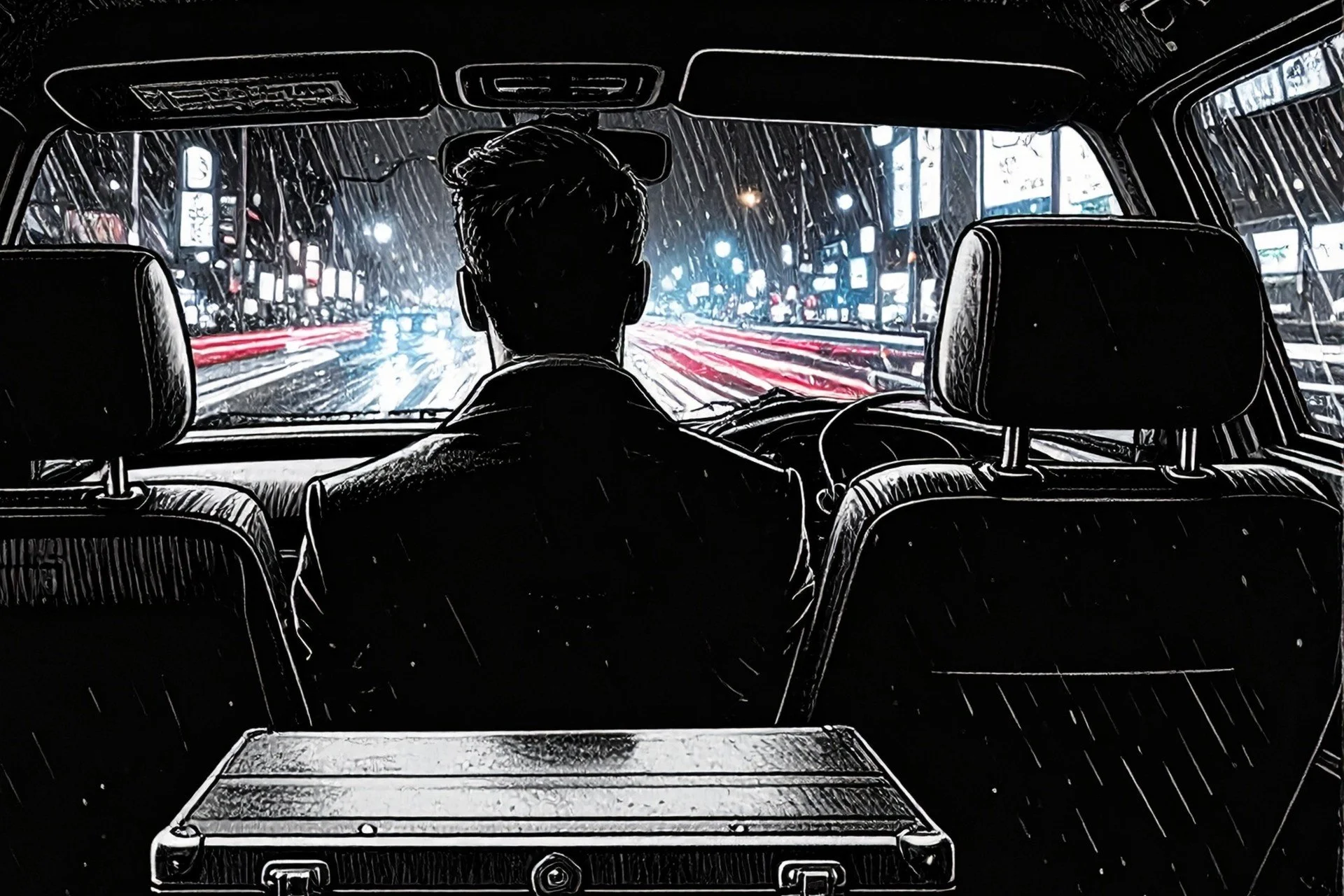
Twenty years of keeping company with a killer: the driver, the case, and the city at night.
By Ellis Ward | November 28, 2026
The most revealing number in this week's Paramount+ charts belongs to a show that ended thirteen years ago.
The original Dexter (Showtime, 2006) sits at number four on the platform, and climbing. Resurrection Season 2 sits at number eight, per Collider. The sequel series in mid-run is being outpaced on the same platform by its own ancestor. That arrangement tells you something specific about why Resurrection is succeeding, and it has little to do with franchise mechanics.
A Character Built Over Twenty Years
The original Dexter launched on Showtime in 2006. James Manos Jr. developed the series, adapting Jeff Lindsay's 2004 novel Darkly Dreaming Dexter. The show's premise: Miami Metro Police Department blood-spatter analyst Dexter Morgan kills serial killers, operating under a code of conduct his adoptive father Harry established to channel and contain him. It ran for eight seasons and 96 episodes. The finale, "Remember the Monsters?", aired September 22, 2013, drawing 2.8 million first-airing viewers, the largest audience Showtime had recorded by Nielsen up to that point.
Michael C. Hall played Dexter across all eight seasons. The character survived the finale in popular memory even when he did not survive it on screen, and when Dexter: New Blood arrived November 7, 2021, reuniting Hall with original showrunner Clyde Phillips after an eight-year absence, the response confirmed the investment had not diminished. New Blood averaged 8 million weekly viewers across platforms over its run, making it the most-watched series in Showtime history. The finale drew 3 million viewers on premiere night. The series ended with Harrison Morgan shooting his father dead, a narrative endpoint that the audience apparently refused to accept as terminal.
Dexter: Resurrection, developed and showrun by Phillips, premiered July 11, 2025, on Paramount+ Premium and Showtime. It opened with a revision: Dexter had survived a ten-week coma. Season 1 ran ten episodes through September 5, 2025. Paramount renewed it October 8, 2025. Season 2 premiered October 30, 2026, ten episodes running weekly on Fridays, finale January 1, 2027. Episode five released November 27, 2026. As of late November 2026, no Season 3 has been announced.
What the Opening Numbers Mean
Resurrection Season 1 debuted to 3.1 million global cross-platform viewers in its first three days, the most-streamed Showtime premiere on record. Over seven days, the figure reached 4.4 million multiplatform. Same-day linear viewership on Showtime registered 221,000 by Nielsen. Social reach in the launch window hit 43 million views and 2.5 million engagements. Franchise consumption on Paramount+ rose 132 percent following the premiere.
Season 1 earned 95 percent on Rotten Tomatoes from 64 reviews, a Metacritic score of 65 from 17 critics, and 91 percent audience approval. Season 2, mid-run as of this writing, sits at 85 percent critics from 16 reviews, a Metacritic score of 75 from five critics, and 98 percent audience approval, a franchise record per Screen Rant. The combined series score of 91 percent critics and 95 percent audience beats the original's 71 percent critics average over eight seasons.
These are not the numbers of an audience rediscovering a brand. They are the numbers of an audience that waited and then returned to approve.
The Control Experiment Ran and Failed
The cleaner test of where the attachment actually lives came from Dexter: Original Sin, a prequel series without Michael C. Hall. It premiered to 2.1 million viewers in its first three days. Showtime renewed it, then canceled it in August 2025 before a second season was produced.
The franchise infrastructure was present. The brand recognition, the Miami Metro setting, the institutional memory of eight seasons. Hall was not. The prequel drew roughly two-thirds of Resurrection's opening audience and failed to hold.
Remove the man, lose the attachment. The result is not ambiguous.
The Structural Reasons This Attachment Is Durable
Academic research on antihero audiences offers a precise account of how the Dexter viewer relationship was built and why it persists through interruption, bad seasons, and even a fake death.
Shafer and Raney's 2012 paper in the Journal of Communication (vol. 62, no. 6) examined story schemas during antihero narratives, documenting how viewers process moral disengagement cues embedded in the storytelling. The Code of Harry is exactly such a cue. By restricting Dexter's targets to killers who have themselves killed, the narrative provides the audience a logical channel for watching without disapproving. It does not ask viewers to endorse; it asks them to follow.
Janicke and Raney (2018, Psychology of Popular Media Culture, vol. 7, no. 4) identified character identification, rather than moral judgment, as the operative mechanism in antihero engagement. Viewers invest through the identification process, which runs prior to and often independent of moral calculation. The audience does not reach a verdict before it cares. It cares first and rationalizes later, if at all.
Oliver, Bilandzic, Cohen and colleagues (2019, Human Communication Research, vol. 45, no. 2) named Dexter explicitly among the defining examples of the antihero phenomenon. Their analysis of direct audience address, the moment a character speaks to the viewer, found that it produces what researchers classify as parasocial interaction: a perceived complicity that predicts identification regardless of the character's moral status. Dexter's first-person voiceover, present in the series since 2006 and carried through Resurrection, makes the audience his sole confidant. Structurally, it makes the audience his accomplice. That design did not change. The audience did not go anywhere.
Granelli and Zenor (2016, International Journal of Communication, vol. 10) documented four distinct viewer perspectives on Dexter's killings, finding no single dominant frame. The character sustains multiple modes of attachment simultaneously, which makes the relationship resistant to resolution. Research on parasocial break-ups, available through the broader media psychology literature collected via ResearchGate, documents the behaviors that follow abrupt parasocial rupture: rewatching prior material, following spin-offs, tracking cast interviews. The New Blood finale engineered exactly such a rupture. Resurrection offered a structural repair. Viewers accepted the terms.
The Critics Who Said It Was Not Earned
Not every critic found the repair satisfying.
Alison Herman, writing in Variety, called Resurrection creatively unnecessary and overly reliant on nostalgia, arguing that whatever freshness the series managed was overpowered by what she described as "the inescapable stench of the old." She praised Michael C. Hall, Peter Dinklage, and Uma Thurman as performers while concluding that the series itself lacked sufficient reason to exist. Entertainment Weekly arrived at a comparable position, calling Resurrection not essential viewing.
These are legitimate positions, and the data does not simply refute them. The opening audience did not wait for critical consensus. 3.1 million cross-platform viewers in three days is prior investment mobilizing before reviews settle, which is precisely what the parasocial attachment literature predicts. The question criticism was right to press is whether the return justified that investment.
The critics who answered yes identified a specific mechanism. Brian Tallerico, reviewing Season 2 for RogerEbert.com, wrote that the writers "remembered that Dexter needed to be fun again." Roxana Hadadi at Vulture described watching Season 2 as "like stepping into a time machine back to the early days of Dexter," praising what she called slyly funny, firmly grasped storytelling.
The original Dexter worked as a dark comedy. The later seasons lost that engine. The audience approval at 98 percent for Season 2 is measuring word-of-mouth among viewers who stayed through Season 1 and returned for more. It reflects restored tone, not opening-weekend momentum. Those are different signals and both are present. The critics who called the series unnecessary and the audiences approving at a franchise record rate are not in fundamental conflict. They are measuring different things: the former the originality argument, the latter the execution argument.
A Note on What the Numbers Are and Are Not Claiming
The 2.8 million viewers for the 2013 original finale were counted by Nielsen as a live telecast audience. The 3.1 million for Resurrection's premiere represents global cross-platform viewership accumulated over three days in a streaming environment across multiple markets.
These are not the same metric applied to the same behavior. The honest claim is that Resurrection outperformed every prior Dexter launch on the metrics appropriate to the streaming era, not that more people watched it in absolute terms than watched the 2013 finale. The New Blood average of 8 million weekly viewers across platforms, the most-watched series in Showtime history, sets the benchmark Resurrection competed against. It competed successfully on those terms.
The Machine Running in Season Two
Season 2 of Resurrection is set three years after Season 1. Dexter Morgan works as a rideshare driver in New York City and continues processing the files left by Leon Prater, the dead billionaire played in Season 1 by Peter Dinklage, whose curated list of killers provides Dexter with targets while also feeding what the season frames as a need for recognition the Code of Harry never accounted for.
The season deploys two active antagonists. Don Framt, known as the New York Ripper, is played by Brian Cox. The Five Borough Killer, played by Dan Stevens, announces his murders to the NYPD. Harrison Morgan, played by Jack Alcott, is now an NYPD Homicide officer, routing him into the same investigative geography his father occupies from across the law. Uma Thurman plays Charley Brown, Leon Prater's former head of security, now operating in collaboration with Dexter. James Remar continues as Harry Morgan, present as the internal voice Dexter still consults and still argues with. Showrunner Phillips described the season's structure as a season-long antagonist running in parallel with weekly discrete targets, the same engine that made the early seasons move.
Paramount co-CEO Chris McCarthy said after the Season 1 premiere that it had "not only rekindled a fiercely devoted fanbase but also captivated a new generation of viewers."
Twenty Years In
The original Dexter sitting at number four, and climbing, while Season 2 sits at number eight is not a chart anomaly. It is the attachment. Audiences are running the original and the sequel in parallel, returning to the source to confirm what drew them in and checking whether the revival deserves continued presence. Through episode five of Season 2, the audience has decided it does.
The Original Sin cancellation, the 132 percent franchise consumption spike after Resurrection launched, the 98 percent audience approval mid-run, the back-catalog chart position: each data point points the same direction. The audience was never attached to the franchise. It was attached to a man it has been complicit with since 2006, through his voiceover, through his kill code, through the architecture of a show designed to make the audience his only confidant.
Twenty years in, the audience is not watching a franchise. It is keeping an appointment. The show finally remembered how to deserve one.
Sources
- Collider, original Dexter out-charting Resurrection Season 2, November 2026
- Paramount press release via The Futon Critic, Resurrection premiere ratings
- Screen Rant, Dexter: Resurrection Season 2 audience score
- Rotten Tomatoes, Dexter: Resurrection Season 1
- Rotten Tomatoes, Dexter: Resurrection Season 2
- Metacritic, Dexter: Resurrection Season 1
- FandomWire, Dexter franchise Rotten Tomatoes comparison
- Slant Magazine, Dexter: Resurrection review
- Dexter Daily, premiere ratings including the 221,000 linear figure via The Hollywood Reporter
- Wikipedia, Dexter: Resurrection
- Shafer and Raney (2012), "Exploring how we enjoy antihero narratives," Journal of Communication 62(6). https://psycnet.apa.org/record/2012-33683-008
- Janicke and Raney (2018), "Modeling the antihero narrative enjoyment process," Psychology of Popular Media Culture 7(4). https://psycnet.apa.org/record/2017-18880-001
- Oliver, Bilandzic, Cohen et al. (2019), "A Penchant for the Immoral," Human Communication Research 45(2). https://www.researchgate.net/profile/Arienne-Ferchaud/publication/331028329_A_Penchant_for_the_Immoral_Implications_of_Parasocial_Interaction_Perceived_Complicity_and_Identification_on_Liking_of_Anti-Heroes
- Granelli and Zenor (2016), "Decoding 'The Code': Reception Theory and Moral Judgment of Dexter," International Journal of Communication 10. https://www.academia.edu/68406059/Decoding_The_Code_Reception_Theory_and_Moral_Judgment_of_Dexter