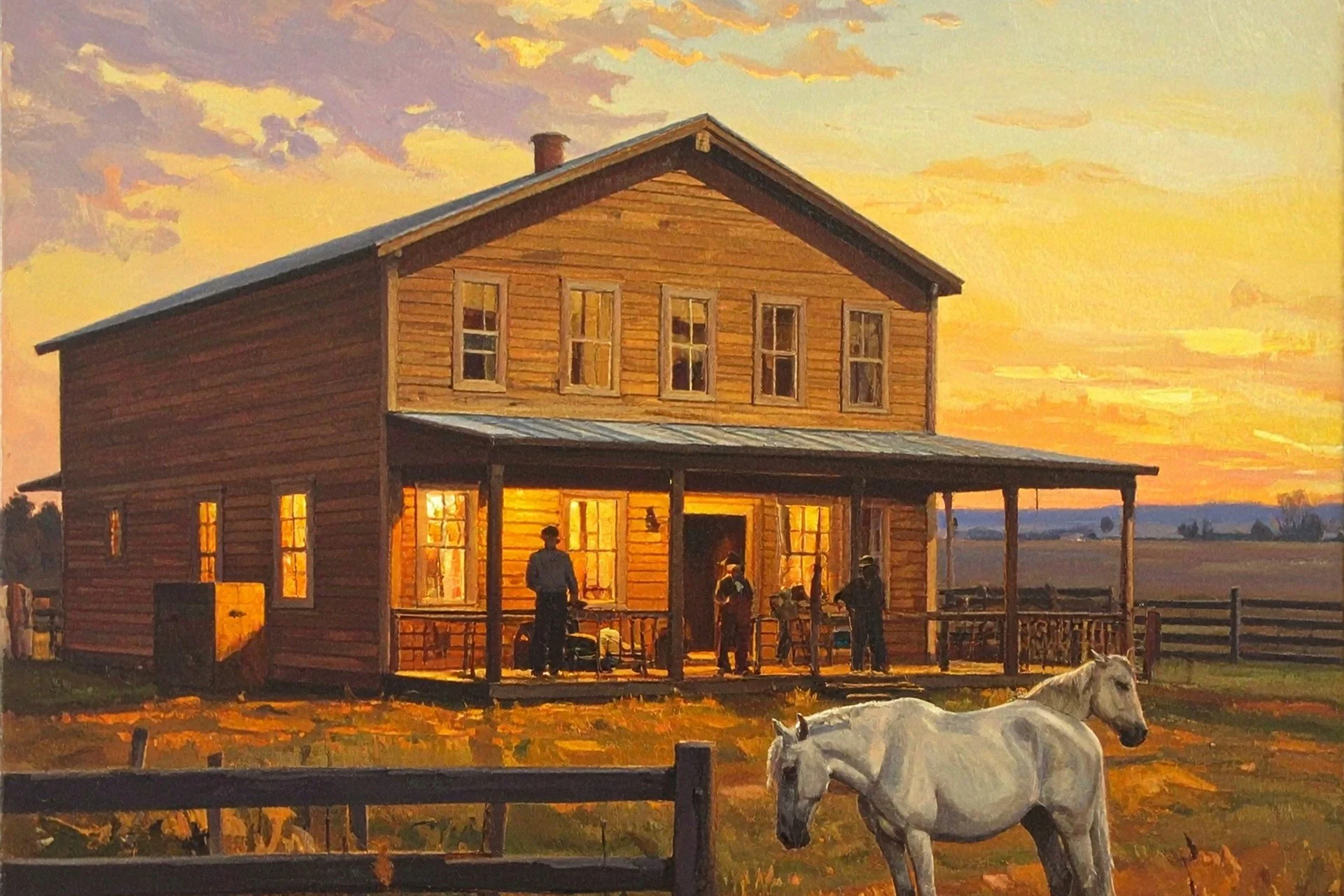
Fennario Ranch at sunset: the show’s fourth season is built around the people the ranch has absorbed.
By Mara Quinn | November 28, 2026
A Show That Absorbs People
French Stewart has played broad, telegraphed characters for most of his career. If you know him from 3rd Rock from the Sun, that's the version filed in your head: squinting, rubbery, loud. So when he appeared in "Black Diamonds," the seventh episode of Tulsa King's fourth season, aired November 27, 2026, as SSA Drake, it took a moment to place him. He played the role completely straight. No winking, no mugging. Just a federal agent with a problem and a point of view.
No trade outlet covered the casting. There was no announcement. Stewart showed up and disappeared into the work.
That describes something the show does consistently. Tulsa King is not a show that runs on stunt casting. It does not play guest appearances for the joke. When someone walks into the frame, the frame holds. Drake is a small role. Stewart played it without irony and without self-consciousness. The scene closed and the show moved on.
That's what a room built on trust looks like. Tulsa King takes people in. It gives them space to become someone other than what you expected. Some of them stay. Some of them grow. The ones who grow are the reason this show, now in its fourth season, feels like it was built to last.
What Tulsa King Is
Tulsa King, created by Taylor Sheridan, premiered on Paramount+ on November 13, 2022. Sylvester Stallone stars as Dwight Manfredi, a New York mob capo released after twenty-five years in prison, then exiled by his own family to Tulsa, Oklahoma, to build an operation from scratch. The concept sounds like a premise for a pilot that runs one season and disappears.
It did not disappear. Terence Winter served as showrunner during Season 1, left after that run, and returned for Season 4 as head writer. The show has used that institutional memory strategically. It knows what it built, and it has let the edges grow softer where they needed to, sharper where they didn't.
Season 2's premiere drew 21.1 million global viewers on Paramount+, a record for the platform at the time. The show ranked as the number one global Paramount+ original of 2024. Season 5 was renewed in October 2026, before Season 4 had even premiered, with production relocated to New York. Its spinoff, Frisco King, starring Samuel L. Jackson as Russell Lee Washington Jr., premieres December 18, 2026.
The streaming ecosystem does not often let mid-tier hits breathe. Tulsa King has been given the room. What the show has done with that room is the subject of some genuine disagreement.
Growing Up Onscreen
The case for the show begins with Scarlet Rose Stallone.
She plays Spencer, introduced in the second episode of Season 1 as a barista at Triangle Coffee Roasters. She appeared in five episodes that season and was not widely noticed. Early criticism of the show focused elsewhere. The Spool called Season 1 episodes "setups without hooks" with "tired jokes," a critique aimed at the writing, not the performers. Spencer, as written in those early hours, did not give Stallone much to work with.
By Season 4, Spencer is a series regular and manages Fennario Ranch following the death of Margaret Devereaux. The character has accumulated responsibility, grief, and moral complication. The actor who plays her has accumulated something too.
"I feel like I have been growing with Spencer," Stallone told Decider on November 27, 2026. "I have been playing her since I was 19 or so and now I'm 24."
Five years inside the same character. That's not nothing. Critics who noted the show's flat early writing were often right, but that flat writing ran into actors who were not flat, and over time the gap closed. The writing caught up, or the actors bent it toward them, or both.
Sylvester Stallone, her father, was asked about the nepotism angle. He gave the most honest possible answer. "Of course it's nepotism, you idiot," he told USA Today, as People reported. "That's why we're parents." The candor is consistent with how the show tends to handle uncomfortable things: directly, without apology.
Martin Starr plays Bodhi, the cannabis entrepreneur who becomes Dwight's unlikely business partner. Collider praised Starr as a scene-stealer from Season 1. While younger performers found their footing, Starr was already there, providing steady ballast that made the show watchable in its shakier early hours. That contrast matters. The young actors arrived unfinished. The show let them finish in public.
Tyson Mitchell's Losses Are Still Coming
Tyson Mitchell, played by Jay Will, is Dwight's first recruit and the character the show asks you to worry about most.
The comparison to Dwight is not incidental. Dwight's worst losses are behind him: twenty-five years in prison, his daughter's childhood, the trial, Margaret. He came through the other side with a kind of battered clarity. Tyson is on the other side of that ledger. His losses are still accumulating.
In Season 2, a car bomb intended for Dwight nearly killed Mark Mitchell, Tyson's father. In Season 4, Tyson is running an ecstasy sideline with Spencer, has attempted a robbery, shot a man named Santiago, and killed English Dan. At a wine auction, an outburst cost Bodhi and Timpone their bid and cost Dwight money, according to CBR. FandomWire noted that the mistakes Tyson has made "would get most aspiring gangsters buried, with Dwight Manfredi cleaning up the wreckage."
The rap ambition complicates the picture. Jay Will writes his own rhymes. TV Insider described his approach as "the no-negotiation thing," a phrase that fits the character: Tyson wants the music, and the crime, and Dwight's respect, and the life, and he is not willing to rank them. That refusal to prioritize is exactly the kind of problem that compounds.
CBR has framed Tyson as the show's emerging biggest problem. That framing is correct, but it understates the texture. Tyson does not feel like a villain. He feels like someone who has not yet had the experience that changes him. Dwight had that experience; it took twenty-five years and a prison cell. Tyson is running toward something similar. The show understands what it feels like to watch that happen from close range.
The Fear Has Already Come True
The collateral damage around Dwight Manfredi is not theoretical.
Mark Mitchell, Tyson's father, survived the car bomb in Season 2 that was meant for Dwight. Joanne Manfredi, Dwight's younger sister, played by Annabella Sciorra, was taken hostage by Jeremiah Dunmire in Season 3. Stacy Beale, Dwight's ATF-agent lover, was transferred to Alaska as punishment for failing to convict him. Theo Montague was burned to death in his own estate. Margaret Devereaux died before Season 4 began; the show did not dramatize her death on screen, but her absence is felt in every scene at Fennario Ranch.
Each of these was a person with weight in Dwight's world. The show does not dramatize their losses as tragic tableaux. It registers them and moves on, the way people at that level actually move on.
Mitch Keller, played by Garrett Hedlund, sits at the edge of this damage zone. Ex-rodeo, ex-con. What makes Mitch worth watching is a moment from that season: when Tyson was moving toward revenge, Mitch talked him down. He could do that because he has actually killed someone and done time. He knows what that choice costs.
Season 2 also teased a romance between Mitch and Tina Manfredi-Grieger, Dwight's daughter, played by Tatiana Zappardino. A gun-practice scene between them was the tell. Zappardino told TV Insider that Mitch is "kind of a connection to my father." Dwight sent Tina back to New York for her safety, which ended it. In Season 4, Mitch's story shifts: he and Spencer run Fennario Ranch together and execute a horse-race fixing scheme, as TV Insider and Decider have both noted.
The obvious reading of Mitch is "cowboy." The blunter reading is mine: Mitch is the white Tyson, older and steadier, skating the same line. Same appetites, same potential for violence, more years on the other side of it. The difference in how those two characters get read is part of what this show is about. The show does not explain that difference. It plants it and walks away.
The Dated Jokes and What They Mean
The Spool noted the boomer humor in Season 1: the app jokes, the rapper jokes, the fish-out-of-water beats built around a 1997 man who doesn't understand 2022. The critique was fair. The jokes dated. Some of them never landed in the first place.
The same show, in Season 4, treats Tyson's hip-hop career with complete seriousness. No punchline. No winking at the camera. The ambition is taken at face value.
This is my observation, not The Spool's. But the gap between those two registers is part of what makes the show's growth claim credible. The humor evolved because the people in the room evolved. That's what settling looks like.
Why Growth Reads as Longevity
Scholarship on serial television has established a consistent argument: audiences sustain allegiance to long-running series when changes read as gradual and plausible. Blanchet and Bruun Vaage, writing in Projections in 2012, argued that serials create bonds through friendship mechanisms, the same psychological logic as repeated exposure and shared history. Murray Smith and Jason Mittell extended the frame: emotional investment requires change, but the change has to feel earned.
Scarlet Rose Stallone's quote to Decider is the mechanism describing itself. She has been inside Spencer since she was 19. The audience has spent those same years watching. Neither party comes to Season 4 as the same entity that showed up for Season 1. That shared time is not backstory. It's the bond.
Veterans like Starr gave the show credibility early, when it needed it. The younger cast gave it a future, once they grew into the material. The two functions worked in sequence, and what emerged is a show where you believe the people, even when you don't quite believe the plot.
What the Numbers Say and What They Miss
Rotten Tomatoes gives Tulsa King a critics score of 78 percent for Season 1, 100 percent for Season 2, 83 percent for Season 3, and 86 percent for Season 4. All four seasons rated Fresh. Audience scores tell a different story: 87, 79, 59, and 72 percent, respectively. Season 3 is where the audience lost patience; Season 4 brought some of them back.
The pattern is not unusual for a show that asks for patience. Critics tend to reward craft and intention; audiences tend to reward payoff. Tulsa King delivers craft consistently. It delivers payoff unevenly.
Season 5 is coming. Filming has moved to New York, which suggests a structural shift in Dwight's world. What started in Tulsa is expanding. The show that began with an exiled capo setting up shop in Oklahoma has earned the right to change ZIP codes.
The deepest thing Tulsa King does is touch heavy subjects without explaining them. Grief, race, aging, loyalty: they're present in almost every episode, and no one on screen says what they mean. People at that level don't explain themselves. The show knows this. It is built around people who have absorbed enormous damage and kept moving, which is not a television premise so much as a description of how a certain kind of life actually works.
That's what French Stewart walked into when he played SSA Drake completely straight. The room was already set that way.
Sources
- Scarlet Rose Stallone and Garrett Hedlund interview, Decider, November 27, 2026
- Scarlet Rose Stallone on working with Sylvester Stallone, People
- The Spool, Tulsa King Season 1 review
- Collider, Tulsa King Season 1 review
- TV Insider, Tulsa King Season 4 / Scarlet Stallone interview
- CBR, Tulsa King Season 4 / Spencer and Mitch coverage
- FandomWire, Tulsa King Season 4 / Tyson Mitchell coverage
- Blanchet, O., and Bruun Vaage, N. "Don, Peggy, and Other Fictional Friends? Engaging with Characters in Television Series." Projections 6(2), 2012.
- Rotten Tomatoes scores (ScreenRant tabulation), Tulsa King Season 4
- Paramount Press Express, Tulsa King series release
- TV Guide, Tulsa King Season 3 coverage