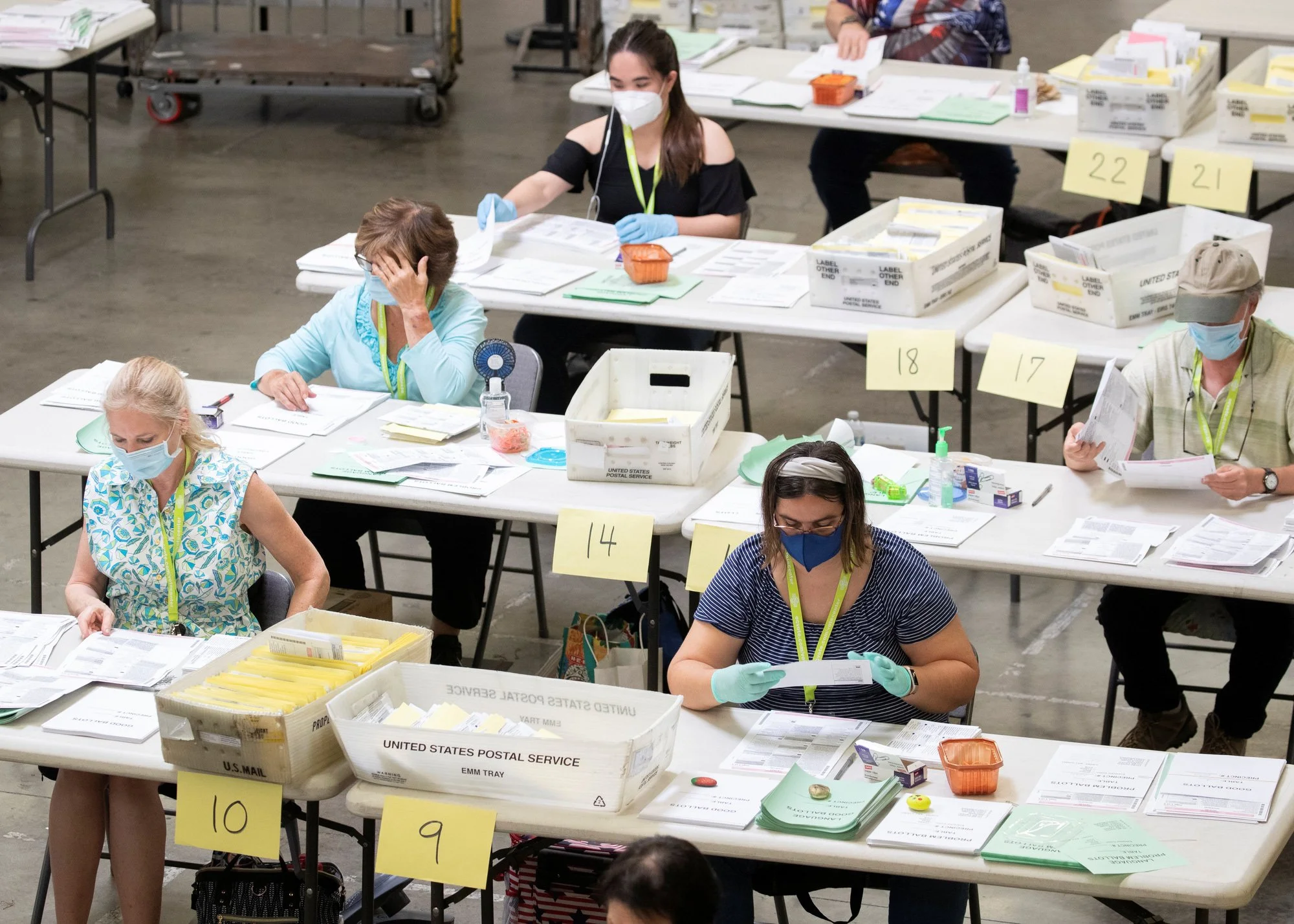
Election workers tally ballots by hand after the scanners failed.
By June Mercer | November 7, 2026
On Election Day in Westchester County, the ballot scanners turned voters away. The machines physically rejected completed ballots, feeding them back out rather than accepting them. Tens of thousands of residents deposited their votes into orange emergency bags and walked out of their polling places, their choices suspended somewhere between cast and counted.
The orange bags went under guard. Hours later, they went to court. Four days on, they are still being scanned.
Why the Scanners Failed
The failure traced back to a programming update applied after the county's election machines had already been tested and prepared for November 3.
According to a statement from the New York State Board of Elections, Westchester County needed to revise its election programming to accommodate a village justice contest in the village of Ardsley. That update was tested and deployed to early voting machines and to the Election Day machines serving Ardsley specifically. The Election Day machines at polling places throughout the rest of the county were left with the original programming.
When voters arrived November 3 and fed their completed ballots into those scanners, the machines could not recognize the ballots and rejected them.
The State BOE statement identified no concerns with the ballot paper itself. The problem was in the programming alone. The machines had one set of instructions; the county's ballots required another. Once officials identified the scope of the mismatch, they deployed replacement media carrying the updated programming, prioritizing restoration of at least one functional scanner per polling place.
The fix came too late for the ballots already in bags.
Orange Bags Under Guard
Poll workers throughout Westchester directed voters whose ballots were rejected to use designated orange emergency ballot bags and containers. Those bags were sealed on the spot and held under bipartisan oversight for the remainder of Election Day, meaning representatives from both parties were required to monitor access and witness any opening of the sealed containers.
No ballot was destroyed. No ballot left without a documented chain of custody.
The emergency procedure existed for exactly this scenario, a scanner failure mid-election, but its scale across polling places throughout the county was not routine. For voters, the procedure meant leaving a polling place without the confirmation a working scanner provides. A machine that accepts a ballot and tallies it offers a kind of immediate, mechanical accountability. An orange bag under bipartisan guard offers a different and slower kind. Many voters had no way to know, walking out, whether the system would work as designed.
The scope of the failure became clear as Election Day progressed. Orange bags accumulated at polling places across the county, holding ballots the machines refused to read.
A Court-Ordered Count
State Supreme Court Justice Paul Marx issued a consent order that set the legal terms for counting Westchester's emergency ballots. Under the order, all unscanned ballots were to be transported under police custody to 450 Saw Mill River Road in Ardsley (the county Parks Department headquarters), and scanning was required to begin no later than 11:00 AM on Wednesday, November 4.
The order required bipartisan representatives to be present whenever sealed containers were opened. Police maintained custody throughout transport and during the count. Scanning was to continue without interruption until complete.
That bipartisan requirement extended the chain of observed custody from Election Day's sealed bags all the way to the counting facility. By Wednesday morning, the machines were running at Ardsley.
Where the Count Stands
The Westchester County Board of Elections logged 15,467 ballots scanned on November 4, the first full day of the court-ordered count. November 5 moved considerably faster: 63,980 ballots processed that day, for a preliminary combined total of 79,447. The Board's November 6 statement described that figure as preliminary and subject to reconciliation and verification, with counting to continue daily as necessary.
A progress snapshot at 1:30 PM on November 5 showed 26,929 ballots scanned to that point, indicating the pace accelerated significantly through the afternoon and evening.
The acceleration did not finish the job. By 1:30 PM on Friday, November 6, approximately 75,000 ballots remained. That afternoon, Elections Commissioner Tajian Nelson, the Democrat, and Commissioner Douglas Colety, the Republican, told reporters they were optimistic that scanning would complete Friday night or Saturday morning, with an online update expected Friday evening.
By 6:59 AM Saturday, November 7, no completion announcement had appeared and no updated total had been posted.
The New York State Board of Elections' official results page carries a formal notice as of this writing: Westchester County results do not include a significant number of unscanned emergency Election Day ballots and are incomplete and subject to change. The November 3 results are not final.
Mail ballots are still arriving. Ballots postmarked by November 3 and received by November 10 may still be counted. Military and special ballots have a later deadline: November 16. The emergency ballot scan will close before the mail window does.
Who Is to Blame
Republican Commissioner Douglas Colety said an investigation will determine whether fault lies with the Board of Elections or with Fort Orange Press, the ballot printing vendor. The question at the center of that investigation is where in the chain the programming divergence occurred: whether the BOE failed to distribute updated media to Election Day polling places across the county, or whether the vendor contributed to the gap. The answer will also inform how the state and other counties prepare for elections where programming changes are deployed after initial testing.
The two possibilities are not mutually exclusive. The State BOE's account describes a selective and incomplete deployment of updated programming but does not, in its public statement, assign responsibility to any party. Its statement describes a chain in which an update reached some machines and not others – but stops short of naming where in that chain the failure occurred.
No timeline for the investigation has been announced.
What This Means for NY-17
The scanner failure landed in the middle of one of the more closely watched congressional contests of the cycle. New York's 17th Congressional District, which covers Westchester County and portions of the Hudson Valley, featured Democratic challenger Cait Conley against Republican incumbent Mike Lawler.
The Associated Press called the race for Conley on election night. The AP national tally showed Conley with 164,256 votes to Lawler's 145,546, with 94.85 percent of the expected vote reported. Lawler conceded the same evening.
AP's partial returns for the Westchester portion of NY-17, with 245 of 270 precincts reporting, showed Conley with 79,447 votes to Lawler's 47,489. The Westchester County Board of Elections separately reported a preliminary total of 79,447 emergency ballots scanned from the county's polling places through November 5. Those figures share a number but measure different things. The Board's figure counts physical ballots processed at the Ardsley facility under the court order; the AP figure counts votes tallied within NY-17's Westchester subunit at a specific point in reporting. Neither figure is the other.
Twenty-five Westchester precincts had not yet reported in AP's partial count. The roughly 75,000 emergency ballots remaining as of Friday afternoon will add to those precincts' totals once scanned. The AP call stands – Conley's lead in the AP national count exceeds 18,000 votes, and Lawler has conceded – but the final margin for the district will not settle until scanning ends and the mail ballot window closes.
That window remains open for most ballots through November 10, and for military and special ballots through November 16.
Rejection as a Form of Accountability
The machines that rejected Westchester's ballots failed to do their primary job. They also, in a specific sense, refused to do something worse.
The New York State Board of Elections noted the character of the malfunction directly: the affected scanners rejected ballots they could not recognize rather than tabulating them incorrectly. That distinction matters. A scanner that accepts an unreadable ballot and assigns its votes to wrong candidates produces results that look complete and are corrupt. Westchester's scanners produced results that looked incomplete and, through the Board's public notice, said so.
That transparency appears at every level of the response. The State BOE's public results page carries a formal incompleteness notice. The court order set a named time, named location, and named oversight requirements for the count. The commissioners named a Friday evening deadline for a progress update. When that update did not appear, the absence was visible rather than hidden.
The emergency procedure did not prevent tens of thousands of Westchester voters from leaving their polling places November 3 without confirmation their votes had registered. The November 3 returns for Westchester County remain officially incomplete four days later. The investigation into who caused the failure has produced no public conclusions.
What held was the procedure built for this failure. Over three days at a county Parks Department facility in Ardsley, that procedure has scanned more than 79,000 ballots under bipartisan supervision and court-ordered conditions.
The count is not finished. It is documented and running.
Sources
- New York State Board of Elections: statement on the Westchester County ballot scanning issues (Nov. 3, 2026)
- Westchester County Board of Elections: November 6 emergency ballot processing update (via White Plains CitizenetReporter)
- The Journal News (lohud): Election Day live coverage, the court order and the scanner failure (Nov. 3, 2026)
- Associated Press: NY-17 results and race call
- News 12 Hudson Valley: Westchester County scans 79,447 emergency ballots (Nov. 6, 2026)